
Policy-Driven Compute Router: Constraint-Based LLM Orchestration
A crucial infrastructure layer that moves beyond simple cost optimization by providing a Policy-Driven Router. It orchestrates LLM agent requests by selecting the optimal endpoint based on predefined, auditable policies that balance required latency, acceptable cost thresholds, and model capability.
How can I stop LLM inference costs from spiraling while still meeting latency needs for critical tasks?
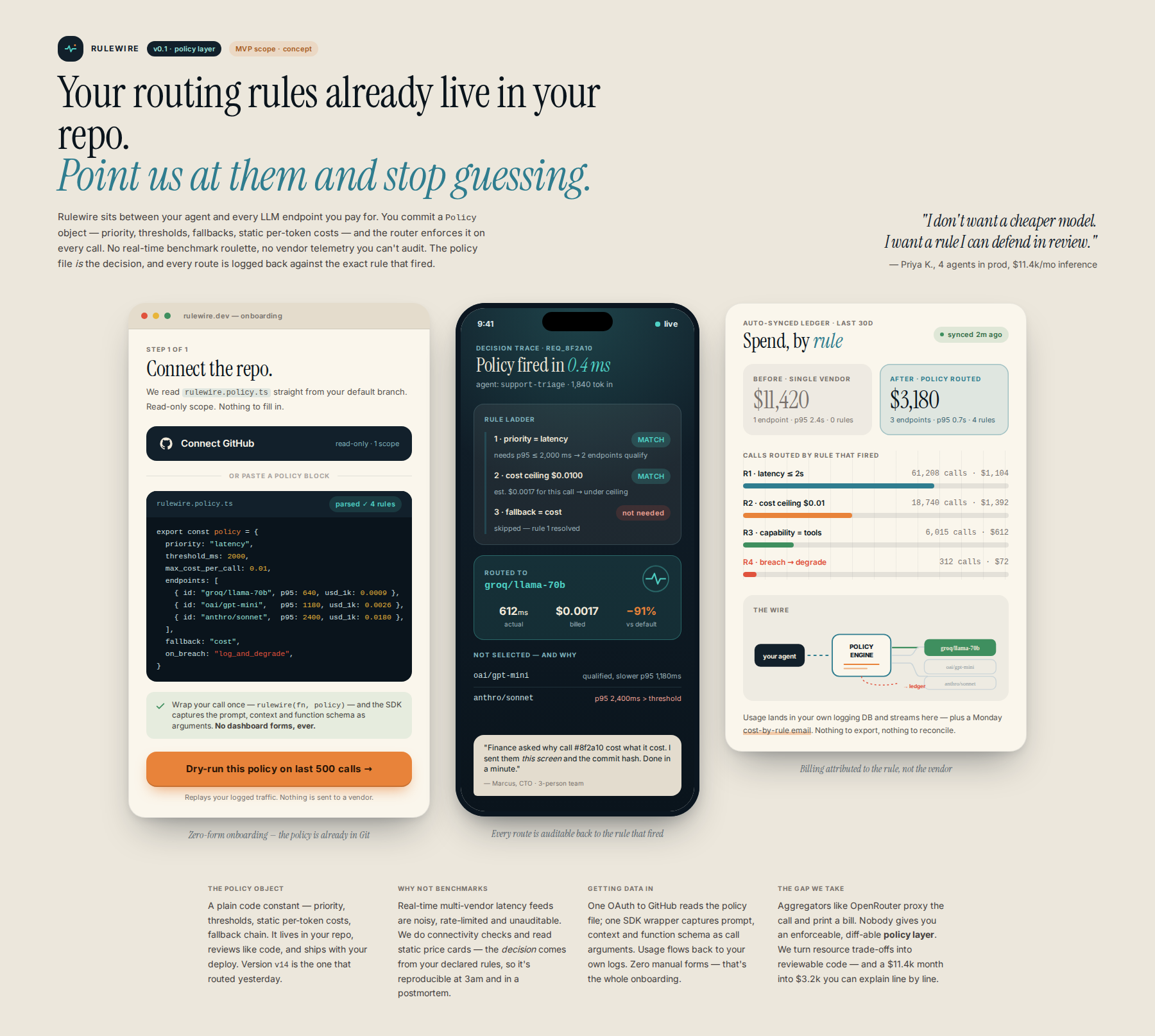
A policy-driven compute router lets developers define auditable rules—like prioritizing latency for critical agent tasks and cost for background ones—rather than tracking spend after the fact. It sits between the application and multiple LLM endpoints, evaluating each request's structured Policy Object (priority, threshold, fallback) against known endpoint pricing and capability data to select a route deterministically. This targets founders and LLM agent developers whose inference spend is volatile, replacing unreliable real-time benchmarking with a stable, logged decision that's transparent for billing and debugging.
Process flow
Who it's for
Founders of AI-powered apps bleeding inference spend (LLM Agent Developers)
Why they need it
The persistent pain is the volatile, high operational cost of inference, which demands more than just cost tracking; it requires a reliable, programmatic mechanism to choose the best available resource based on the specific needs of the task (e.g., 'If the task is critical, latency is paramount; if background, cost is paramount').
What it is
A 'Policy Router' protocol that sits between the agent application and multiple LLM APIs/Runnables. Instead of relying on unreliable real-time benchmarking, the user defines a structured policy (e.g., 'Prioritize Endpoint A unless cost exceeds $0.01, then switch to Endpoint B'). The Router executes this policy to guarantee resource selection.
How it works
- The client submits a compute task and a structured Policy Object (e.g.,
Policy: {Priority: Latency, Threshold: 2s, Fallback: Cost}). - The Router evaluates the task requirements against the defined policy and the available endpoints.
- It queries the endpoints for static cost data and performs initial connectivity checks, but the core decision is driven by the Policy Object, not real-time performance metrics.
- The Router selects the optimal endpoint based on the highest priority rule defined in the policy (e.g., if latency is the highest priority, it selects the endpoint known to meet the latency constraint, regardless of cost, unless the policy dictates otherwise).
- The request is routed, executed, and the usage cost/metadata is logged against the policy for transparent billing.
Differentiation
Existing solutions are limited to simple API aggregation or basic cost wrappers (e.g., OpenRouter). The GAP is the Policy Engine: we provide the first unified, auditable Policy Layer that allows developers to model and enforce complex resource trade-offs programmatically. We transition the technical risk from volatile real-time measurements to a stable, highly defined, and auditable policy mechanism, making the MVP technically achievable and differentiating us from simple data proxies.
Implementation sketch
- Develop the core Policy Engine (the 'router agent') using the 'memoryengine' to accept task definitions and structured Policy Objects.
- Build a minimal backend service that integrates 2-3 stable, high-traffic APIs (e.g., Anthropic, self-hosted Llama 3) and primarily focuses on ingesting static/semi-static pricing and capability metadata.
- Implement the Policy Decision Matrix: Create the logic that reads the Policy Object and executes the selection logic (e.g., check latency constraint first, then cost constraint, then default to the cheapest option).
First step: Set up a basic Python class structure for the Policy Object and define the core routing method signature: route_task(task_id, policy_object) -> endpoint_selection. Test this structure locally using mock endpoint data to validate the policy logic before integrating any live API keys.
Remaining risks
- The Policy Object abstraction may introduce complexity and friction for the target user (Founders). If defining the policy (e.g., setting thresholds, defining priority fallbacks) is not immediately intuitive, developers may revert to simpler, hardcoded routing logic, undermining the necessity of the Policy Router. — The product must be accompanied by an extremely simple, high-level Domain Specific Language (DSL) or a visual policy builder that allows developers to define goals (e.g., 'Must perform well in a live chat scenario') rather than writing complex logical structures (e.g.,
If Latency > X, then Cost < Y). - The value proposition remains highly dependent on the continued existence and stability of the integrated endpoints. If a major API provider (e.g., Anthropic, OpenAI) changes its pricing structure, deprecates a model, or modifies its API schema, the Policy Router's core metadata and routing logic will break, requiring immediate, costly maintenance. — Develop standardized, modular integration adapters for the most common API interaction patterns (e.g., 'Streaming Chat Adapter,' 'Batch Summarization Adapter'). This minimizes the blast radius of any single endpoint change, allowing the router to swap out an entire adapter without rewriting the core policy engine.
- The solution risks being perceived as merely a sophisticated, centralized abstraction layer. If the market views this as simply 'better metadata management' rather than a foundational protocol, adoption will stall, as the core value is the protocol layer, not just the service. — Focus marketing and documentation heavily on the 'auditable governance' aspect. Position the Policy Object as a standardized, auditable contract for compute resource selection, making it a necessary layer for compliance and debugging in complex agentic workflows.
Watch for: Early signals that the target audience is attempting to build their own simple, localized 'policy' logic using multiple service keys, indicating they prefer the control of direct API access over the abstraction provided by the router. Kill criterion: The appearance of a major cloud provider (AWS, Azure, GCP) or a foundational LLM model provider (Anthropic, OpenAI) announcing a native, policy-driven 'compute governance layer' or 'resource orchestration service' that directly addresses cost/latency trade-offs.