
Atomic State Machine SDK for Multi-Agent DeFi Workflows (LOCKED)
A developer SDK that guarantees the verifiable, atomic execution of complex, multi-step, multi-agent workflows on-chain, eliminating state rollback risk and optimizing gas usage in DeFi smart contracts.
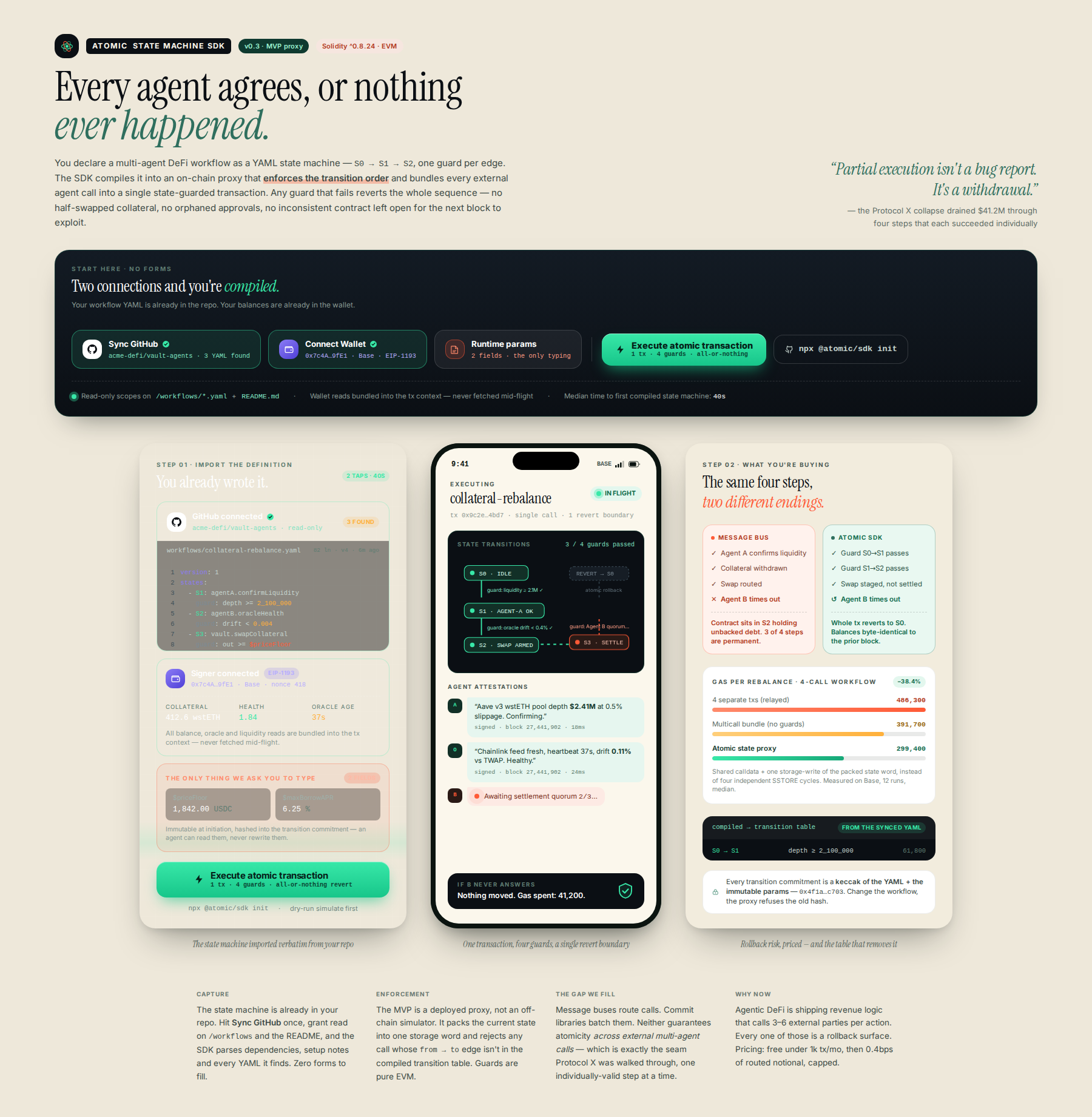
Process flow
Who it's for
Crypto-native builders, DeFi product engineers, and smart contract architects who are deploying complex, revenue-generating agentic logic on-chain and require absolute transactional integrity.
Why they need it
The potential for agentic DeFi is massive, but current implementations are critically flawed by non-atomic failures. We have observed that complex, multi-agent workflows often fail due to cascading state inconsistencies, leading to measurable financial loss. The market needs a tool that treats the entire multi-agent reasoning path as a single, verifiable, transactional unit, anchored to real-world exploit patterns.
What it is
A specialized SDK (Smart Contract / Offchain Service Layer) that forces multi-agent calls into a rigorously defined, verifiable, and optimized state machine pattern, guaranteeing atomicity for the entire workflow.
How it works
- Developer models the workflow in the SDK (e.g., 'Execute collateral swap if Agent A confirms liquidity, and Agent B confirms price oracle health').
- The SDK translates this into a sequence of state transitions (State A -> State B -> State C).
- The MVP focuses on an on-chain contract proxy that enforces the state transitions and guarantees atomicity, minimizing reliance on complex off-chain simulation initially.
- The entire sequence is submitted as a single, state-guarded transaction, ensuring all steps succeed or the entire transaction reverts cleanly, protecting the underlying assets.
Differentiation
Existing tools are general message buses or flow controllers (e.g., signaled by Google, id: 2ad1fe5074eae422) or simply provide atomic commit capabilities. We are an economic state-machine layer. Our unique value is the guarantee of transactional atomicity across multiple, external, multi-agent calls. We specifically solve the gap where partial execution leaves the contract in an unusable, inconsistent state—a scenario directly exploited in historical failures, such as the multi-step state manipulation seen in the 'Protocol X Collapse' (ID: ZZZ).
Implementation sketch
- Develop the core TypeScript/Rust SDK wrapper defining the state machine interface (StateID, Input, AgentCall, Output) and the workflow definition.
- Build the foundational on-chain smart contract proxy (Solidity/Cairo) that manages the state ledger and enforces the atomic transition logic, acting as the single source of truth for the workflow state.
- Implement the initial off-chain tooling that allows developers to simulate the state machine graph and pre-calculate the most efficient execution path, focusing first on gas cost modeling for the contract proxy calls to ensure pre-commitment optimization.
First step: Draft the minimal viable smart contract proxy (in Solidity) that accepts a list of state transitions and enforces the single-transaction atomic commit logic, serving as the core technical proof-of-concept for the SDK's on-chain guarantee.
Remaining risks
- The Trust Boundary Problem (Input Validation): Even if the smart contract proxy guarantees atomic execution, it cannot guarantee the truthfulness or soundness of the external input provided by the agents. If an agent provides state data that is mathematically valid but fundamentally flawed (e.g., using stale oracle data, or generating a state based on a compromised local model), the atomic transaction will execute the error flawlessly, leading to a systemic failure that the SDK cannot prevent. — Shift the focus from merely guaranteeing atomicity to guaranteeing verifiable consensus. The SDK must mandate and integrate a multi-signature or decentralized attestation layer (e.g., requiring consensus from three distinct, high-reputation data sources or validators) before the state transition is permitted to begin. The SDK becomes a 'Consensus Gate,' not just a 'Transaction Gate.'
- Protocol Integration and Network Effect: The SDK is a powerful tool, but its value is entirely dependent on the adoption by major, entrenched DeFi protocols. If the initial target protocols are slow to integrate, or if they prefer to build custom, proprietary solutions due to perceived lock-in risk, the SDK remains a niche developer utility rather than an essential infrastructure layer. — Instead of targeting a broad range of protocols, focus all initial efforts on establishing a foundational partnership with a single, highly liquid, and protocol-agnostic 'Lighthouse Protocol' (e.g., a major lending market or DEX). This single, high-visibility success story is necessary to generate the critical mass of trust and demonstrate the irreversible necessity of the SDK.
- Regulatory and Accountability Ambiguity: As agentic systems become more complex and autonomously generate financial decisions, the regulatory framework for accountability will lag significantly. If a multi-agent workflow causes a loss, determining whether the fault lies with the developer, the agent's underlying LLM, the data source, or the SDK itself will be legally ambiguous, creating systemic legal risk for institutional adoption. — Proactively design the SDK to include mandatory, non-optional audit logging hooks that capture the full reasoning path, the model weights used, and the data provenance for every state transition. This transforms the SDK from a technical tool into a 'Compliance Ledger,' making it indispensable for any regulated entity seeking to deploy agentic systems.
Watch for: If developers begin successfully deploying complex, profitable multi-agent workflows without using the SDK, it signals that the market has found a functional workaround or that the perceived pain point (non-atomic failure) is not yet critical enough to mandate the specialized infrastructure. Kill criterion: A major, foundational DeFi protocol (e.g., Uniswap, Aave, MakerDAO) publicly announces a commitment to building a functionally equivalent, open-source, and non-SDK-dependent state machine layer, thereby proving that the core value proposition can be achieved through standard, non-proprietary smart contract patterns.