
AI Cost-Efficiency & Prompt Optimization Engine (V2.0)
A specialized SaaS intelligence layer that analyzes API usage logs to calculate the true Cost-Efficiency Ratio (CER) and autonomously generates precise, actionable prompt engineering recommendations to maximize profitability for enterprise AI applications.
How can I tell if I'm overspending on GPT-4 calls for a specific task?
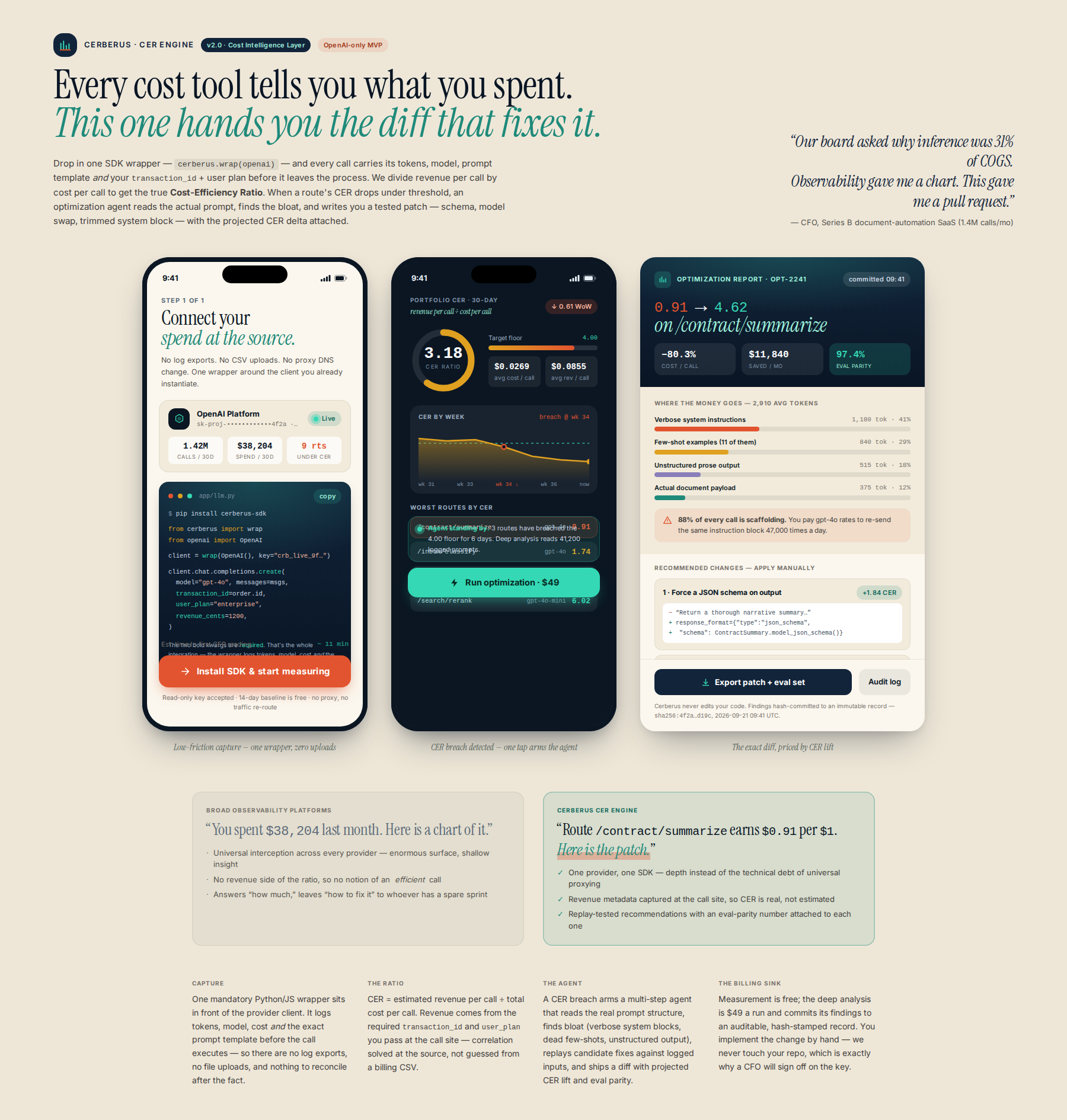
A cost-efficiency layer can flag this by ingesting API usage logs and calculating a Cost-Efficiency Ratio (revenue per call divided by cost per call); when it drops below a set threshold, an optimization agent analyzes the prompt for cost-bloat like verbose instructions or unstructured output. It then generates a report with specific fixes, such as adopting a JSON schema or switching to GPT-3.5 Turbo, along with projected CER improvement. This is aimed at SaaS CFOs and product owners running LLM-powered applications who need measurable ROI from AI spend.
Process flow
Who it's for
SaaS CFOs and Product Owners building LLM-powered applications who need immediate, measurable ROI from their AI spend.
Why they need it
They struggle to translate raw inference costs into actionable product profitability metrics. The inability to automatically identify and suggest cost-reducing prompt modifications dramatically slows adoption and limits scaling potential. Quote: 'We know we are spending too much on GPT-4 for this specific task.'.
What it is
A dedicated 'Cost Intelligence Layer' focused on automated Prompt Optimization. It integrates via standard API keys, ingests usage logs, calculates the CER, and uses an agent to suggest specific, high-impact, and manually implemented prompt and model modifications.
How it works
- Integration: The system requires API keys for a single, high-volume provider (e.g., OpenAI). It ingests usage logs (API calls, tokens, costs).
- Cost Calculation: It calculates the Cost-Efficiency Ratio (CER) = (Estimated Revenue per Call / Total Cost per Call).
- Optimization Agent: When the CER drops below a threshold, a dedicated agent analyzes the prompt structure, identifies cost-bloat areas (e.g., overly verbose instructions, lack of structured output), and generates a detailed report with specific, tested recommendations (e.g., 'Implement this JSON schema' or 'Switch to GPT-3.5 Turbo').
- Reporting: The client receives a data-backed report detailing the projected CER improvement and the exact code/prompt changes required for manual implementation.
- Billing Sink: The client pays a small fee to execute the advanced, multi-step optimization analysis and commit the findings to an auditable record.
Differentiation
Unlike broad cost observability tools that merely report spend, our solution is an active, autonomous financial intelligence agent. We solve the 'how to fix it' problem, not just the 'how much was spent' problem. By narrowing the MVP to prompt optimization for a single provider, we mitigate the immense technical debt of universal interception, providing a superior, actionable layer that existing platforms do not offer.
Implementation sketch
- API Logger Module: Develop the initial module to securely ingest and parse API usage logs (tokens, costs) from a single target provider (e.g., OpenAI).
- Prompt Analysis Agent: Build the core NLP/Agent logic to analyze prompt structure against cost-reduction best practices and identify specific optimization vectors.
- Reporting Engine: Create a structured reporting module that outputs actionable, copy-paste prompt modifications and clear, data-backed CER improvement projections.
First step: Define the API contract for ingesting usage logs (e.g., specifying required fields like model_name, input_tokens, output_tokens, timestamp) and build a proof-of-concept Python script that successfully parses these logs into a structured database table (e.g., using SQLite) to calculate the initial CER.
Remaining risks
- Vendor Lock-in and API Dependency Risk: The entire value proposition is tied to the logging structure, pricing model, and API stability of a single major provider (e.g., OpenAI). If that provider significantly changes its API contract, pricing structure, or deprecates a model, the core functionality of the 'API Logger Module' fails instantly, regardless of how strong the agent logic is. — Design the system with a strict abstraction layer for cost data ingestion. While the MVP focuses on one provider, the architecture must be designed to swap out the entire data source connector (the 'Logger') with minimal changes to the 'Analysis Agent' and 'Reporting Engine'. This prevents the entire product from being a single point of failure.
- Market Skepticism and Trust Barrier: CFOs and Product Owners are inherently risk-averse. Even if the CER improvement is mathematically sound, the market may resist trusting an autonomous agent to dictate core product logic (i.e., telling them how to write their prompts). They may view the recommendations as 'black box' suggestions, requiring excessive manual validation and slowing adoption. — Shift the initial sales focus from 'optimization' to 'auditing.' Position the tool as an objective, non-judgmental 'Cost Audit Report Generator' that simply highlights discrepancies and quantifies potential savings, rather than presenting itself as the authoritative 'fixer.' This lowers the psychological barrier to adoption.
- Commoditization by Hyperscalers: The core functionality (observability + optimization) is a perfect fit for the large cloud providers (AWS, Google Cloud, Microsoft Azure). These companies have massive incentives to integrate this exact intelligence layer into their native cost management dashboards, potentially offering it for free or at a prohibitive discount, making the standalone middleware an expensive niche. — Do not compete solely on cost. The differentiation must pivot to a hyper-specific, vertical niche (e.g., compliance, financial reporting, or highly regulated industries) where the cost of failure (and thus the cost of the AI) is astronomically high, and where the current hyperscaler tools are too generic to handle the nuance.
Watch for: If enterprise users are happy simply using standard, native cloud cost management dashboards (e.g., AWS Cost Explorer) and do not proactively ask for the 'Optimization Agent' layer, it indicates that the market views cost tracking as a necessary overhead, but not a critical, actionable, or painful problem that requires an autonomous solution. Kill criterion: If a major cloud provider (e.g., OpenAI, Microsoft Azure) releases a native, integrated, and free 'Cost-Optimizing Prompt Tuning' feature that is exposed via a simple API hook, the entire business model is immediately invalidated, requiring a complete pivot to a non-LLM-centric value proposition.
Sources the council used
Real-world evidence that grounded this idea — judge it for yourself.
- thesaascfo.com
- developers.google.com
- developer.apple.com
- developer.android.com
- developer.microsoft.com