
Latency-Aware Context Guardian: RAG Context Compression Layer
A specialized, performance-oriented middleware for AI app founders that intercepts and dynamically compresses context retrieved from knowledge bases (RAG), ensuring the minimal, most actionable context is passed to the LLM while guaranteeing that the total latency overhead remains negligible compared to the savings gained from token cost reduction.
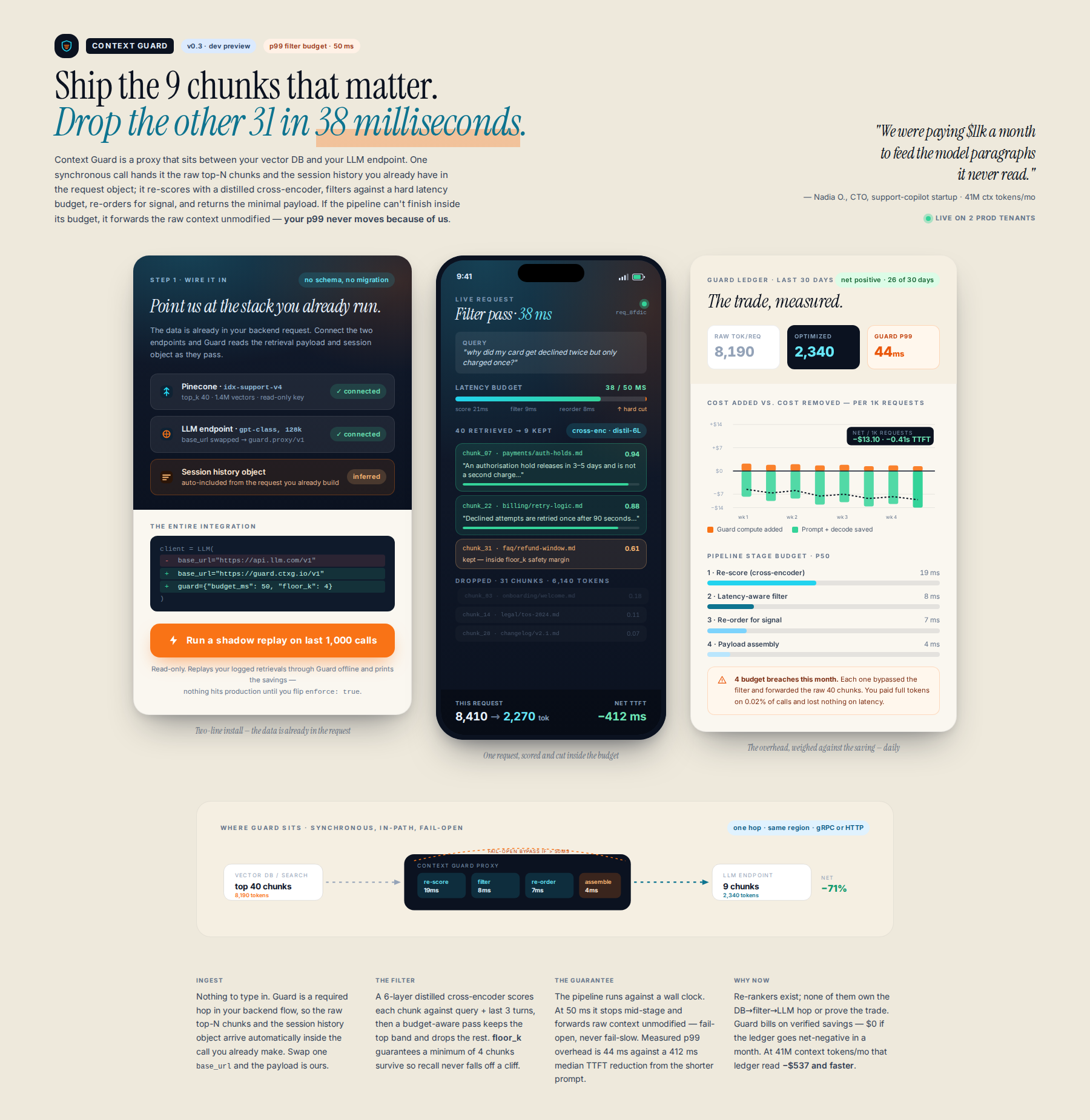
Process flow
Who it's for
Founders of AI-powered apps that rely heavily on RAG and are constrained by both operational inference costs and end-user latency requirements.
Why they need it
As RAG becomes standard, the economic and performance bottleneck shifts from the prompt itself to the sheer volume of retrieved context. Passing excessive, low-relevance 'fluff' not only wastes tokens and drives up costs but also adds unnecessary processing time, making high-accuracy RAG economically and experientially unsustainable at scale.
What it is
A 'Context Guard' proxy that sits between the Vector Database/Search API and the LLM API endpoint. It executes a latency-optimized, multi-stage context compression pipeline: re-scoring, filtering, and re-ordering the retrieved chunks to ensure maximum signal-to-noise ratio with minimal added delay.
How it works
- The middleware intercepts the raw list of retrieved context documents/chunks (e.g., the top N results).
- It executes a specialized, lightweight scoring mechanism (e.g., a highly optimized cross-encoder or a dedicated embedding comparison) to score each chunk against the query and history.
- Crucially, it performs a latency-aware filtering pass, prioritizing the retention of high-scoring chunks while discarding low-relevance chunks, ensuring the total processing time overhead of the filter is < 50ms.
- It constructs the final, minimal context payload, passing only the optimized, relevant chunks to the LLM API.
- It provides a comparative dashboard tracking 'Raw Context Tokens,' 'Optimized Context Tokens,' and 'Context Processing Latency' to quantify the net positive impact on user experience and cost savings.
Differentiation
Unlike simple caching or general context compression, our solution is purpose-built for RAG and solves the critical trade-off between cost and speed. We do not merely 're-rank'; we provide a measurable, automated, and superior integration layer that handles the entire workflow (DB -> Filter -> LLM) while guaranteeing that the latency overhead of the compression step is demonstrably outweighed by the speed and cost benefits of the resulting prompt. This solves the key gap of 'latency-optimized context compression' in production RAG systems.
Implementation sketch
- Build the core proxy service (e.g., using FastAPI or Cloudflare Workers) to intercept the context passed before the LLM call.
- Prototype the scoring mechanism: Start with a highly optimized, small, quantized cross-encoder model (e.g., specialized BERT variant) running on a dedicated endpoint to score chunk relevance against the query.
- Implement the core logic: Define a strict filtering threshold and a measured time budget (e.g., max 50ms for the entire re-ranking step). The system must pass a 'Speed vs. Savings' internal benchmark.
- Develop the 'Efficiency Dashboard' to track the three key metrics: Token Reduction %, Cost Savings $, and Latency Overhead ms.
First step: Select a single, high-volume, standardized RAG workflow (e.g., corporate policy documents from PDF format) and build a basic Python script that measures: 1) Time taken to pass raw context (N tokens); 2) Time taken to pass a manually filtered context (N/2 tokens); 3) Time taken to run a simple cross-encoder filter and pass the filtered context. The goal is to establish a measurable latency delta.
Remaining risks
- The 'Law of Diminishing Returns' on Cost Savings: The actual cost savings realized by the user are marginal (e.g., < 10% reduction) because their knowledge bases are already highly curated, or the LLM's context processing is already highly efficient. This means the cost of maintaining and operating the middleware (compute, maintenance, overhead) exceeds the measurable savings, leading to poor ROI perception. — Focus the initial sales pitch not on maximizing cost savings, but on guaranteeing a measurable performance floor. Instead of 'save X tokens,' pivot to 'reduce unpredictable latency spikes by Y ms' or 'ensure operational stability regardless of context size.' This shifts the value from cost reduction to risk mitigation.
- Vendor Lock-in and Feature Parity: Major vector database providers (Pinecone, Weaviate) or LLM API platforms (OpenAI/Anthropic) decide to integrate context compression/re-ranking functionality directly into their core API offerings. If the mechanism becomes a native feature, the middleware loses its primary differentiation and becomes a mere wrapper, severely limiting its defensibility. — Maintain a deep focus on the 'Integration Layer' and 'Dashboard' experience. The value must be positioned as a unified orchestration layer that handles the entire workflow (DB query -> Re-rank -> Context Assembly -> LLM call) and provides superior, holistic metrics and governance that the individual vendor APIs cannot match.
- The 'Semantic Overkill' Problem: The most critical context needed for a good answer is often not the single highest-scoring chunk, but the combination of 2-3 moderately relevant chunks that, when viewed together, provide a nuanced understanding. Overly aggressive filtering, even if technically accurate, might discard the necessary 'glue' context, leading to factually correct but contextually incomplete answers. — Develop a secondary, 'context synergy' scoring layer. Instead of scoring chunks individually against the query, the system should score the combination of the top N chunks against the query, rewarding diversity and complementary information rather than just raw relevance. This moves the focus from 're-ranking' to 'context synthesis.'
Watch for: A pattern of founders complaining about the complexity and time required to integrate the middleware with their existing, diverse tech stack (e.g., one founder using LangChain, another using LlamaIndex, and a third using raw API calls). This indicates that the 'seamless integration' promise is failing, and the operational friction is too high for adoption. Kill criterion: If a single, established, non-AI infrastructure vendor (e.g., AWS, Azure) launches a native, highly performant, and cost-effective 'Context Compression Service' as part of their core AI platform offering, it would signal that the problem is being commoditized at the infrastructure level, making the product fundamentally unviable.