
Verifiable, Cost-Optimized LLM Audit Gateway for Legal/Compliance
An intelligent, specialized API gateway that provides an immutable, auditable record of every LLM interaction used for regulatory compliance and legal document analysis. It guarantees the lowest possible inference cost while ensuring a verifiable, defensible audit trail of model usage, inputs, and decision paths.
How can we prove which AI model was used for a compliance decision during an audit?
A specialized audit gateway can generate a tamper-proof record of every LLM call made during regulated document analysis. It routes each task through a multi-stage model pipeline while logging the model name, exact input, cost, and selection rationale at every step, then bundles these into a cryptographically signed audit report using a hash chain. This is designed for legal tech firms, compliance departments, and financial institutions that must produce verifiable proof of model usage during internal or regulatory audits, not just optimize inference cost.
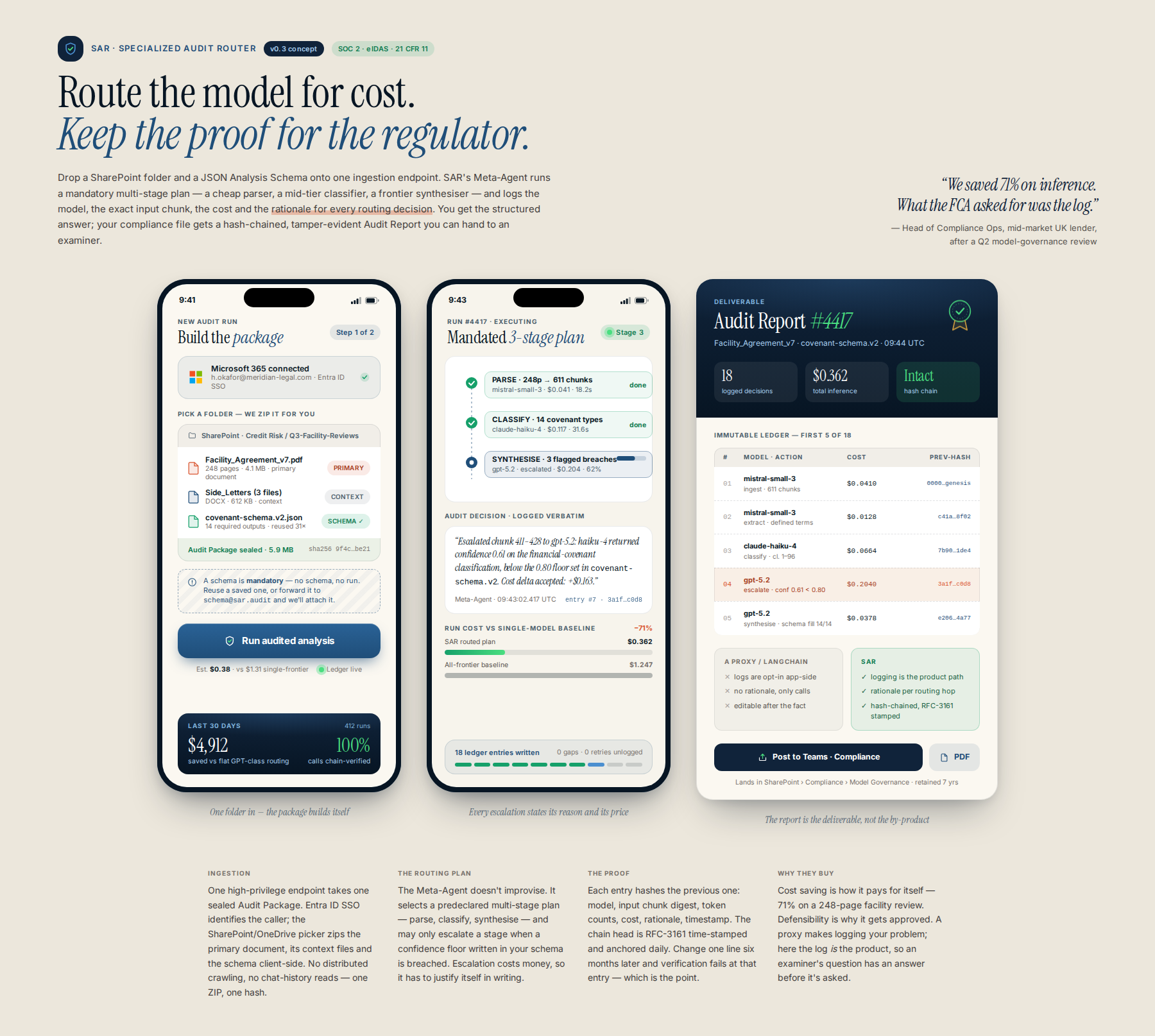
Process flow
Who it's for
Legal tech firms, compliance departments, and financial institutions that process high volumes of regulated documents and require absolute proof of model usage for internal/external audits.
Why they need it
The pain is shifting from 'pure token cost' to 'regulatory risk and lack of auditable proof.' When a compliance failure occurs, the inability to prove which model, with what parameters, was used is a greater operational risk than the token cost itself. We provide the necessary defensibility.
What it is
The Specialized Audit Router (SAR) is a hosted API gateway designed specifically for structured, regulated document analysis. Unlike general routers, SAR doesn't just route for cost; it routes for verifiability. It mandates a multi-stage execution plan, and crucially, it logs every decision point, model call, and cost metric to create a tamper-proof, comprehensive audit log. The user gets the optimized result, but the platform provides the regulatory defensibility.
How it works
- The user sends a document and an 'Analysis Schema' (JSON object defining required outputs) to the SAR endpoint.
- The SAR's Meta-Agent analyzes the document and the schema, executing a predefined, multi-stage plan (e.g., Model X for parsing, Model Y for classification, Model Z for synthesis).
- Crucially, at every step, the SAR logs the model name, the exact prompt/input chunk, the cost incurred, and the rationale for the model selection (the 'audit decision').
- The SAR aggregates the results into a single, structured output AND generates a comprehensive, immutable Audit Report (including cryptographic proof of the transaction). The user pays for the service, and the report is the primary value deliverable.
Differentiation
Existing solutions are simple proxies (e.g., basic API wrappers) or general workflow orchestrators (e.g., LangChain/LlamaIndex). These tools handle execution but fail to provide a mandatory, cryptographically verifiable audit trail that links cost optimization directly to regulatory compliance. Our gap is the combination of automated, cost-aware routing with mandatory, auditable regulatory logging. We transition the value proposition from 'cost-saving feature' to 'regulatory compliance asset.'
Implementation sketch
- Build a proof-of-concept API endpoint accepting a document and an 'Analysis Schema'.
- Implement the core multi-stage execution logic for a single task (e.g., 'Indemnity Clause Identification'), ensuring the system can gracefully fail or log when an unanticipated structure is encountered.
- Develop the Audit Log microservice: This service must accept the input/output/cost data from the multi-stage execution and generate a cryptographic hash chain (Merkle tree or similar) associated with the final output, providing the 'proof' of the transaction for the user's audit report.
First step: Draft a technical specification and simple UI wireframe for the 'Audit Report' JSON output, defining the required fields (Input Hash, Model Call Hash, Cost, Timestamp, etc.) and outlining the necessary cryptographic signing mechanism (e.g., using a specific hashing algorithm) to make the report tamper-proof. This shifts the immediate focus from 'routing complexity' to 'data integrity'.
Remaining risks
- Regulatory Scope Creep and Legal Ambiguity: The legal and compliance domain is constantly evolving. Even with a defined 'Analysis Schema,' the system cannot account for unforeseen regulatory changes, novel document formats, or ambiguous legal intent. The Meta-Agent's reliance on a defined schema means that any deviation from the expected structure or required output field will cause a failure, leading to a gap in the audit trail or, worse, a false sense of security. — Shift the sales pitch from 'automation' to 'governance.' Integrate a mandatory human-in-the-loop review step where the client's internal legal team must validate the proposed 'Analysis Schema' and the system's decision-making rationale before the audit report is finalized. This makes the product a compliance assurance tool rather than a fully autonomous solution.
- Vendor Lock-in and API Instability: The core value proposition (cost optimization) relies entirely on the real-time, stable pricing and capability matrix of multiple external LLM APIs (OpenRouter/OpenAI/Anthropic). If a major provider suddenly changes its pricing model, deprecates a key model, or introduces rate limits without warning, the entire cost-optimization layer breaks instantly, regardless of how robust the audit logging is. — Design the Meta-Agent layer with an extreme level of abstraction. Instead of hard-coding model calls, build a dynamic 'Model Capability Registry' that allows the system to swap out entire model families (e.g., replacing all GPT-4 calls with a combination of Gemini and Anthropic) with minimal code changes, making the cost routing resilient to external API volatility.
- Adoption Resistance due to Black-Box Trust: While the audit report is technically perfect, the target audience (Legal/Compliance) is inherently risk-averse and prefers established, predictable processes. The concept of relying on a complex, automated 'Meta-Agent' to determine the optimal, non-obvious path for legal analysis introduces a new form of operational risk—the risk of trusting an automated black box. This trust deficit can outweigh the cost savings. — Focus initial adoption not on the cost savings, but on the guarantee of auditability. Partner with a major, established legal services firm to conduct a joint pilot where the SAR is used to validate the internal audit process, positioning the product as a necessary risk mitigation asset rather than a cost-saving utility.
Watch for: A major enterprise workflow orchestration platform (e.g., Microsoft Power Automate, Salesforce) adding a basic, integrated 'Audit/Compliance' module that replicates the core functionality (logging, schema-guided flow) without requiring a specialized, external gateway. This would commoditize the core value proposition. Kill criterion: If the target market continues to treat the 'Meta-Agent's decision-making process as a black box that cannot be fully explained by a human expert, even with the cryptographic audit trail. The value must transition from 'We saved you money' to 'We provided you with legally defensible proof.' If the latter cannot be proven, the product fails.