
Governance Proxy: Verifiable Scope Adherence for Institutional DeFi Execution
A specialized, auditable execution module that provides verifiable, least-privilege computational boundaries for institutional agents operating within highly regulated smart contract environments (e.g., institutional DeFi asset management). We solve the critical problem of proving that an agent cannot exceed its pre-defined operational scope.
How can an institution prove an autonomous DeFi agent never exceeds its spending authority?
A governance proxy enforces this by requiring every agent action to pass a pre-execution scope check against a signed contract defining approved protocols, function calls, and budget limits. Just-in-time, time-bound credentials are issued only within that scope, and each call is cryptographically logged; settlement releases funds only if the audit trail confirms the agent stayed within its defined scope and budget. This is built for institutional DeFi asset managers, compliance officers, and enterprise treasury systems needing auditable, least-privilege control over on-chain agents.
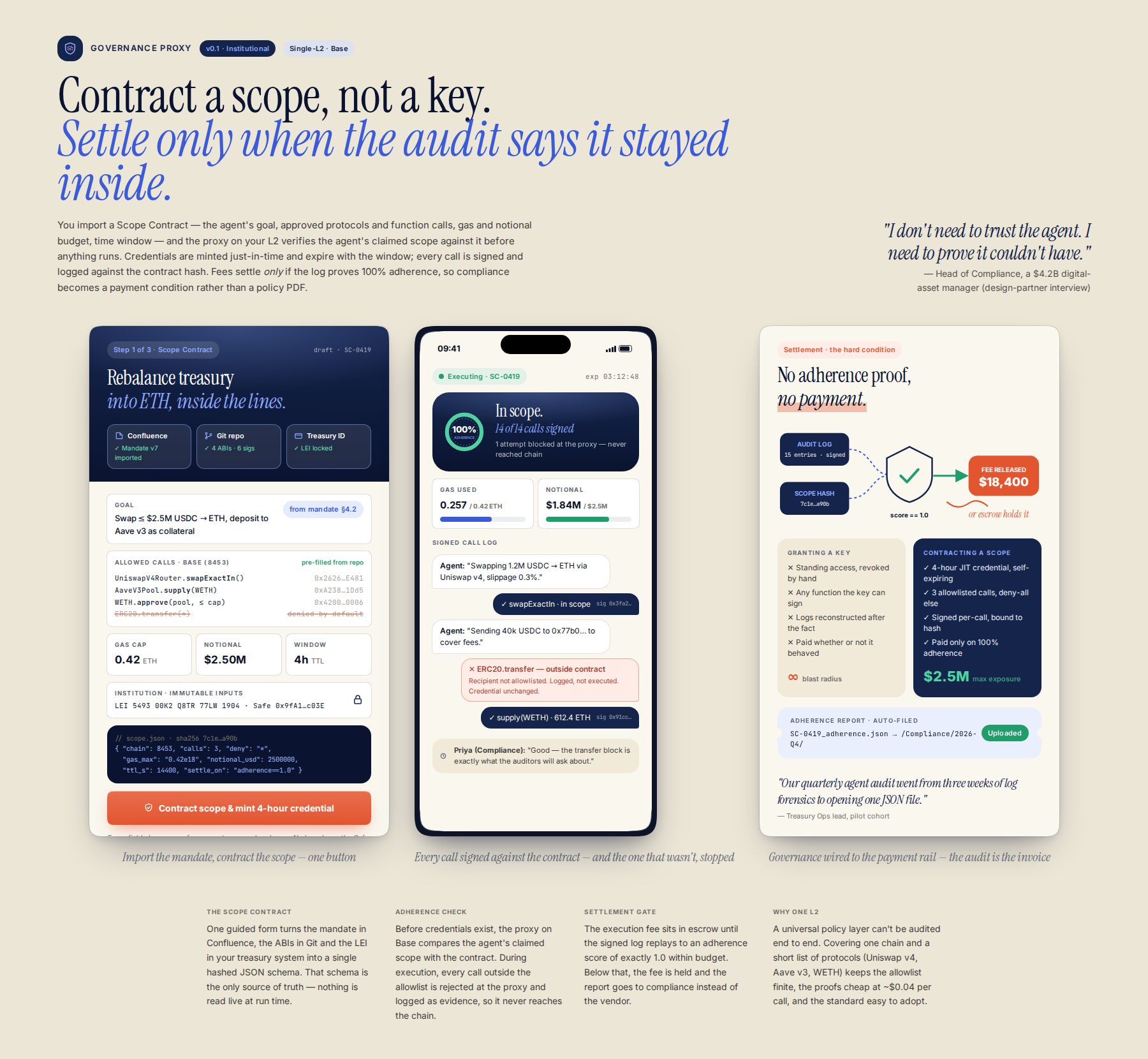
Process flow
Who it's for
Institutional DeFi Asset Managers, Compliance Officers, and Enterprise Treasury Systems.
Why they need it
Large financial institutions require agents to interact with on-chain assets while maintaining strict, auditable control. Pain points include: 'How do we prove that an automated agent, designed to manage multi-million dollar treasuries, will never exceed its explicitly granted operational scope or budget?' and 'We need a mechanism that forces external execution to adhere to defined, audited operational boundaries before funds are released.'.
What it is
A governance proxy layer that acts as a mandatory, audited gatekeeper for agent actions within a defined, restricted scope (e.g., a single L2 network). It replaces the concept of 'granting a key' with a model of 'contracting a limited, auditable compute-action scope, backed by verifiable scope adherence.'
How it works
- The Institution defines a Scope Contract: This contract specifies the agent's goal, the required approved tools/APIs (e.g., specific DeFi protocols, defined function calls), the maximum budget (gas/compute limit), and the strict operational boundaries.
- The Governance Proxy (on the target L2) validates the contract and performs a 'Verifiable Scope Adherence Check' against the agent's claimed scope.
- Credentials are generated just-in-time, limited in scope, and time-bound.
- Execution: The Agent runs within the secure environment, and every API call/state change is cryptographically signed and logged against the original contract.
- Settlement: Upon successful completion, the payment is executed ONLY if the audit log validates the agent stayed strictly within the defined scope AND budget, linking governance directly to utility settlement.
Differentiation
Unlike general vault solutions or simple policy hooks, our system makes the payment rail a hard, auditable condition of execution, solving the economic governance gap for high-value assets. We are not building a universal layer; we are building the definitive, scope-enforcement standard for a specific, high-value, single-L2 vertical, making the scope manageable and instantly valuable to enterprise adopters.
Implementation sketch
- MVP Scope: Focus the initial proof-of-concept on a single L2 (e.g., Polygon) and a single, constrained use case (e.g., validating and executing a specific token swap on a single, known DeFi protocol).
- Build a secure Go/Rust service (The Proxy) that accepts JSON-RPC calls, enforcing the static scope validation locally (pre-execution check).
- Integrate a minimal smart contract on the L2 that stores the contract hash, defined budget, and the final audit log hash. This contract is the single point of truth for settlement.
- Wire the payment intake (x402 concept) to ensure funds are released ONLY after the Proxy successfully submits the verifiable, scope-compliant audit trail to the blockchain.
First step: Set up a local development environment (Go/Rust) and write a minimal proof-of-concept Proxy service that accepts a hardcoded JSON-RPC call payload and validates if the requested function signature matches one of three pre-approved, static function signatures (e.g., 'swap_token_A_to_B'). This proves the basic scope-check logic before integrating any blockchain components.
Remaining risks
- Regulatory Drift and Jurisdiction Risk — The technical scope adherence solves computational boundaries, but it does not solve legal boundaries. The regulatory landscape (AML, sanctions, jurisdictional requirements) changes far faster than the protocol can update. A perfect technical execution can still violate a novel legal mandate. This requires continuous, expensive partnership with specialized legal/compliance firms, making the system's operational cost unpredictable and highly dependent on external, non-technical inputs.
- Ecosystem Lock-in and Single Point of Failure (L2/Protocol) — By focusing the MVP on a single L2 and a single constrained use case, the system gains immediate feasibility but creates extreme dependency. If the chosen L2 network faces a major security exploit, or if the specific DeFi protocol becomes deprecated or fundamentally changes its smart contract logic, the entire governance layer fails, requiring a costly, full re-architecture rather than a simple patch.
- Institutional Inertia and Trust Barrier — Even if the system is technically sound, the market is built on established, often opaque, trust relationships (e.g., direct custodian relationships). Convincing a highly risk-averse institution to mandate a third-party, non-optional, 'mandatory intermediary' layer for their core treasury functions is a massive change in operational procedure. The risk is not technical failure, but organizational resistance and the difficulty of achieving the necessary institutional buy-in.
Watch for: Any signal that a major incumbent DeFi protocol or centralized custodian begins building a 'governance hook' directly into their core smart contracts, bypassing the need for a separate, external Proxy layer. This would immediately diminish the value proposition of the Proxy as a mandatory intermediary. Kill criterion: The inability to secure a pilot program with a major, multi-jurisdictional financial institution that is not solely motivated by technical curiosity but by a critical, immediate operational need. If the initial enterprise adopters view the Proxy as an added cost/complexity rather than a mandatory risk reduction feature, the model fails.
Sources the council used
Real-world evidence that grounded this idea — judge it for yourself.