
Regulatory Compute Ledger for Auditable AI Workflows
A mandatory, non-repudiable compliance middleware that captures, standardizes, and cryptographically signs the entire execution history of multi-model agentic workflows for regulated industries.
How can regulated companies prove their AI agents followed compliance rules during an audit?
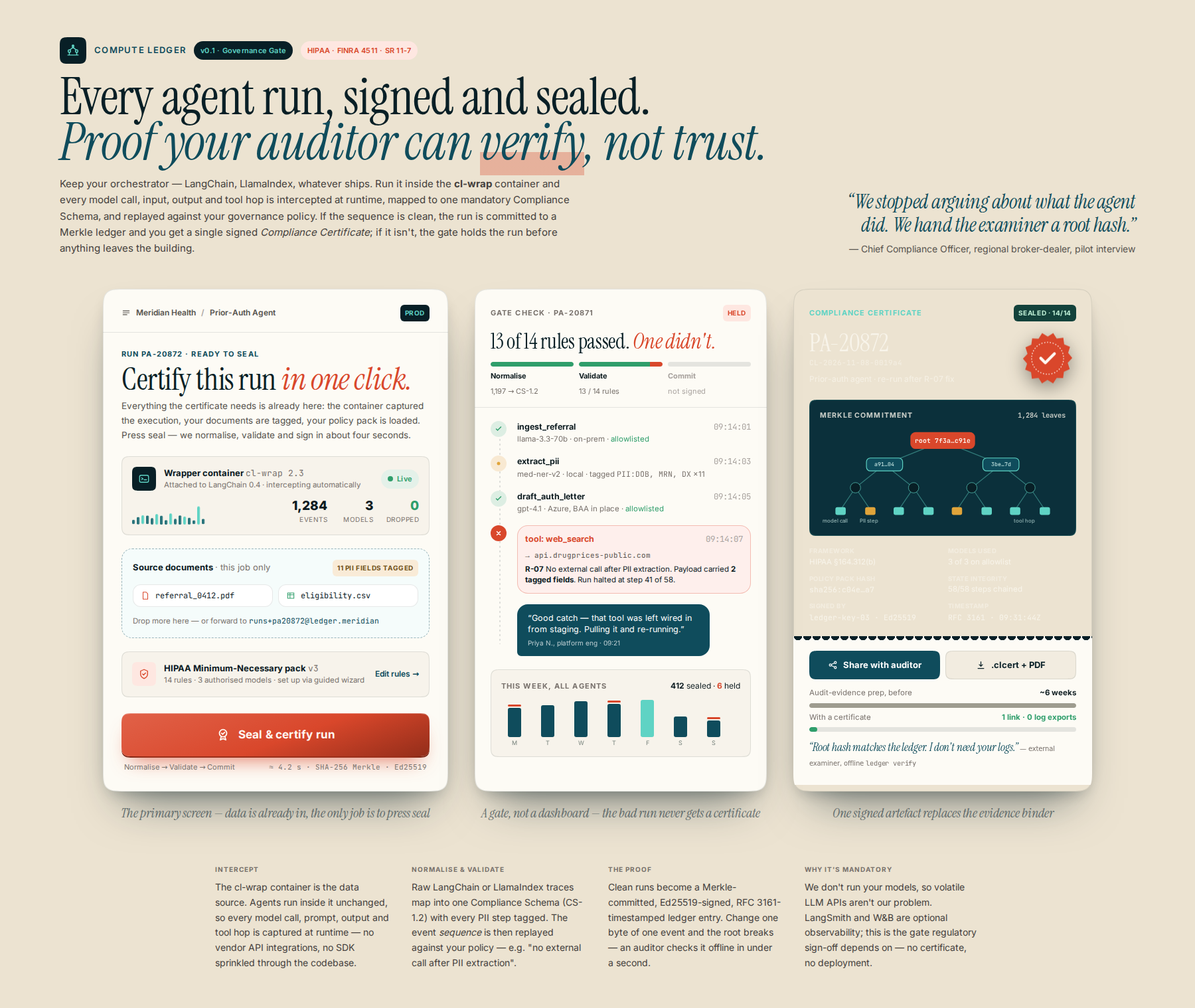
A compute ledger middleware can generate a cryptographically signed, tamper-proof record of an AI agent's entire execution history for exactly this purpose. It intercepts logs from orchestration frameworks like LangChain or LlamaIndex, normalizes them into a standardized compliance schema, validates the event sequence against governance policy, and commits a Merkle-tree-based signed ledger entry as legally admissible proof of computation. It's built for AI governance teams, healthcare providers, and financial institutions under mandates like HIPAA or FINRA.
Process flow
Who it's for
Enterprise AI Governance teams, Healthcare providers, and Financial institutions operating under strict regulatory mandates (e.g., HIPAA, FINRA).
Why they need it
In regulated sectors, the risk is not cost overruns, but audit failure. Current observability tools (like LangSmith, W&B) provide technical logging, but they lack the standardized, tamper-proof, and legally verifiable ledger required to prove compliance, model lineage, and data handling protocols during a mandatory audit.
What it is
A specialized 'Compute Ledger' service that intercepts execution logs and generates a single, immutable, cryptographically signed record (a 'Compliance Certificate'). This certificate proves that the agent followed all defined governance rules, used only authorized models, and maintained state integrity throughout the process.
How it works
- The developer runs the agent using their existing, preferred orchestration framework (e.g., LlamaIndex, LangChain).
- The framework outputs a detailed raw execution log (including model calls, inputs, outputs, and metadata).
- Our Compute Ledger Middleware intercepts this log and executes three critical processes: a. Schema Normalization: It maps the raw vendor log into a single, mandatory, standardized Compliance Schema (e.g., ensuring all PII handling steps are tagged). b. Compliance Validation: It checks the sequence of events against the client's defined governance policy (e.g., 'No external call allowed after PII extraction'). c. Ledger Commitment: It generates a Merkle-tree-based, signed, immutable ledger entry, providing a verifiable proof of computation suitable for legal audit.
Differentiation
We are not an execution runtime, which avoids the impossible engineering task of maintaining stability across volatile LLM APIs. We are a mandatory compliance and financial middleware. Unlike generic observability platforms (LangSmith, W&B) which are viewed as optional 'nice-to-have' tools, we are positioned as a critical, non-negotiable 'Governance Gate' required for regulatory sign-off. We solve the fundamental business problem of 'Verifiable Accountability' by acting as the single source of truth for auditability, thus de-risking the entire AI deployment for regulated enterprise use cases.
Implementation sketch
- Identify a single, highly regulated niche (e.g., Financial Fraud Detection).
- Define the mandatory Compliance Schema for that niche (e.g., must track specific data fields like 'Source IP' and 'PII Masking').
- Build a proof-of-concept parser that accepts the raw JSON output from a single, common API (e.g., OpenAI's standard log format) and maps it only to the defined Compliance Schema.
- Implement the cryptographic signing mechanism (e.g., using a verifiable timestamping service) to create the immutable ledger entry.
First step: Select one specific regulatory niche (e.g., HIPAA) and define the core 'Compliance Schema' for that niche. Then, write a small Python script to parse the raw JSON log output from the single most common vendor (e.g., OpenAI) and validate that it successfully populates only the fields defined in the Compliance Schema.
Remaining risks
- Regulatory Fragmentation and Scope Creep (The Compliance Hydra). While solving one niche (e.g., HIPAA) is manageable, the moment a client requires compliance for a second, different jurisdiction (e.g., GDPR, FINRA, specific state laws), the 'Compliance Schema' becomes exponentially complex. The product risks becoming an unmaintainable, bespoke legal database rather than a generalized piece of infrastructure. — Do not build the compliance logic into the ledger itself. Instead, abstract the compliance rules into a highly configurable, external Policy Engine. The ledger should only record that a policy was checked and what the outcome was, allowing the client's legal/governance team to update the ruleset without requiring a code deployment from your side.
- The 'Observability Tax' Perception. Even if the product is technically superior, the market may view it as an expensive, proprietary layer of 'over-observability.' If major cloud providers or established orchestration tools (like LangChain/LlamaIndex) begin integrating robust, native compliance and logging features, your entire value proposition could be undercut and absorbed into a standard platform feature. — Focus on the cryptographic proof of non-repudiation and the verifiable legal chain of custody, rather than just the data points. Position the product not as 'better logging,' but as the only tool that provides a legally admissible 'Certificate of Computation' required by external auditors.
- Vendor Dependency on Log Format Stability. Although the product is designed to sit on top of existing tools, the entire system relies on the raw execution log output remaining stable. If a major vendor (e.g., OpenAI) changes its log format, or if a core orchestrator (e.g., LlamaIndex) updates its logging structure, the Middleware must be updated immediately, creating a massive, continuous integration burden that threatens the 'mandatory' status of the product. — __
Watch for: A major, well-funded competitor (e.g., an enterprise observability platform like Datadog or a cloud vendor) announcing a 'Compliance Mode' or 'Governed Execution' feature that directly addresses the audit trail requirement. This would immediately commoditize the core value proposition. Kill criterion: A breakthrough in model architecture (e.g., fully local, fully deterministic models running on edge hardware) that eliminates the reliance on external, proprietary, API-driven LLM calls. If the computation can be verifiably contained and audited entirely within the client's private, on-premises hardware, the need for a third-party 'Compute Ledger' vanishes.
Sources the council used
Real-world evidence that grounded this idea — judge it for yourself.