
Sentinel: Universal LLM Usage Verifier & Audit Mesh
A standardized, verifiable orchestration layer that normalizes raw AI usage data from disparate model providers into a single, canonical, and auditable record, enabling reliable cost control for autonomous agents.
How can AI agents reliably track and audit their LLM spending across different providers?
A verification middleware layer solves this by intercepting raw usage data from each provider's API and normalizing it into one canonical, cryptographically signed usage record before billing. It works by routing a request through a cost-benefit router, capturing the provider's raw token/compute metadata, mapping it into a standardized schema, and passing that proof to a payment layer for atomic deduction and an immutable audit trail. This is aimed at Web3 developers building autonomous agents who need financial accountability across proprietary, inconsistent LLM billing formats.
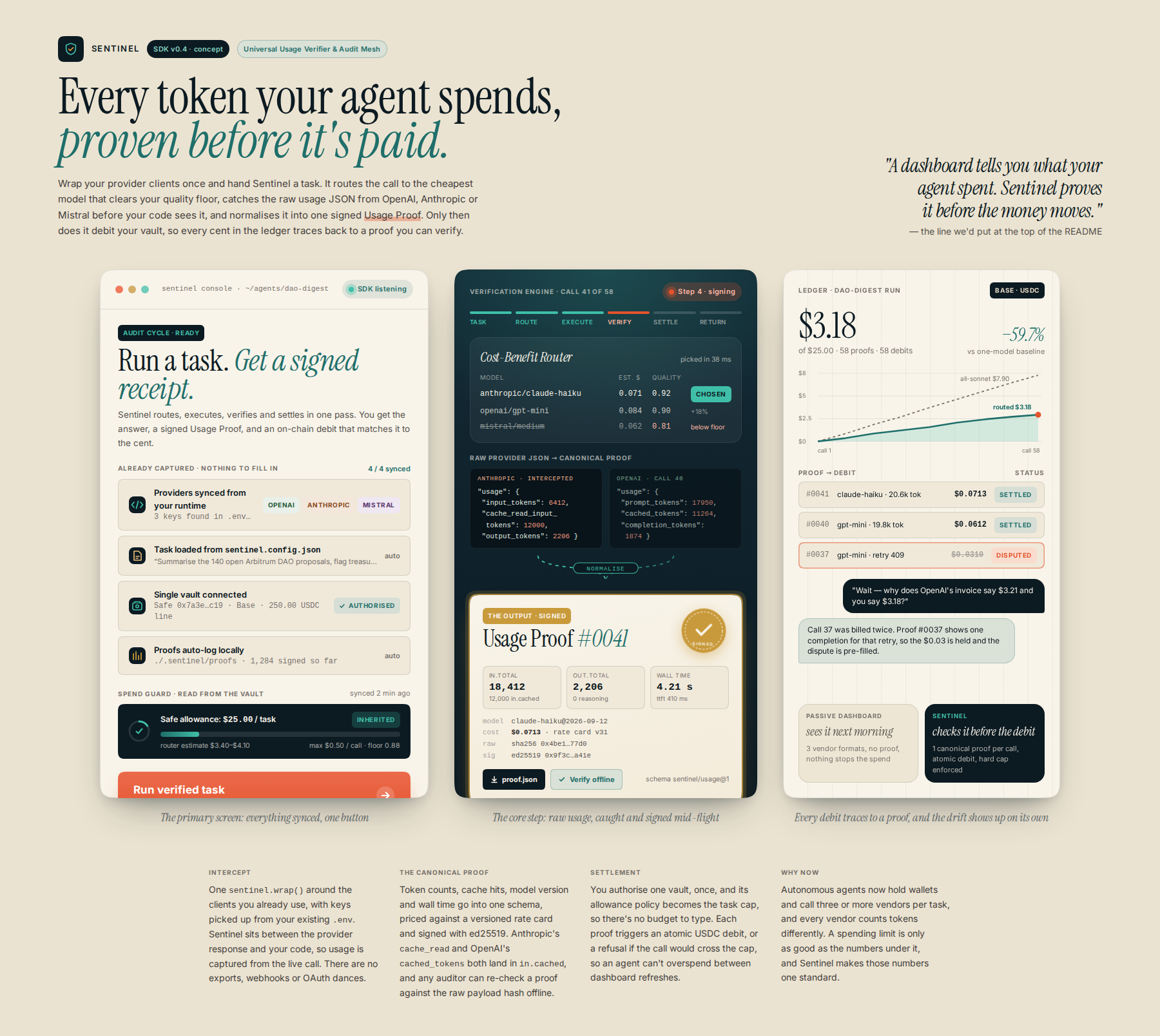
Process flow
Who it's for
Web3 developers building autonomous AI agents
Why they need it
AI agents are hampered by the lack of a single, standardized control plane that can reliably measure and audit usage across multiple, proprietary LLM APIs. This fragmentation makes financial accountability and accurate cost optimization impossible.
What it is
Sentinel is a middleware service and SDK that acts as a Universal Usage Verifier. It intercepts raw API calls, standardizes the resulting usage metadata (tokens, compute time, model ID) into a canonical proof format, and provides a verifiable ledger for cost calculation and deduction.
How it works
The process works as follows:
- The developer passes an agent task and a total budget to the Sentinel SDK.
- Sentinel intercepts the request and runs it through the Cost-Benefit Router, dynamically selecting the optimal model/provider.
- The request is executed by the chosen provider. Upon completion, the provider returns raw usage data (e.g., Anthropic JSON, OpenAI JSON).
- (The Core Step) Sentinel's Verification Engine intercepts this raw data, normalizes it into a canonical Usage Proof (containing standardized token counts, model version, and time), and cryptographically signs this proof.
- This Usage Proof is then passed to the payment rail layer, which calculates the final cost and atomically executes the payment deduction on the user's wallet, creating an immutable, auditable record of usage and expenditure.
- Finally, the developer receives the request details, the standardized Usage Proof, and the deduction confirmation, completing a full audit cycle.
Differentiation
Unlike passive observability dashboards, which only track usage after the fact, Sentinel is an active, standardized verification engine. Unlike previous spending limit frameworks, which often fail to handle multi-vendor complexity, Sentinel solves the fundamental data interoperability problem by creating a canonical Usage Proof. It combines dynamic model routing logic with a robust, standardized data verification and immutable settlement layer, solving the agent's lack of an owned, standardized control plane.
Implementation sketch
- Build a wrapper SDK (Python/TypeScript) that accepts task payload and budget (USDC/Base).
- Implement the Cost-Benefit Router to select the optimal provider (Model ID, Provider).
- Develop the Usage Verification Layer: A module that ingests raw usage JSON from different APIs (OpenAI, Anthropic, etc.) and maps all variable fields (e.g., 'input tokens', 'completion tokens') into a single, standardized internal schema (the Canonical Usage Proof).
- Integrate the smart contract/service layer proxy to receive the Canonical Usage Proof, calculate the final cost, and execute the atomic payment deduction on Base/USDC.
- Build a dashboard displaying the standardized Usage Proof ledger, showing the source API, the canonical data, and the final financial settlement.
First step: Build a minimal proof-of-concept (PoC) in Python that takes two distinct, raw usage JSON payloads (e.g., one from OpenAI and one from Anthropic) and successfully maps all unique fields into a single, standardized Python dictionary structure (the Canonical Usage Proof). This validates the core data standardization hypothesis.
Remaining risks
- Vendor Lock-in and API Drift: The system's core functionality relies on integrating with proprietary, external APIs (OpenAI, Anthropic, etc.). These vendors can change their API structures, billing models, or rate limits at any time without warning, forcing continuous, expensive maintenance and potentially breaking the 'Canonical Usage Proof' layer. — Design the Verification Engine with an abstraction layer that treats vendor API responses as 'data sources' rather than hard dependencies. Prioritize developing a standardized schema that accommodates known future changes (e.g., adding a placeholder for 'multimodal token count') and build automated monitoring tools that alert developers immediately upon detecting schema drift in a connected vendor API.
- Asynchronous Financial Reconciliation Failure: The process is a multi-stage, asynchronous transaction (API Call -> Usage Capture -> Verification -> Deduction). If a network failure or service outage occurs after the LLM usage is consumed but before the smart contract executes the deduction, the system enters an ambiguous, unbilled state. This creates a massive financial liability and destroys trust. — Implement a guaranteed, idempotent 'Reconciliation Service' that runs in the background. This service must periodically poll for transactions that have confirmed usage proof generation but lack a final, verifiable deduction record. It must automatically trigger compensating transactions or flag the user/administrator with high-priority alerts for manual reconciliation.
- The 'Audit' Feature Becomes the Primary Value, Not the 'Cost Control': While the pitch emphasizes cost control, the most defensible and least competitive aspect is the 'standardized data verification' and 'auditable ledger.' If the market adopts the Verifier/Audit Mesh as a mandatory compliance layer (e.g., for regulated industries), the cost optimization becomes secondary, and the business must pivot its sales strategy to compliance and data governance first. — Do not lead with 'cost-saving.' Lead with 'regulatory compliance' and 'data provenance.' Market the service as a mandatory 'LLM Usage Compliance Gateway' that provides an immutable, standardized audit trail required by financial or medical regulators, making the cost control a natural, secondary benefit of achieving compliance.
Watch for: If the primary source of developer engagement shifts from solving the 'cost' problem (which is visible) to solving the 'data interoperability' problem (which is abstract), it signals that the market is adopting the Verifier/Audit Mesh as a necessary infrastructure standard, which is a strong positive signal. Kill criterion: A single, high-profile, unrecoverable incident where the system successfully consumes LLM resources but fails to generate or process the Usage Proof, resulting in unbilled usage and a direct financial loss to the user. This compromises the core trust contract of the entire service.
Sources the council used
Real-world evidence that grounded this idea — judge it for yourself.