Agent Rail: State-Machine Workflow Abstraction Layer (LOCKED)
A lightweight, standardized runtime environment that guarantees transactional state persistence and verifiable execution logging for multi-agent workflows, abstracting away underlying hardware and resource allocation complexity.
How can small teams make multi-agent AI workflows reliable instead of silently failing mid-run?
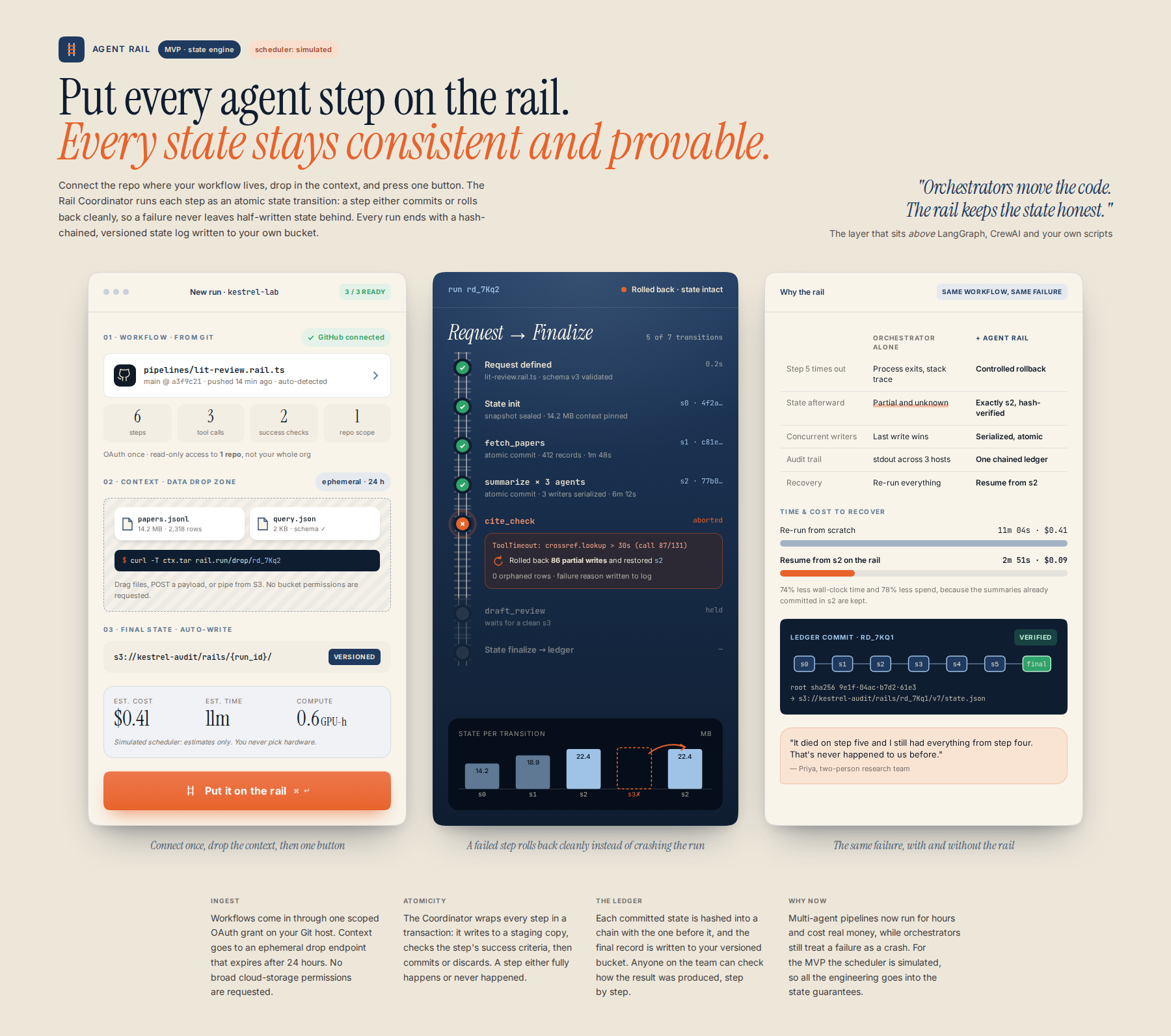
A state-machine runtime layer that wraps agent workflows in atomic, auditable transactions solves this by managing Request Definition, State Initialization, Atomic Execution, and State Finalization as one lifecycle. If a step fails, it triggers a controlled rollback and logs the full state history instead of crashing, so the outcome is always verifiable. It's built for infrastructure-constrained dev teams and researchers running multi-step pipelines who can't afford constant manual monitoring of distributed agent state.
Process flow
Who it's for
Small, infrastructure-constrained development teams and advanced researchers requiring reliable, multi-step AI pipelines.
Why they need it
Current agentic workflows are fundamentally unreliable because they lack guaranteed state consistency and atomic transaction handling across independent compute nodes. This requires constant, unsustainable manual monitoring. The critical, unaddressed gap is the operational layer that enforces reliable, transactional state transitions regardless of the underlying hardware or orchestration tool.
What it is
A standardized API and runtime engine designed to act as a centralized 'rail' for all AI agentic systems. It manages the entire lifecycle: Request Definition -> State Initialization -> Atomic Execution -> State Finalization. The core function is guaranteeing that the workflow state is always consistent and verifiable.
How it works
- A developer defines a complex agent workflow using our SDK, specifying logical steps, tool calls, and success criteria.
- The Agent Rail Coordinator receives the workflow and initiates the state machine. For the MVP, the Resource Scheduler is mocked or simulated to provide resource cost estimates, allowing us to focus purely on the state logic.
- Execution begins: The Coordinator executes steps sequentially, ensuring that each state transition is atomic.
- State Management: If any step fails, the system does not crash; instead, it triggers a controlled rollback, preserves the complete state log, and reports the failure reason, guaranteeing the final state is always auditable.
- Upon successful completion, the final, verifiable state is committed to the ledger, providing a single source of truth for the entire process.
Differentiation
This solution addresses the operational limitations of high-level orchestration frameworks and enterprise compute platforms. While existing tools manage code flow or payment endpoints, none provide the integrated, verifiable layer that combines robust, state-machine enforcement and centralized, atomic state management. We are the operational layer that sits above the orchestration tools, solving the critical gap of guaranteed state consistency in multi-step, distributed agent workflows.
Implementation sketch
- Build the core SDK wrapper that allows defining a workflow manifest (steps, dependencies, success criteria).
- Develop the State Machine Engine: Implement the core logic that accepts a workflow manifest and processes state transitions (Success/Failure/Rollback) based on mocked inputs (i.e., assuming resources are available).
- Implement the internal Transaction Ledger: Build the service responsible for logging every state change, call, and transition to guarantee a persistent, verifiable audit trail.
First step: Define the core State Machine interface (e.g., Python class/interface) that accepts a 'Workflow Manifest' and outputs a 'Final State Object,' ignoring resource constraints entirely for the first iteration.
Remaining risks
- The 'Operational Black Box' Risk: The system becomes an opaque, complex layer that is difficult for end-users to debug or trust when an agent fails. If the audit log/state machine is too complex, users will abandon it and revert to simpler, visible tooling (like direct code execution or simpler workflow managers) because the debugging overhead outweighs the benefit of guaranteed state. — Design the logging and failure reporting (the 'read' side) to be maximally human-readable and actionable. The primary focus for the next phase must be on the developer experience of debugging a failure, not just proving the failure can be logged.
- The 'Integration Tax' Risk: While the solution abstracts hardware, the actual tools and agents used by the user (e.g., a specific proprietary API, a custom RAG pipeline) still require significant effort to integrate into the SDK manifest. If the cost of building the workflow manifest for every new tool outweighs the benefit of the state guarantee, adoption will stall. — Focus on building a 'Universal Tool Adapter' pattern within the SDK. The goal should be to make integrating a new external tool as simple as copy-pasting an API endpoint and defining its input/output schema, minimizing custom code required by the user.
- The 'Commodity Abstraction' Risk: The concept of guaranteed state consistency is a foundational pattern (e.g., distributed transactions, event sourcing). If major cloud providers (AWS Step Functions, Google Workflows) or major enterprise orchestration tools decide to bake this state guarantee into their core offerings, the niche value of this specialized, vendor-specific 'Rail' could evaporate rapidly. — The differentiation must pivot from what it does (state management) to how it enables unique, unreplicable workflows (e.g., specific multi-agent coordination patterns or novel failure recovery mechanisms that go beyond standard transaction rollback).
Watch for: If the market begins to treat the 'State Machine' as a feature that can be added on top of existing, mature orchestration tools (e.g., LangChain/AutoGen), rather than recognizing it as a fundamental architectural requirement, it signals that the core gap is being misunderstood or commoditized. Kill criterion: If the core SDK/Runtime cannot demonstrably handle a multi-step workflow involving at least three distinct, external, and non-trivial services (e.g., a database write, an external API call, and an LLM call) while maintaining a perfect, verifiable state log, it indicates the underlying state machine engine is not robust enough to handle real-world distributed failure modes.
Sources the council used
Real-world evidence that grounded this idea — judge it for yourself.