
Predictive TCO Modeling for Autonomous Agents
A pre-deployment simulation layer that provides developers with a deterministic, guaranteed estimate of an autonomous agent's maximum operational cost (TCO) before a single line of code runs.
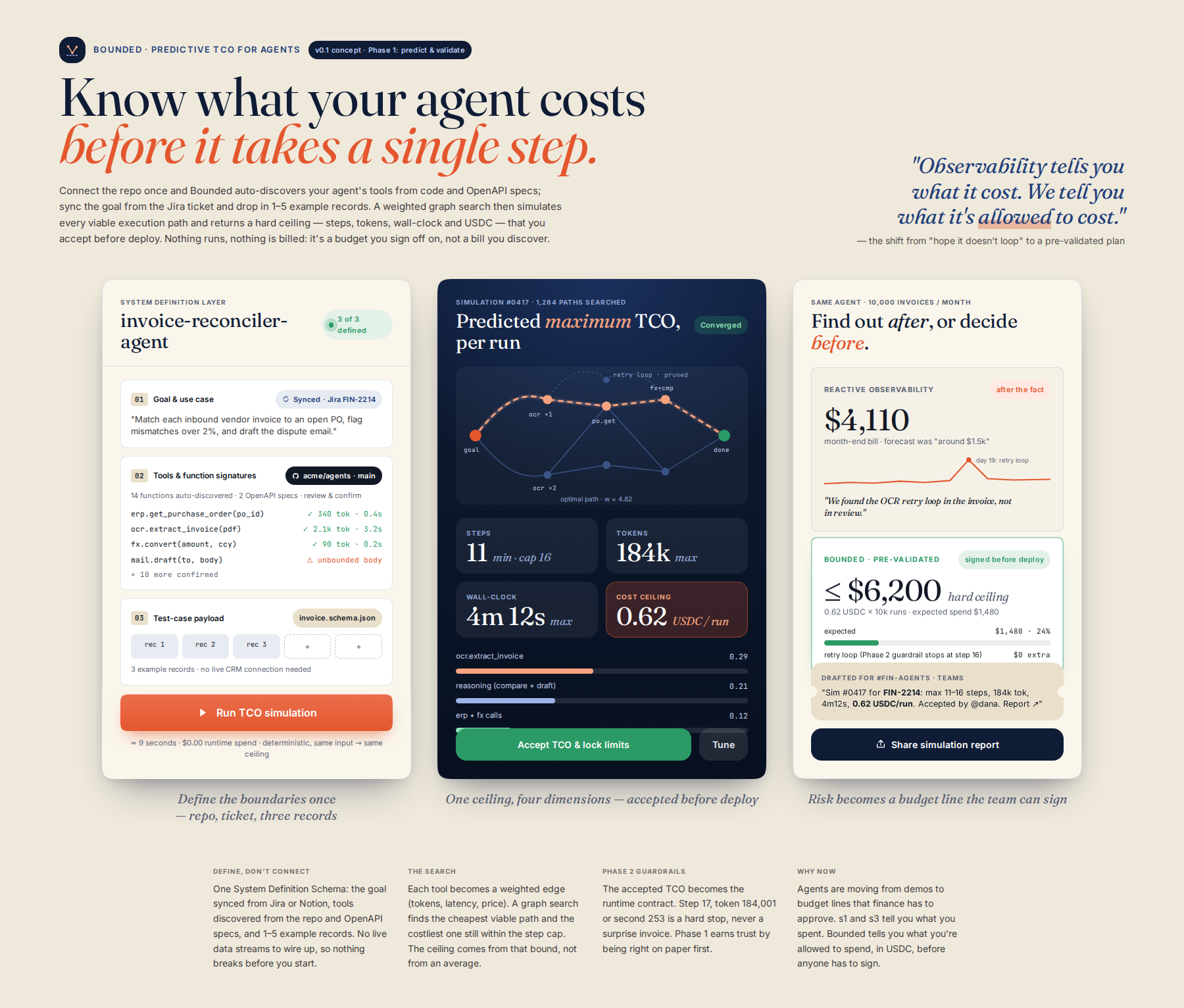
Process flow
Who it's for
Developers and enterprise teams building complex, multi-step autonomous agents.
Why they need it
Users face significant deployment risk due to the unpredictable and variable operational expenditure (OPEX) of multi-step AI agents. The inability to accurately budget for 'gas' makes production adoption slow and financially risky. Quote: 'pay for gas. And there are pros and cons to both.'
What it is
A middleware API that acts as a high-fidelity computational and financial simulator, allowing users to model and validate agent performance against a hard, predicted budget (steps, tokens, time, and dollar cost) without incurring real runtime costs.
How it works
The user defines a goal and provides the agent's available tools/APIs. The system ingests this information and runs a predictive TCO model. This module uses a weighted graph search algorithm to simulate the most efficient execution paths, calculating the minimum required steps, the maximum resource consumption (tokens/time), and the associated estimated cost (USDC). The user must accept this simulated TCO before deployment. The final runtime environment (Phase 2) will then use these modeled limits as hard guardrails, but the initial value proposition is the prediction and validation phase.
Differentiation
Existing observability tools (like 's1' or 's3') are reactive, providing cost reports after the fact. Standard MLOps platforms offer basic resource logging but lack a unified, predictive TCO model that integrates computational limits with financial estimation. Our solution is a proactive design guardrail that transforms deployment risk into a pre-validated, budgeted plan, fundamentally shifting the developer workflow from 'hope it doesn't fail' to 'know exactly how much it will cost.'
Implementation sketch
- Build a core FastAPI endpoint that accepts a defined task goal and a list of available tools/APIs.
- Develop the TCO Predictor Module: Implement a graph search algorithm (e.g., A*) that treats the agent's goal as the target node and the tools as weighted edges. The weights must incorporate estimated costs (tokens/steps/time) for simulation.
- Design the Output Schema: The module must output a clear, actionable JSON object containing 'Minimum Estimated Cost,' 'Maximum Predicted Cost,' and 'Required Resource Bounds' (steps/tokens).
- Initial MVP Goal: Achieve deterministic cost estimation for simple, linear agent workflows. The complexity of the graph search can be iteratively expanded.
First step: Prototype the TCO Predictor Module by creating a simple Python class that simulates a fixed, linear workflow (e.g., 'Tool A -> LLM call -> Tool B') and calculates the cumulative cost based on hardcoded weights (tokens/steps/cost) to prove the graph traversal logic before integrating it with FastAPI.
Remaining risks
- Model Drift and Black Box Costs — The entire predictive model is based on current, weighted cost estimates (tokens/steps/time). If the underlying cost structure of any major component (e.g., OpenAI's pricing changes, or a new, more expensive tool is introduced) changes, the model's predictions will instantly become inaccurate. The system is inherently fragile because it is a projection of a dynamic, external market, not a fixed computation.
- Tool Scope and Dependency Hell — The accuracy of the TCO prediction relies on the developer providing a complete and accurate cost model for every single external API/tool. If a tool has variable costs (e.g., database queries that cost $0.001 per record, but the developer only provides a flat rate estimate), the simulation will fail to capture the true operational expenditure, making the prediction useless for high-fidelity budgeting.
- Developer Workflow Friction — While the pain point is clear, forcing developers to adopt a mandatory, complex pre-simulation step introduces significant workflow friction. If the simulation process itself is slow, requires too much setup, or fails to perfectly predict the optimal path (i.e., it's always slightly too conservative), developers will bypass the guardrail and revert to faster, less safe, but familiar development cycles.
Watch for: A noticeable trend of developers or early adopters using the simulation results merely for 'fun' or 'best-guess' estimates, rather than treating the output as a mandatory, deterministic, and binding budget constraint for production deployment. Kill criterion: A major cloud provider (AWS, Google Cloud, Azure) or a primary LLM vendor (OpenAI, Anthropic) announces a native, integrated, and highly accurate 'predictive cost modeling' feature within their existing developer console or SDK, effectively commoditizing the core value proposition.
Sources the council used
Real-world evidence that grounded this idea — judge it for yourself.