
Agent Attribution Gateway (AAP): Governance for High-Risk Microservices
A specialized, mandatory proxy layer designed for critical, high-risk microservices to govern, track, and log every single API call, providing cryptographic proof of attribution and enforcing usage quotas.
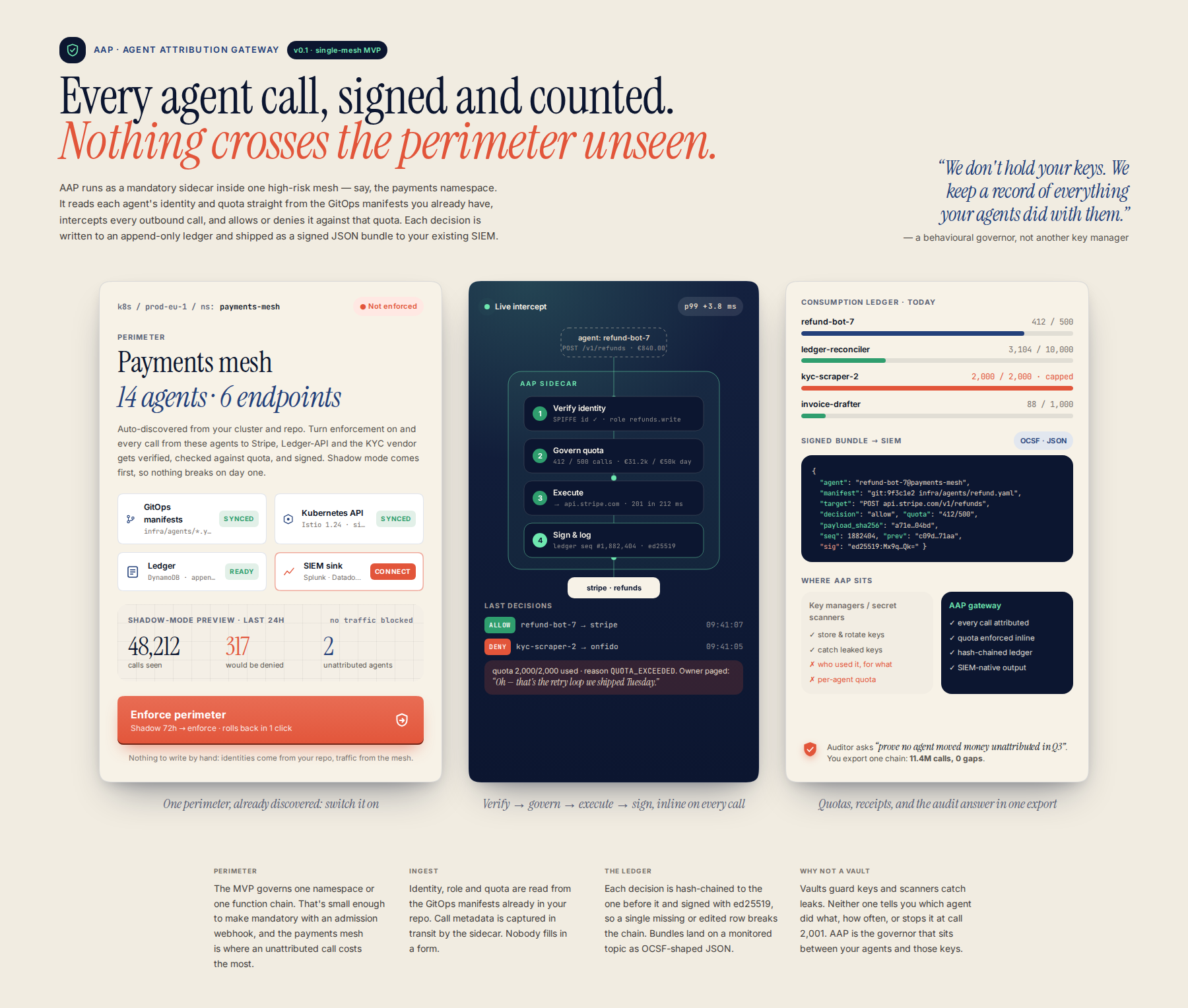
Process flow
Who it's for
Security/DevOps team managing specific agent runtimes, compliance officers, and automated workflow developers.
Why they need it
AI agents multiply potential access paths and create weak attribution due to shared or inherited service accounts. Instead of attempting universal coverage, we focus on solving the attribution gap in the most critical, observable, and high-risk environments (e.g., internal financial microservices or cloud function chains). This requires a mandatory choke point to enforce accountability and granular usage logging. (Source: p2)
What it is
An Agent Attribution Proxy (AAP) that sits between autonomous agents and designated external endpoints. It acts as a Zero-Trust Gateway for AI actions and usage governance, proving that all activity within a controlled perimeter is observed and attributed.
How it works
- Scope Limitation: The MVP scope is limited to a single, easily enforceable runtime environment (e.g., a Kubernetes Ingress/Sidecar proxy or a specific Cloud Function chain). This immediately mitigates the 'universal mandatory' architectural risk.
- Interception: The agent's call is intercepted by the AAP Proxy.
- Verification: The AAP verifies the agent's identity and reads its manifest/role.
- Governance: The AAP checks the agent's assigned quota/rate limit for the specific resource/endpoint, enforcing governance rules.
- Execution & Logging: If authorized, the AAP executes the call, logs the action (success/failure/reason), and updates the agent's internal, immutable consumption counter in a dedicated ledger.
- Output: This provides real-time, auditable attribution and governance enforcement within the defined perimeter.
Differentiation
Existing solutions focus either on preventing key exposure or key storage. We provide the mandatory, run-time, granular attribution and quota management layer. By scoping the MVP to a specific, high-risk runtime (e.g., an internal microservice mesh), we solve the core attribution problem in a highly feasible manner, addressing the coverage gap relative to both s2 and s3. We are not a key manager; we are a mandatory behavioral governor.
Implementation sketch
- Build a core proxy service (e.g., a sidecar container or API Gateway middleware) capable of receiving and forwarding requests for the designated high-risk microservice.
- Develop the Agent Manifest/Role system, allowing developers to define an agent's allowed endpoints, quotas, and governance rules (e.g., 'Agent X can call Endpoint Y up to 100 times per day').
- Implement the internal state and logging module: Upon successful request, the proxy writes an immutable, time-stamped record to a dedicated, auditable ledger (e.g., a secure database or dedicated blockchain log) and increments the agent's internal usage counter.
First step: Draft the technical specification for a simple sidecar proxy (e.g., using Istio/Envoy) that intercepts all outbound HTTP calls from a test container and logs the source IP, destination URL, and request headers to a temporary file, validating the interception mechanism.
Remaining risks
- Organizational/Adoption Resistance: The requirement for a 'mandatory choke point' is a massive cultural and operational hurdle. Even if technically perfect, adoption requires deep cooperation from multiple, often siloed, development teams who may resist the overhead of routing all traffic through a central, non-optional proxy. — The solution must be framed not as an enforcement tool, but as a critical, highly valuable 'observability layer' that solves immediate, painful compliance/auditing needs. Success depends on making the proxy invisible to the developer (excellent DX) while being mandatory to the system architect.
- Data Normalization Complexity: While the scope is limited to one environment, the proxy must still handle diverse communication protocols (e.g., HTTP/JSON, gRPC/Protobuf, WebSockets) and normalize all metadata (headers, payloads, timing, identity claims) into a single, coherent, and immutable ledger schema. Schema drift or unexpected protocol variations will undermine the 'immutable' claim. — Invest heavily in a protocol abstraction layer and enforce strict schema validation at the ingress point. Treat the logging/ledger schema as the single source of truth, and build adapters for every protocol variation against that schema.
- The 'Last Mile' Problem: The core value is derived from the mandatory nature of the choke point. Any failure in the underlying orchestration layer (e.g., a developer bypassing the sidecar via a direct internal service call, or a service mesh misconfiguration) immediately voids the attribution guarantee, leaving the system vulnerable to the exact problem it was designed to solve. — __
Watch for: Any internal discussion that shifts from 'How do we implement this?' to 'How do we make this mandatory for every service?' (indicating a loss of scope focus and an inability to manage the organizational change required). Kill criterion: If the initial proof-of-concept cannot achieve 100% interception coverage within the designated high-risk environment, even with the best-effort sidecar implementation, the core premise of 'mandatory attribution' is fundamentally flawed for the current technical stack.
Sources the council used
Real-world evidence that grounded this idea — judge it for yourself.