
Bespoke Compute Bottleneck Solver: Paid PoC for Niche AI Research
A hyper-specialized, paid consulting service that solves a documented, high-cost computational bottleneck for a single, elite research partner. Instead of building a general index, we provide a proprietary, predictive signal model trained on the partner's unique, internal data streams to optimize their compute allocation and accelerate their breakthrough research.
How can AI research labs predict and prevent GPU memory bottlenecks in novel model architectures?
A bespoke predictive signal model trained on a lab's own compute usage logs and architectural metadata can forecast resource bottlenecks before they cause training failures. It ingests internal data on GPU memory, interconnect bandwidth, and CUDA kernel usage, then generates a bottleneck score with concrete recommendations, such as pre-allocating HBM ahead of a predicted failure window. Delivered as a paid monthly service integrated into orchestration tools like Slurm or Kubernetes, it targets university labs and corporate R&D teams running high-cost, novel architectures such as Looped Transformers.
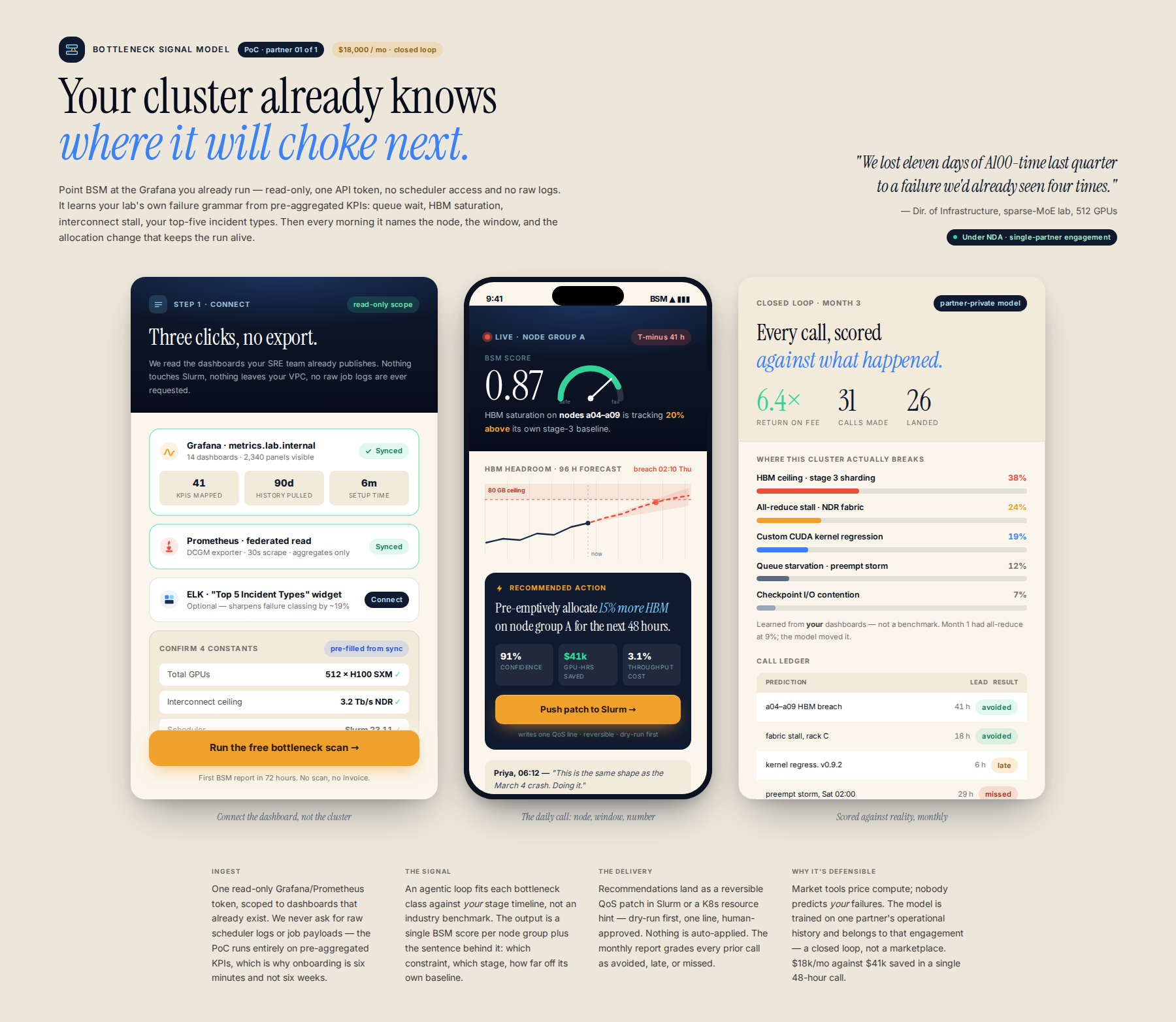
Process flow
Who it's for
Advanced AI research teams (e.g., specialized university labs, corporate R&D departments) that face critical, documented computational bottlenecks in novel, high-cost model architectures.
Why they need it
The core pain is not general market volatility, but the inability to predict and optimize the resource requirements for a bleeding-edge, specialized task (e.g., optimizing memory usage for Looped Transformers or managing attention matrix sparsity). General market rates fail because they cannot account for the unique, internal operational constraints and resource dependencies of a proprietary research workflow. Solving this bottleneck saves millions and provides a clear, measurable ROI for the partner.
What it is
A proprietary, bespoke 'Bottleneck Signal Model' (BSM) that ingests the partner's internal usage logs, maps resource constraints (GPU memory, interconnect bandwidth, specialized CUDA kernels), and generates a predictive score for resource optimization and failure mitigation. This is a paid, closed-loop intelligence service.
How it works
- Data Ingestion: Secure a paid agreement with the partner to ingest their internal compute usage logs and architectural metadata. This is the core, defensible asset.
- Signal Processing: Develop the agentic loop to analyze resource consumption patterns, identifying resource bottlenecks (e.g., 'bottleneck type X occurs 20% more often than predicted during stage Y').
- Prediction Layer: Calculate the BSM score, providing concrete recommendations (e.g., 'Pre-emptively allocate 15% more HBM on Node A for the next 48 hours to prevent bottleneck failure').
- Distribution: Deliver the solution as a high-value, paid monthly service integrated directly into the partner's existing compute orchestration tools (e.g., Slurm, Kubernetes).
Differentiation
Competitors offer resource listings or general market pricing (e.g., OpenRouter, specialized cloud APIs). Our differentiation is providing the internal, proprietary predictive layer. We are not a signal market; we are a bottleneck mitigation service. The gap is the lack of a dedicated, paid, closed-loop intelligence system that operates on a client's confidential, deep-dive operational data to solve a specific, high-stakes problem. This makes the WTP signal immediate and quantifiable.
Implementation sketch
- Identify 3-5 target labs/corporate R&D groups and prepare a highly specific, non-index-based PoC proposal addressing a known compute limitation (e.g., 'reducing memory access latency in Looped Transformer training by X%').
- Develop a minimal data mapping framework (not a scraper) to prove the ability to ingest and normalize the partner's specific internal log formats.
- Build a proof-of-concept model that takes the partner's provided data and outputs 3-5 actionable, quantifiable recommendations, demonstrating immediate value.
First step: Draft 3 highly customized, non-index-related PoC proposals (e.g., 'Optimizing HBM utilization for Model X at Lab Y') and schedule introductory calls with the technical leads at 3 target research institutions to gauge their specific, known compute pain points.
Remaining risks
- Client Lock-in and Dependency Risk (The Single Bet): The entire business model is predicated on the success and continued funding of a single, elite research partner. If that lab shifts its focus, changes its internal compute architecture, or faces internal budget cuts, the entire revenue stream and technical foundation collapses instantly. — The service must be designed with modularity. Instead of solving one specific bottleneck, the company must prove the BSM methodology can be applied to 2-3 fundamentally different, high-value bottleneck types (e.g., memory vs. interconnect vs. I/O) across different industries, creating a portfolio of use cases rather than a single client dependency.
- The 'Consulting Trap' (Failure to Productize): The bespoke nature of the service is highly defensible but inherently non-scalable. There is a significant risk that the company becomes perpetually trapped as an expensive, high-touch consulting firm, unable to productize the BSM into a replicable, API-driven product because the core value relies too heavily on the client's unique, proprietary data structure. — Immediately begin developing a 'Synthetic Data Layer' or a parameterized framework that simulates the input data structure required for the BSM. This allows the company to demonstrate the model's value proposition to subsequent, non-partner clients using anonymized or simulated data, proving the model's general applicability before requiring deep internal access.
- IP Ownership and Trust Boundary Erosion: Since the BSM is trained on the client's most sensitive, proprietary internal usage logs and architectural metadata, the legal definition of IP ownership for the derived knowledge (the optimized resource allocation rules) is a massive, unresolved risk. The client may feel entitled to the insights generated, creating a perpetual trust challenge. — Establish a legally ironclad agreement that explicitly defines the boundary: the client owns the raw data, the company owns the BSM model architecture and the proprietary weighting algorithms. Furthermore, the contract must stipulate that the derived knowledge is a service and cannot be extracted or used by the client without a new, paid service agreement.
Watch for: Any indication from the client that they are developing internal 'shadow' tools or hiring internal staff to replicate the BSM's functionality. This signals that the client views the solution as a necessity to be internalized, rather than a paid, external service, which is the ultimate threat to revenue. Kill criterion: The client refuses to sign a paid Letter of Intent (LOI) or a paid PoC contract for the next three identified target labs, indicating that the perceived value of the solution is still viewed as speculative risk rather than measurable, immediate ROI.