
Regulated Audit Trail for Agentic Financial Transactions
A specialized compliance middleware layer that provides an immutable, granular, and regulatory-grade audit trail for every micro-transaction executed by autonomous AI agents in highly regulated financial environments.
How can firms create a regulatory-grade audit trail for AI trading agent transactions?
A compliance middleware layer can generate an immutable, regulatory-grade audit trail for every micro-transaction an AI agent executes. It intercepts each agent workflow call, calculates the compute cost, settles via stablecoin rails, then produces a structured JSON record with agent ID, endpoint, duration, and regulatory code, hashing it into an append-only ledger. This targets quant trading firms, hedge funds, and institutions bound by MiFID II or SEC reporting, where standard billing tools like Stripe lack the structural depth and immutability regulators require.
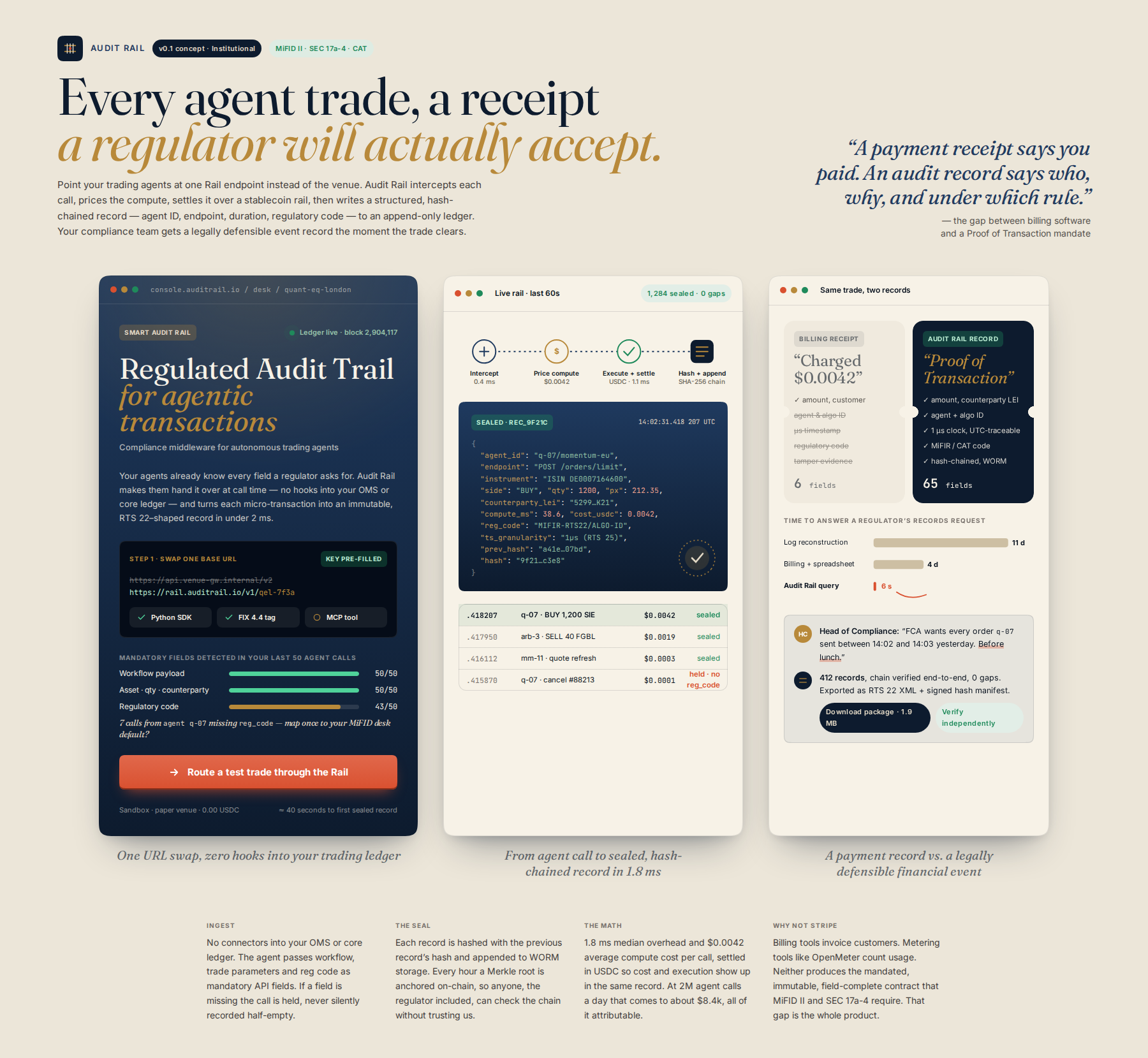
Process flow
Who it's for
Quantitative trading firms, hedge funds, and financial institutions subject to strict regulatory reporting (e.g., MiFID II, SEC).
Why they need it
Regulated finance requires not just fast settlement, but perfectly auditable settlement. Current billing systems (Stripe, etc.) treat financial transactions as commercial payments, not legally mandated, auditable financial events. Failure to generate a compliant, immutable audit trail for every computation cost or order placement can result in massive regulatory fines and operational shutdown.
What it is
A Smart Audit Rail service that intercepts agent workflows, calculates required costs, executes the transaction, and generates a cryptographically verifiable, structured, and compliant audit record that satisfies specific regulatory reporting standards.
How it works
- An AI trading agent initiates a complex, high-speed workflow call through the Rail's API endpoint.
- The Rail middleware intercepts the call, calculates the required compute cost, and executes the transaction (using stablecoin rails for immediate visibility).
- Upon successful execution, the system does not just record a payment; it generates a comprehensive, time-stamped, and structured JSON payload containing all necessary metadata (agent ID, specific API endpoint called, compute duration, regulatory code, etc.).
- This payload is immediately hashed and written to a dedicated, append-only ledger (the Audit Trail), making it instantly available for regulatory review, fulfilling the 'Proof of Transaction' mandate.
Differentiation
Existing general billing platforms (Stripe, s1) are designed for generalized commercial invoicing and lack the mandated structural depth and immutable ledger required for regulatory reporting. OpenMeter is a metering layer, not a compliance layer. Our service fills the critical gap of the 'Mandatory, Immutable, Regulatory-Grade Audit Contract,' transforming a simple payment record into a legally defensible financial event record.
Implementation sketch
- Define the minimum viable regulatory data schema (e.g., based on MiFID II record keeping standards) that must be captured for a single transaction.
- Build the API Gateway prototype to accept and successfully parse a simulated agent workflow call, ensuring the required data fields are extracted.
- Integrate a basic immutable logging mechanism (e.g., a private blockchain side-chain or verifiable data structure) to hash and timestamp the captured data payload, proving its existence and integrity at a specific time.
First step: Draft a preliminary technical specification detailing the necessary data schema and field constraints required to satisfy the audit trail requirements of the most stringent applicable regulation (e.g., MiFID II transaction reporting format). This focuses the engineering effort on compliance structure, not payment mechanics.
Remaining risks
- Regulatory Scope Creep and Jurisdictional Conflict: The regulatory landscape (MiFID II, SEC, etc.) is not static; it changes constantly and varies by jurisdiction. Building a system compliant with today's rules risks obsolescence tomorrow, requiring continuous, costly, and unpredictable schema updates that undermine the 'middleware' simplicity. — Abstract the regulatory compliance layer entirely. Instead of hardcoding schemas for specific regulations, build a pluggable 'Compliance Schema Engine' that allows regulatory bodies or specialized third-party compliance vendors to inject and validate new required data fields without requiring core code changes to the transaction processing pipeline.
- Deep Integration Friction and Vendor Lock-in: Quant trading firms operate on highly optimized, proprietary, and often decades-old infrastructure. Forcing the integration of a new, mandatory middleware layer (the Audit Rail) risks significant operational friction, resistance from internal IT teams, and the perception that the service is adding unnecessary complexity rather than solving a problem. — Do not attempt to intercept the core, high-speed trade execution path initially. Instead, position the service as a 'Compliance Data Offload Layer' that consumes existing, non-critical log streams (e.g., pre-trade risk checks, data feed ingestion logs) and retroactively structures them into the immutable audit trail, proving value without disrupting the critical path.
- The 'Compliance Tax' Perception: The value proposition is currently framed as mitigating risk, which is inherently viewed by finance executives as a necessary cost center ('Compliance Tax'). If the solution cannot demonstrably translate compliance into a quantifiable operational advantage (e.g., faster audit response time, lower operational risk score, automated regulatory filing), adoption will stall at the budget approval stage. — Shift the sales narrative from 'Compliance' to 'Operational Resilience and Efficiency.' Demonstrate how the structured, immutable audit trail allows the firm to rapidly prove compliance during an audit, thereby minimizing the potential financial loss and operational downtime associated with a regulatory failure.
Watch for: Any signal that the target market views compliance reporting as a static, annual requirement rather than a dynamic, real-time operational risk that can be optimized and monetized. Kill criterion: A major regulatory body issues a directive that requires the audit trail to be hosted on a specific, non-standardized, proprietary infrastructure (e.g., a mandated consortium blockchain or government-controlled data vault), thereby eliminating the middleware's ability to operate independently.
Sources the council used
Real-world evidence that grounded this idea — judge it for yourself.