
Agent-Optimized Edge LLM Profile Marketplace
A decentralized marketplace for validated, performance-optimized configuration profiles, guaranteeing stable and high-performance local LLM inference on specific, controlled edge hardware.
How do I guarantee a local LLM runs stably on a specific edge device like a Jetson Orin?
A marketplace of validated, hardware-specific optimization profiles can guarantee stable local LLM inference on a defined edge target. Each profile bundles battle-tested quantization levels, memory allocator settings, and context window policies for a single hardware stack, and must pass staked, benchmarked validation before being listed for sale. A dedicated runtime client then downloads and applies the profile without touching the OS kernel, replacing manual low-level tuning with automated, market-vetted configuration. It targets industrial IoT developers, edge AI engineers, and system integrators.
Process flow
Who it's for
Industrial IoT Developers, Edge AI Engineers, and System Integrators
Why they need it
Current local LLM deployment suffers from an unmanageable gap between universal model capability and the specific, stable constraints of edge hardware. The market lacks a reliable, automated, and economically incentivized layer to translate complex, physical hardware limits (e.g., 'NVIDIA Jetson Orin, 8GB LPDDR5') into actionable, guaranteed runtime configurations.
What it is
The Optimization Profile Protocol (OPP): A highly constrained infrastructure layer that lists, validates, and facilitates the recommendation and payment for standardized, version-controlled optimization profiles (e.g., 'Jetson-Orin-Quant-Optimized Profile v1.0'). These profiles dictate specific, battle-tested settings (quantization levels, memory allocators, context window policies) that a stable, dedicated runtime client can interpret and apply to a single, defined hardware stack.
How it works
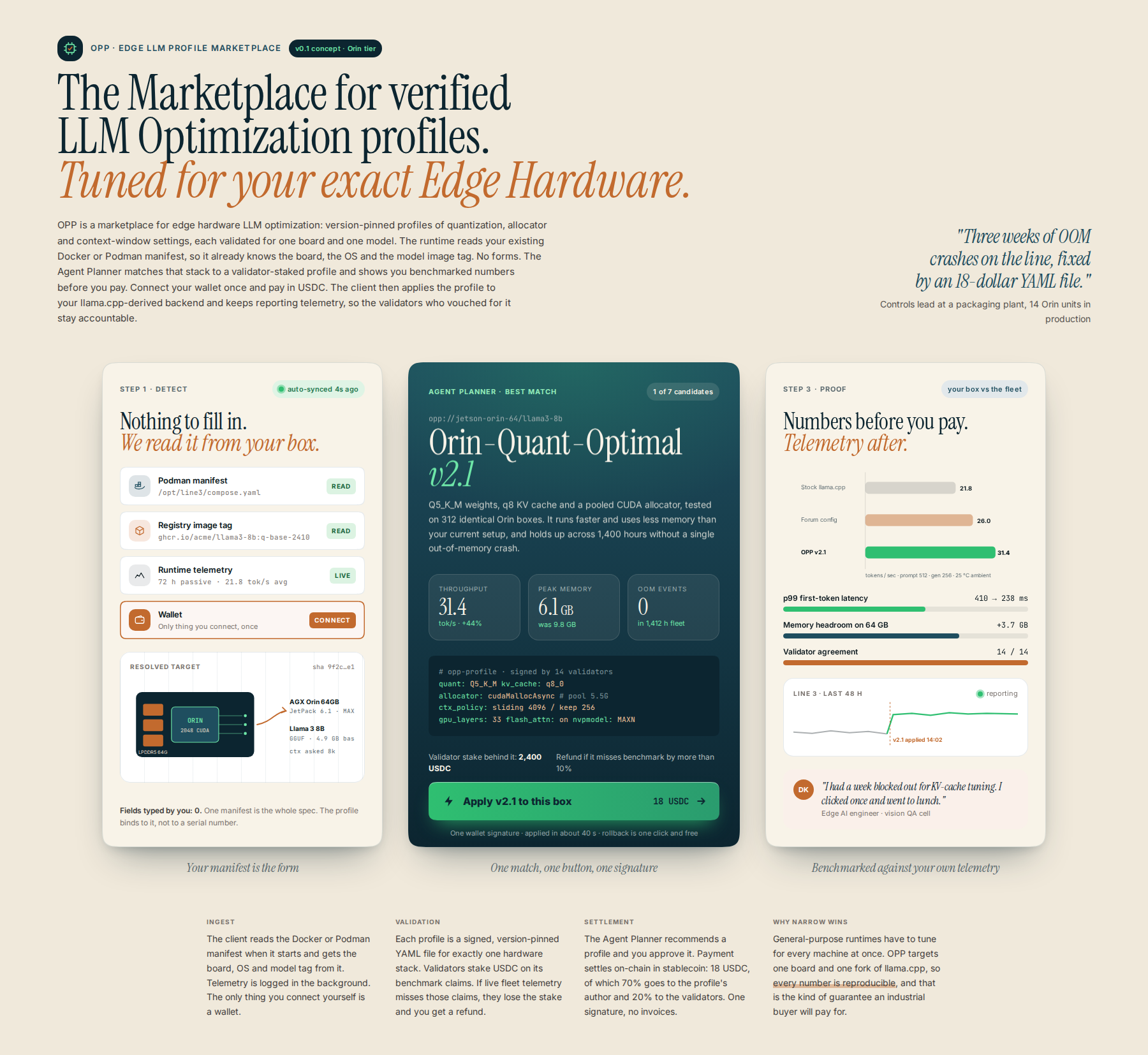
- A user defines their target edge hardware and LLM (e.g., 'Jetson Orin, Llama 3 8B').
- The Agent Planner analyzes the request and queries the OPP marketplace for the optimal, pre-vetted profile (e.g., 'Optimal v2.1').
- The user purchases the recommended profile on-chain via staked USDC/stablecoin rails.
- The specialized local LLM runtime client downloads the profile JSON/YAML, interprets the parameters, and applies these settings to the existing base LLM inference process, guaranteeing stable execution via a single, dedicated, and stable open-source framework (e.g., a specialized backend derived from llama.cpp).
Differentiation
This is superior to current methods because it eliminates the risk of universal OS patching by focusing on a single, stable edge hardware target. The core difference is the shift from manual, low-level engineering risk to automated, market-driven parameter governance and validation for a narrow scope. It standardizes the 'how-to-run-it-best' knowledge base for industrial deployment, which is distinct from general-purpose cloud/desktop solutions (e.g., AWS GPU Instance Profile, or general llama.cpp usage). The gap is the combination of automated, standardized, deep-level hardware/data-constraint optimization knowledge AND the economic incentive layer (agents/crypto payment rails) to make that optimization knowledge verifiable and commercially available.
Implementation sketch
- Build the base smart contract (on L2/Solana-esque chain) to handle profile listing, validation staking, and payment rails.
- Develop the Agent Orchestrator API that accepts constrained hardware specs and LLM model IDs, and executes the search algorithm against the list of standardized profiles.
- Create the specialized client-side 'Profile Interpreter Utility' (the critical piece): This utility will be designed only for the target edge device's specific APIs, ingesting the JSON/YAML and passing parameters to the stable, dedicated inference backend without needing to touch the OS kernel.
First step: Identify 3-5 commercially available, stable edge computing platforms (e.g., Jetson Orin, Raspberry Pi CM4) and write a proof-of-concept (PoC) Python script that reads a simple JSON profile (e.g., 'quantization_level: 4') and correctly passes that parameter to a stable, open-source backend library (like a dedicated llama.cpp wrapper) running on that specific hardware platform.
Remaining risks
- Governance and Liability of Profile Validation: Although the scope is narrowed to a single edge device, the marketplace still requires a mechanism to guarantee that a purchased profile (JSON/YAML) will not only compile but also deliver the promised performance improvement. If a bad profile is sold, the marketplace faces massive liability and trust issues, potentially leading to systemic collapse due to unmanageable quality control. — Implement a robust, staked validation system where profile creators must submit profiles for mandatory, verifiable, and automated benchmarking against a set of standard test models and workloads (e.g., a standardized MMLU benchmark run on the target hardware). Profiles should only be listed after passing multiple, independently verified performance thresholds, and the staking mechanism should include a penalty/slashing mechanism for profiles proven to be misleading or non-functional.
- API Dependency and Vendor Lock-in: The entire system remains critically dependent on the internal, undocumented APIs of the stable, dedicated open-source backend (e.g., the specific configuration hooks of a llama.cpp wrapper). Any minor update or change in the underlying open-source framework (which is maintained by non-corporate volunteers) could instantly break the 'Profile Interpreter Utility,' requiring constant, non-trivial maintenance that is difficult to monetize or govern. — Design the 'Profile Interpreter Utility' to operate as a thin abstraction layer that communicates with the backend via a strictly defined, stable, and version-controlled wrapper API that sits above the underlying library's internal calls. This prevents the profile utility from needing to know the deep internal workings of the backend, only the stable interface presented by the wrapper.
- Market Over-Specialization and Obsolescence: By focusing intensely on a single, controlled edge device (e.g., Jetson Orin), the marketplace becomes highly vulnerable to the emergence of a competing, superior, or more commercially viable piece of hardware (e.g., a new NPU architecture or a different vendor's standard). If the market shifts focus, the entire library of profiles becomes instantly obsolete, trapping the ecosystem in a vendor lock-in that is too narrow for long-term growth. — While maintaining the narrow focus for stability, the system must simultaneously build a 'Profile Adaptor' layer that allows the core profile structure (JSON/YAML) to be semi-abstracted. This would allow the marketplace to rapidly generate new adaptor modules for emerging, standardized hardware targets without rewriting the entire core profile governance system.
Watch for: Market resistance to the 'Profile' concept itself. If developers prefer to simply fork the stable open-source backend and manually apply the optimization parameters (even if harder) rather than paying for a profile, it indicates that the value of the automated, standardized knowledge layer is not perceived as high enough to justify the transaction cost (time, money, trust). Kill criterion: The inability to consistently benchmark and prove a quantifiable, measurable, and repeatable performance gain (e.g., a guaranteed 10%+ reduction in memory usage or latency) using the profiles on the target hardware, suggesting that the optimization gains are either negligible or highly dependent on unstandardized, non-transferable usage patterns.
Sources the council used
Real-world evidence that grounded this idea — judge it for yourself.