
Niche-Specific GPU Compute Intelligence Layer (A100 Reliability Scoring)
A highly specialized middleware intelligence layer that focuses on solving the extreme data risk associated with sourcing high-end, unreliable GPU compute (e.g., A100 access in specific regions), providing developers with a proprietary, verifiable 'Reliability Score' to guarantee compute quality.
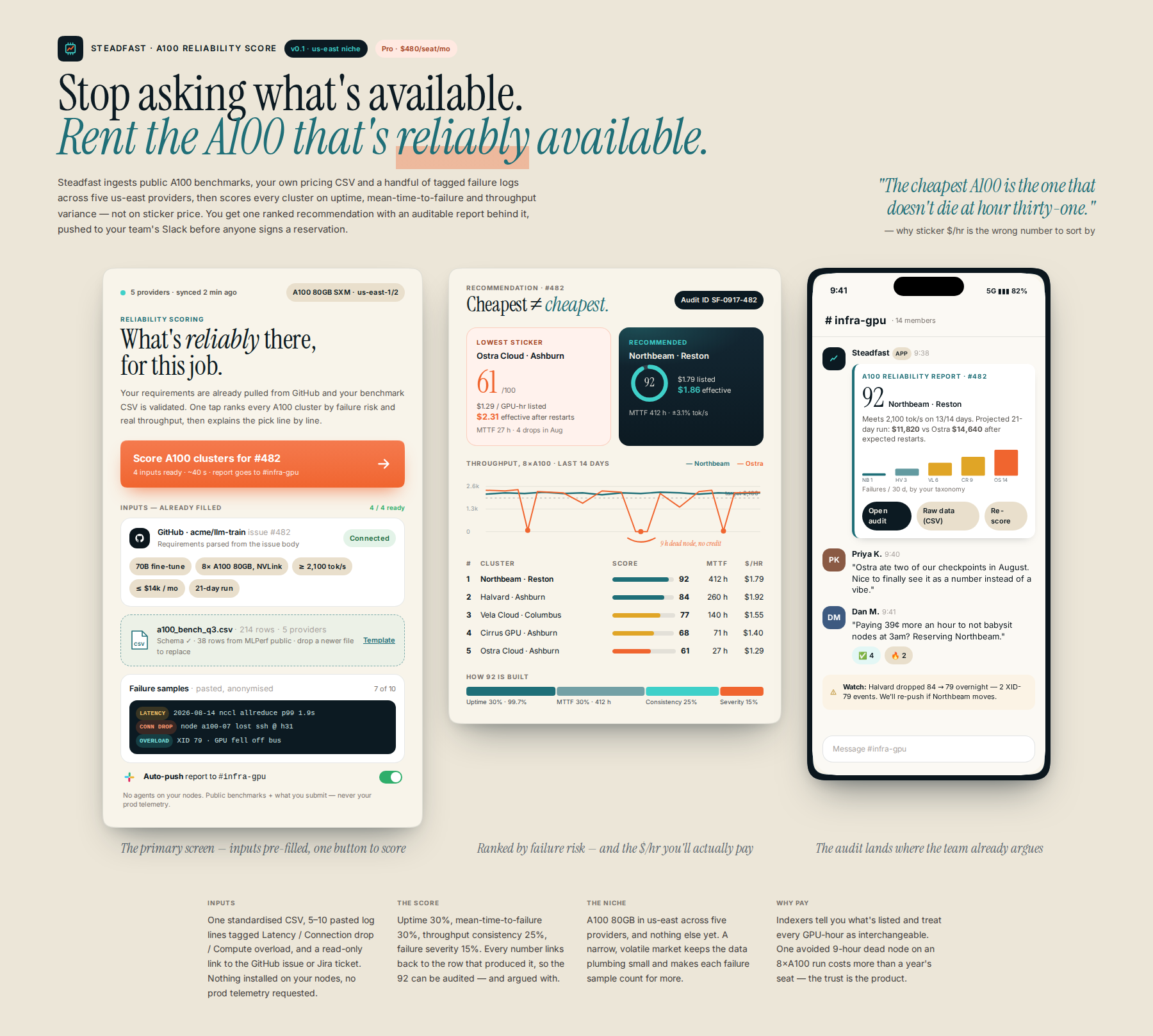
Process flow
Who it's for
AI Infrastructure Builder/Dev
Why they need it
Developers require guaranteed performance and uptime for mission-critical agents, but current indexers only provide raw listings. The inability to trust the reliability of decentralized compute resources (especially high-demand, limited hardware like A100s) makes planning complex, long-running agent workflows prohibitively risky.
What it is
An automated intelligence platform that aggregates and standardizes raw compute data (availability, pricing, logs) from multiple sources, transforming it into a single, proprietary 'Reliability Score' and 'Performance Predictor' focused initially on a single, high-value hardware niche.
How it works
- Niche Focus: Limit the initial scope to a single, high-demand, and historically volatile hardware type (e.g., A100 GPU) in a defined geographic region. This drastically reduces the initial data plumbing complexity.
- Data Ingestion: Build a focused data pipeline to ingest real-time metrics (pricing, utilization, and crucial failure/latency logs) from 3-5 key providers serving this niche.
- Proprietary Scoring: Develop the scoring engine. The 'Reliability Score' will weight factors like historical uptime, mean time to failure, and consistency of throughput, going beyond simple uptime percentages.
- Recommendation: The system ranks and recommends the optimal compute cluster, providing a transparent, auditable report detailing the score and the underlying data that justifies the recommendation.
- Monetization: Charge a premium subscription for access to the proprietary, actionable scores, solving the 'trust' problem.
Differentiation
This is not an indexer (like s1) or a simple comparison tool. Existing solutions fail because they treat compute resources as fungible commodities. We solve the trust and data standardization problem by introducing a verifiable, proprietary 'Reliability Score' derived from analyzing failure modes and historical performance variance. We move the developer from 'What is available?' to 'What is reliably available?'
Implementation sketch
- Define the initial scope: Select the target niche (e.g., A100 GPU in US-East region) and identify the top 3-5 data sources/APIs.
- Build a minimal viable data ingestion pipeline for these 3-5 APIs, focusing only on capturing uptime logs and basic pricing data for the target niche.
- Develop the scoring model prototype: Implement the basic weighted average for the 'Reliability Score' based on the limited, standardized data collected in the previous step.
First step: Identify the top 3-5 APIs/data sources for the chosen niche (A100/US-East) and prototype the data schema required to capture standardized uptime logs and pricing data from all of them. This proves the data plumbing feasibility before writing the scoring algorithm.
Remaining risks
- Market Saturation and Commoditization of the Score — The proprietary 'Reliability Score' is a single point of intellectual property. If a major cloud provider or indexer replicates the methodology (e.g., by offering their own 'Trust Score' based on similar metrics), the core defensibility of the product vanishes, turning the score into a commodity feature.
- Over-reliance on Niche Focus — The current success hinges on the extreme volatility and limited supply of the A100 GPU in a specific region. If the market stabilizes, or if a new, more reliable hardware type emerges (e.g., a next-gen accelerator), the unique pain point that justifies the premium subscription may disappear, leading to a sudden drop in demand.
- Data Pipeline Maintenance Debt — While the initial scope is manageable, the operational cost and complexity of maintaining the data ingestion pipeline across 3-5 external APIs (handling rate limits, schema changes, and API deprecations) is immense. A single failure in data plumbing could render the score inaccurate and unusable, leading to a catastrophic loss of developer trust.
Watch for: If developers begin to utilize the raw data feeds (e.g., querying the raw uptime logs or pricing APIs) directly, rather than relying on the proprietary 'Reliability Score,' it signals that the score is perceived as a mere convenience, not a critical, indispensable layer of trust. Kill criterion: If the cost of maintaining the necessary data pipeline (API access, specialized engineering labor, data storage) exceeds 30% of the projected annual subscription revenue from the current niche, the model is financially unsustainable and must pivot or terminate.
Sources the council used
Real-world evidence that grounded this idea — judge it for yourself.