State-Consistent Orchestration Layer with Execution Memory Graph (EMG)
An autonomous orchestration layer providing a unified, graph-based, and inherently traceable memory state for managing complex, multi-service LLM workflows.
How do you fix brittle, hard-to-debug multi-agent LLM pipelines?
Multi-service LLM workflows fail when context fragments and state gets passed inconsistently between services, producing opaque, non-deterministic errors. An orchestration middleware layer can intercept every LLM call, tool invocation, and database write, logging each as a node in a versioned Execution Memory Graph that serves as the single source of truth for system state. Engineers building complex multi-agent applications can then query the graph to trace why a given state occurred, or rewind and inject corrected context at the exact failure point rather than only debugging after the fact.
Process flow
Who it's for
AI engineers building complex, multi-agent, multi-service LLM applications.
Why they need it
Complex workflows fail due to context fragmentation, inconsistent state passing between services, and opaque failure modes. Current tooling forces developers to bolt together pieces, leading to brittle, non-deterministic, and hard-to-debug systems. (Addresses p1, p2, p4)
What it is
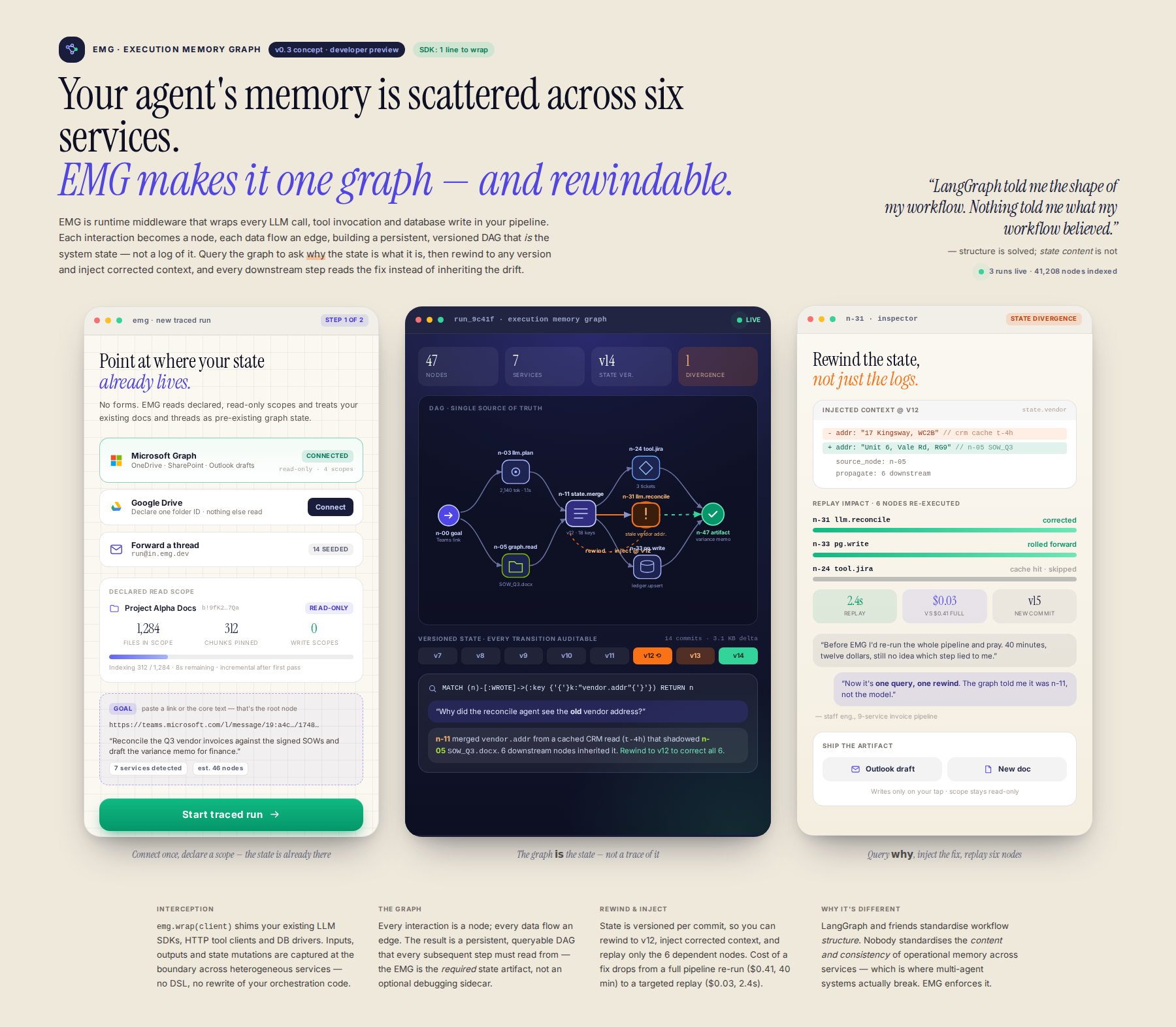
A runtime middleware that wraps all LLM calls and service integrations, mapping the entire execution path, decision points, and memory modifications into a persistent, queryable Directed Acyclic Graph (DAG) representing the 'System State.' This graph becomes the single source of truth for the entire workflow.
How it works
- Unified Interception: The system intercepts inputs, outputs, and state modifications across heterogeneous services (LLM APIs, external tool calls, databases).
- Graph Construction: Each interaction is logged as a node, and the data flow defines the edges, creating a comprehensive Execution Memory Graph (EMG).
- State Recovery & Consistency: Developers can query the graph to understand why the state is what it is (traceability) and can programmatically 'rewind' or inject corrected context at any point to ensure state consistency across the entire pipeline, not just for debugging.
- Versioned State: The EMG is versioned, making state transitions auditable.
Differentiation
Unlike existing frameworks that focus only on defining the structure (e.g., LangGraph), our system standardizes and enforces the content and consistency of the operational memory state across disparate services. We treat the EMG not as a debugging aid, but as the primary, required state artifact that all subsequent steps must read from, solving the systemic state management problem.
Implementation sketch
- Develop a standardized, abstract middleware API hook capable of wrapping calls to various LLM/service interfaces.
- Implement a graph database backend (e.g., Neo4j) to store the versioned Execution Memory Graph (EMG) for each session.
- Build a visualization/API layer that allows developers to query the graph for state lineage, validate state consistency, and programmatically inject corrective state context at failure points.
First step: Build a proof-of-concept middleware hook that successfully wraps only the interaction between a single LLM call (using OpenAI API) and a single external database write (using SQLAlchemy) to generate and persist the initial EMG structure in Neo4j for a single, controlled workflow.
Remaining risks
- The middleware layer becomes an insurmountable integration bottleneck, requiring deep, proprietary knowledge of every LLM/service API it touches, leading to vendor lock-in and unmanageable maintenance overhead. — Scope the MVP to a narrow, well-defined set of initial integrations (e.g., OpenAI + Postgres) and build the abstraction layer using established, open standards (like OpenAPI specifications) rather than attempting universal interception from day one.
- The complexity of the state graph (EMG) itself becomes the primary source of developer confusion, overwhelming the perceived benefit of 'traceability' with excessive noise and cognitive load. — Develop sophisticated, automated state summarization and anomaly detection features that surface only deviations or critical path divergences to the user, rather than presenting the entire raw graph by default.
- The core value proposition—state consistency—is functionally achievable by existing, specialized distributed transaction logging or workflow orchestration tools (e.g., Temporal, Cadence) if the graph visualization is treated as a secondary feature. — Focus marketing and technical documentation on the semantic interpretation of the state graph (the 'why' behind the state change, linking it back to LLM reasoning/prompts) rather than just the state tracking mechanism itself.
Watch for: If initial POC adoption requires the team to spend more than 70% of engineering time building custom wrappers for non-standard APIs, the project scope is too broad. Kill criterion: If a major, established workflow orchestration platform (e.g., LangChain, LlamaIndex) releases a native, standardized, and fully featured state-lineage/graph-versioning mechanism that solves the systemic state consistency problem without requiring external middleware.
Sources the council used
Real-world evidence that grounded this idea — judge it for yourself.