HIPAA Audit Log Validator: Pre-execution Compliance Reporting
A specialized, non-invasive validation service that ingests existing audit logs and workflow artifacts to report, with high fidelity, potential HIPAA violations that would occur if AI agents processed Protected Health Information (PHI).
Can AI safely check medical billing workflows for HIPAA violations before they happen?
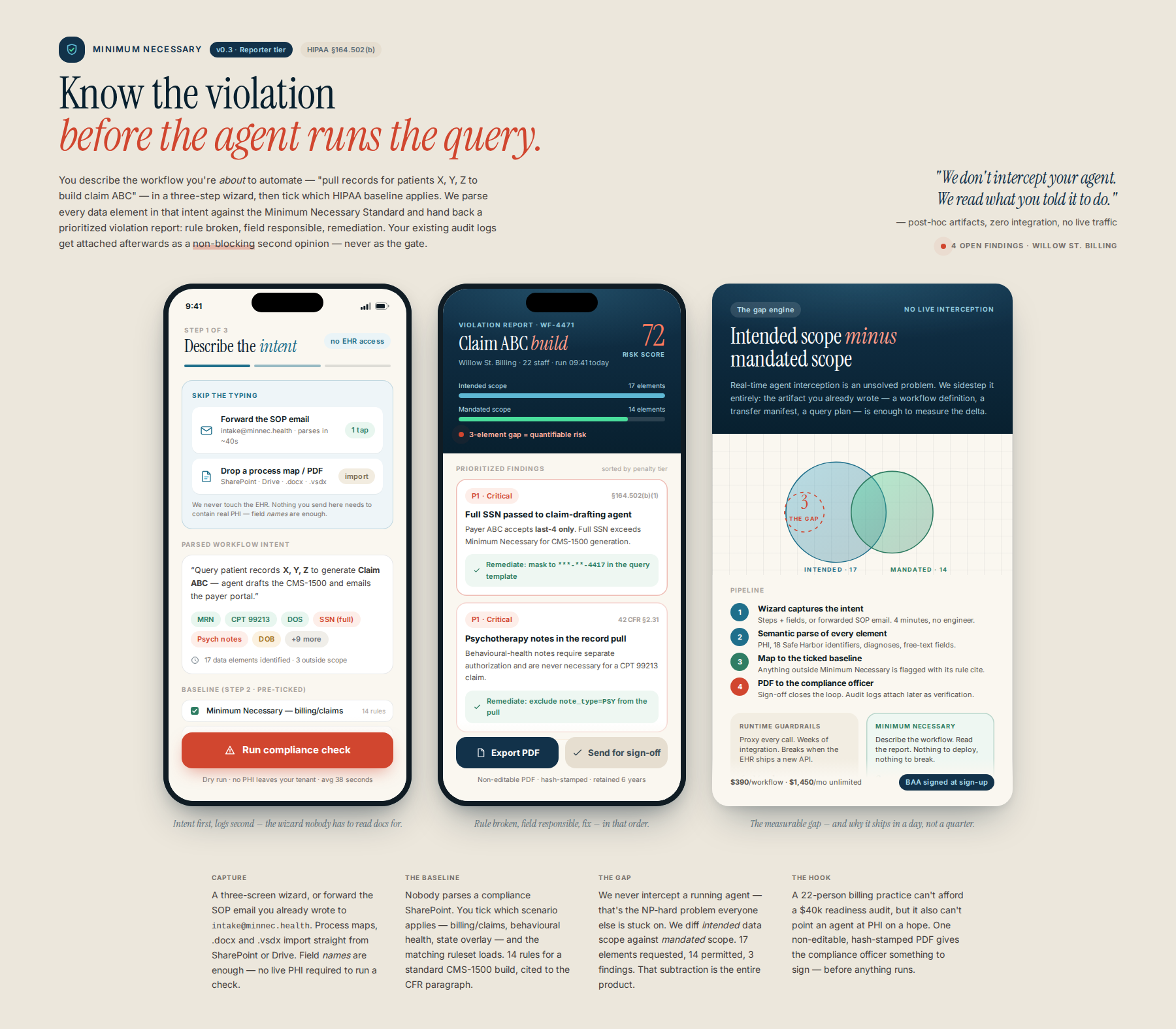
Yes, by analyzing existing audit logs and workflow manifests against HIPAA's Minimum Necessary Standard rather than intercepting live AI agent actions in real time. The system ingests a planned data query or transfer manifest, identifies each PHI data point, flags any that exceed the defined process's necessary scope, and outputs a prioritized violation report requiring compliance officer sign-off. It's built for small to mid-sized medical billing practices and specialty clinics running existing EHR/billing systems.
Process flow
Who it's for
Small to mid-sized medical billing practices and specialty clinics (5-100 staff) with existing EHR/Billing systems.
Why they need it
Current risk management relies on retrospective auditing. When AI agents are introduced, the risk of non-compliance is systemic and immediate. This system shifts the focus from preventing the action (which requires perfect, complex interception) to proving the risk by analyzing the intended action's data footprint against known regulatory mandates.
What it is
A 'PHI Compliance Reporter' module that takes structured or semi-structured audit logs/workflow definitions (e.g., a planned data query or data transfer manifest) as input, semantically parses the data elements against a narrow, pre-defined regulatory baseline (HIPAA Minimum Necessary Standard), and outputs a prioritized, actionable risk report.
How it works
- The client provides a sample audit log or a defined workflow manifest (e.g., 'Query patient records X, Y, Z to generate Claim ABC').
- The Reporter ingests this artifact, identifying all data points (PHI, identifiers, diagnoses).
- It maps these data points against the specialized HIPAA ruleset, flagging any data element that is outside the 'Minimum Necessary' scope for the defined process.
- It outputs a detailed, prioritized 'Violation Report' detailing the specific rule broken, the data point responsible, and the required remediation action, requiring sign-off from the compliance officer.
Differentiation
Unlike general governance tools (e.g., 'b5e9b974ab5acdaa') or basic access control frameworks, this product does not attempt to intercept the live agent execution. Instead, it ingests post-hoc artifacts. This bypasses the NP-hard problem of real-time interception and focuses solely on the measurable gap: comparing the intended data scope against the mandated data scope. The gap is 'Quantifiable Risk Reporting from Existing Audit Artifacts.'
Implementation sketch
- Develop a proof-of-concept ingestor that accepts structured JSON/CSV audit logs mimicking common EHR/Billing system outputs.
- Build the core semantic parsing logic focused only on identifying and classifying PHI elements (Name, DOB, Diagnosis Code, etc.) and their associated metadata (Source System, Destination).
- Create a simple visualization showing the input artifact, the HIPAA rule violated, and the resulting risk score/report.
First step: Identify and download 3-5 sample, anonymized audit log/data manifest samples from 3 different small clinic billing departments (via partnership/consulting) to build the initial data schema for the PoC ingestor.
Remaining risks
- The 'Minimum Necessary' standard is highly context-dependent and often requires deep, nuanced interpretation that cannot be perfectly encoded into a static ruleset or semantic parser, leading to false negatives (missing actual violations) or false positives (blocking legitimate workflows). — Focus initial marketing and sales efforts not on 'perfect compliance,' but on 'risk surface area reduction' by quantifying the potential data leakage based on the type of data present, rather than attempting to prove absolute adherence to every nuance of the law.
- The target buyer (clinic compliance officer) may not have the technical bandwidth or institutional mandate to feed the system consistent, high-quality, structured audit logs/manifests, causing the entire product to stall at the ingestion stage. — Partner with a small EHR/Billing system vendor to embed the ingestion module directly into their existing workflow export/API layer, effectively making the data feed automatic and mandatory for using the vendor's service.
- The perceived value of the report is limited if the client already has access to enterprise-grade GRC (Governance, Risk, and Compliance) tools that offer similar, albeit less specialized, risk reporting capabilities, leading to commoditization. — Deepen the differentiation by integrating a 'Remediation Pathway Suggestion' engine. Instead of just flagging 'Violation X,' the system must suggest the exact compensating control or process change required by HIPAA to fix the data flow, making it a prescriptive operational tool, not just a reporting one.
Watch for: A major, visible shift in HIPAA enforcement guidance or the release of a new, standardized, machine-readable format for audit logs from major EHR vendors. This would signal a change in the required input schema, potentially invalidating the current PoC data model. Kill criterion: If, after securing initial pilot partners, the primary feedback loop indicates that the required input data (audit logs/manifests) is too inconsistent, too proprietary, or too difficult to extract consistently across the top 3 target EHR systems, the core premise of 'ingesting existing artifacts' fails.