
Context Guard: Cost-Auditing Layer for Local Retrieval Prioritization
A specialized, cost-aware utility layer that guarantees RAG context retrieval is sourced locally first. It de-risks high-cost agent workflows by proactively minimizing expensive external API calls, providing measurable, auditable proof of cost avoidance through a dedicated dashboard.
How can I stop RAG agents from racking up unpredictable external API costs?
A cost-auditing layer can enforce local-first retrieval, checking a local cache before any external context query and only falling back to an external call when necessary. It intercepts RAG requests, consults a local memory store first, and logs the decision path to calculate a measurable 'cost avoidance' metric on an auditable dashboard. This targets founders of AI applications whose agent workflows depend on dynamic external retrieval and suffer cost spikes from context sprawl, providing proof of savings rather than just a general optimization claim.
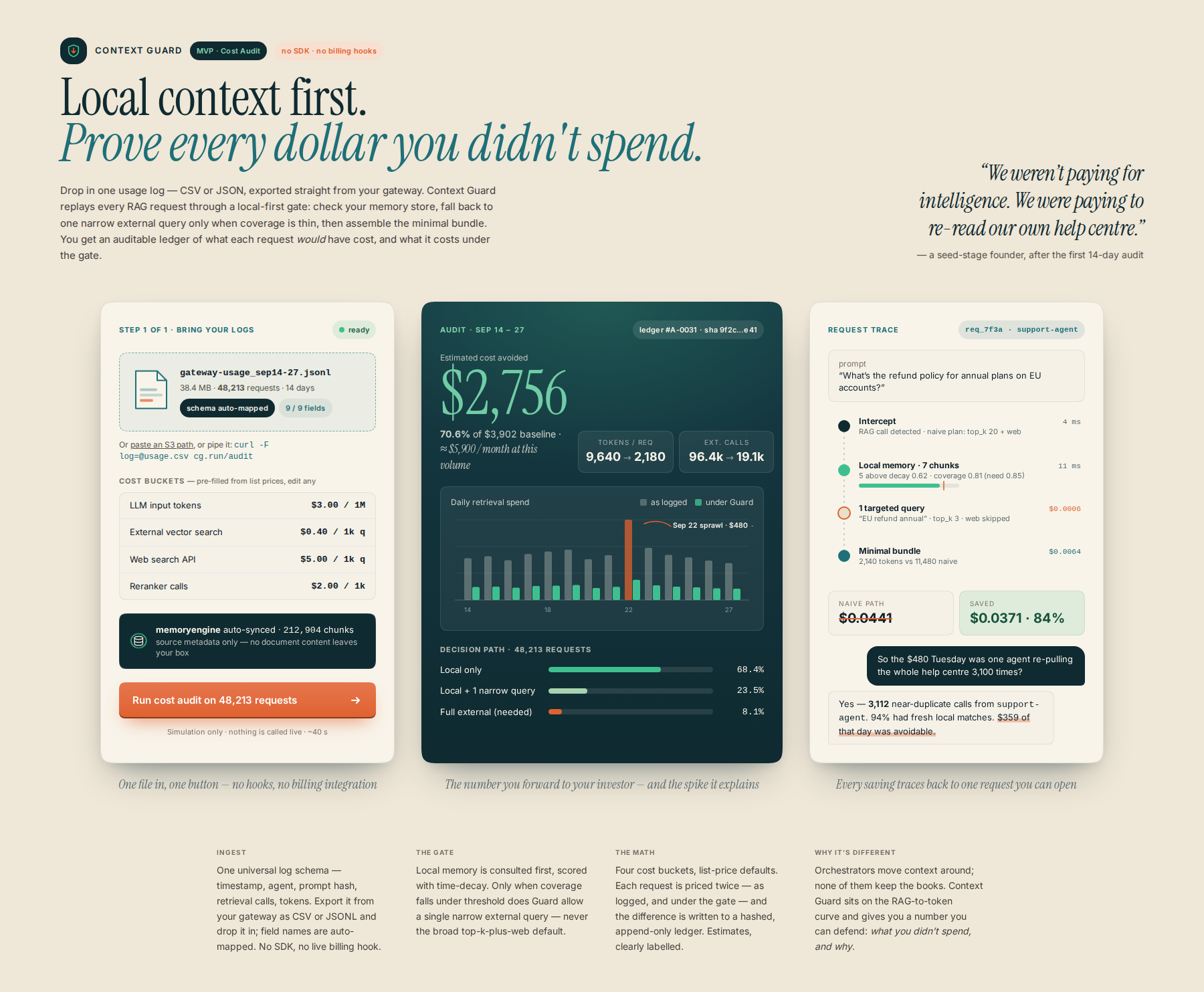
Process flow
Who it's for
Founders of AI-powered applications whose agent workflows rely heavily on dynamic, external knowledge retrieval (RAG) and face unpredictable, high-friction cost spikes due to context sprawl.
Why they need it
The primary pain point is the variable, disproportionately high cost of continuously stuffing complex, external context into LLM prompts. While cost optimization is known, the most immediate, measurable, and technically contained cost sink is the redundant, expensive external API call required for context retrieval. We are tackling 'context sprawl' by proving measurable, guaranteed cost reduction via a local-first strategy.
What it is
A dedicated Context Guard service that intercepts RAG workflows. Instead of relying on complex, high-friction live billing integration, the MVP is a 'Cost Auditing Dashboard' that ingests sample usage logs. It simulates the local-first prioritization: 1) Check local cache/memory. 2) If necessary, perform a targeted external query. 3) Assemble the minimal context bundle and, critically, calculates and displays the estimated cost saved by avoiding unnecessary external API calls.
How it works
- Request Interception: The gateway intercepts a request requiring context retrieval (RAG flow).
- Local Prioritization: It first consults the local, high-speed memory store ('memoryengine'), checking for relevant, time-decayed context chunks.
- Minimal External Query (Fallback): If the local context is insufficient, it triggers a constrained external search query.
- Cost-Aware Simulation: The system then compiles the minimal context bundle and, instead of executing the live call, it records the decision path and calculates the cost difference, providing the client with a concrete, auditable 'Cost Avoidance' metric.
Differentiation
Unlike general orchestration tools (like basic LangChain implementations) that simply manage data flow, Context Guard is a dedicated cost-gate specifically designed around the RAG-to-LLM token expenditure curve. We don't promise full optimization; we promise a measurable, guaranteed reduction in the most common, highest-friction expense: redundant or overly broad context API calls. We fill the GAP of a pre-built, auditable cost-accounting layer that standard workflow managers lack.
Implementation sketch
- Build a Proof-of-Concept API wrapper that accepts a query and a target context source (Vector DB API key).
- Implement the core logic: Check local cache first (mocking success/fail). If a 'miss' occurs, simulate the required external query call but do not execute it live.
- Develop a mock dashboard UI that accepts sample JSON usage logs (Input: Query, Context Used, External Call Made) and runs a simple comparison algorithm to visualize 'Context-Call Success Rate' and 'Estimated Cost Avoidance' (Local Path vs. External Path).
First step: Create a minimal Python script that accepts two lists of context data (Local Cache Hits vs. External DB Calls) and outputs a formatted JSON object summarizing the 'Estimated Token Savings' and 'Cost Avoidance Percentage' by running a simple calculation, proving the core quantitative hypothesis immediately.
Remaining risks
- The cost-optimization narrative is insufficient to overcome fundamental performance requirements (latency/reliability). — The market might prioritize speed or guaranteed uptime over cost savings. If a client's primary pain is 'the agent fails 10% of the time,' a cost-saving utility will be viewed as a secondary feature, not a core necessity. We must maintain a secondary narrative focusing on 'Context Integrity' or 'Guaranteed Context Depth' to provide value beyond just the wallet.
- The 'Local First' pattern is an architectural best practice, not a proprietary secret. Major cloud providers (AWS, GCP, Azure) could absorb this functionality into their core vector/data services, effectively commoditizing the 'Context Guard' pattern and rendering our utility layer a simple, un-differentiated wrapper. — Focus the differentiation not on the pattern (local-first RAG) but on the auditable financial layer and the integration with non-standard, siloed enterprise data sources that current cloud infrastructure cannot natively connect to or cost-model.
- The complexity of the client's internal data governance and access control (RBAC) is underestimated. Even if the context is locally available, the client may have complex, undocumented rules about which users or which workflows are allowed to access which context chunks, making the 'local cache' a compliance nightmare rather than a technical solution. — Treat the first sale as a compliance/governance audit tool, not just a cost-saver. Position the Context Guard as the necessary 'Audit Trail' for context access, solving the regulatory headache before addressing the financial one.
Watch for: If potential clients repeatedly ask 'How does this improve the failure rate or latency?' before asking about cost savings, it signals that the market views the problem as a performance/reliability issue, not a financial one. Our entire pitch must immediately pivot to address the performance metric. Kill criterion: If the target user base refuses to share any sample usage logs or mock data for the Cost Auditing Dashboard, it indicates a fundamental lack of trust in our ability to accurately model their internal, proprietary data flow, and the concept cannot move past the theoretical stage.