
Guardrails: GPU Compute Quota Enforcement for Enterprise Agents
A centralized SaaS platform that enforces and budgets multi-tenant AI agent execution by metering and gating usage based on a single, critical resource: GPU compute time, providing predictable and auditable resource governance.
How can enterprises stop one AI agent from burning through the shared GPU budget?
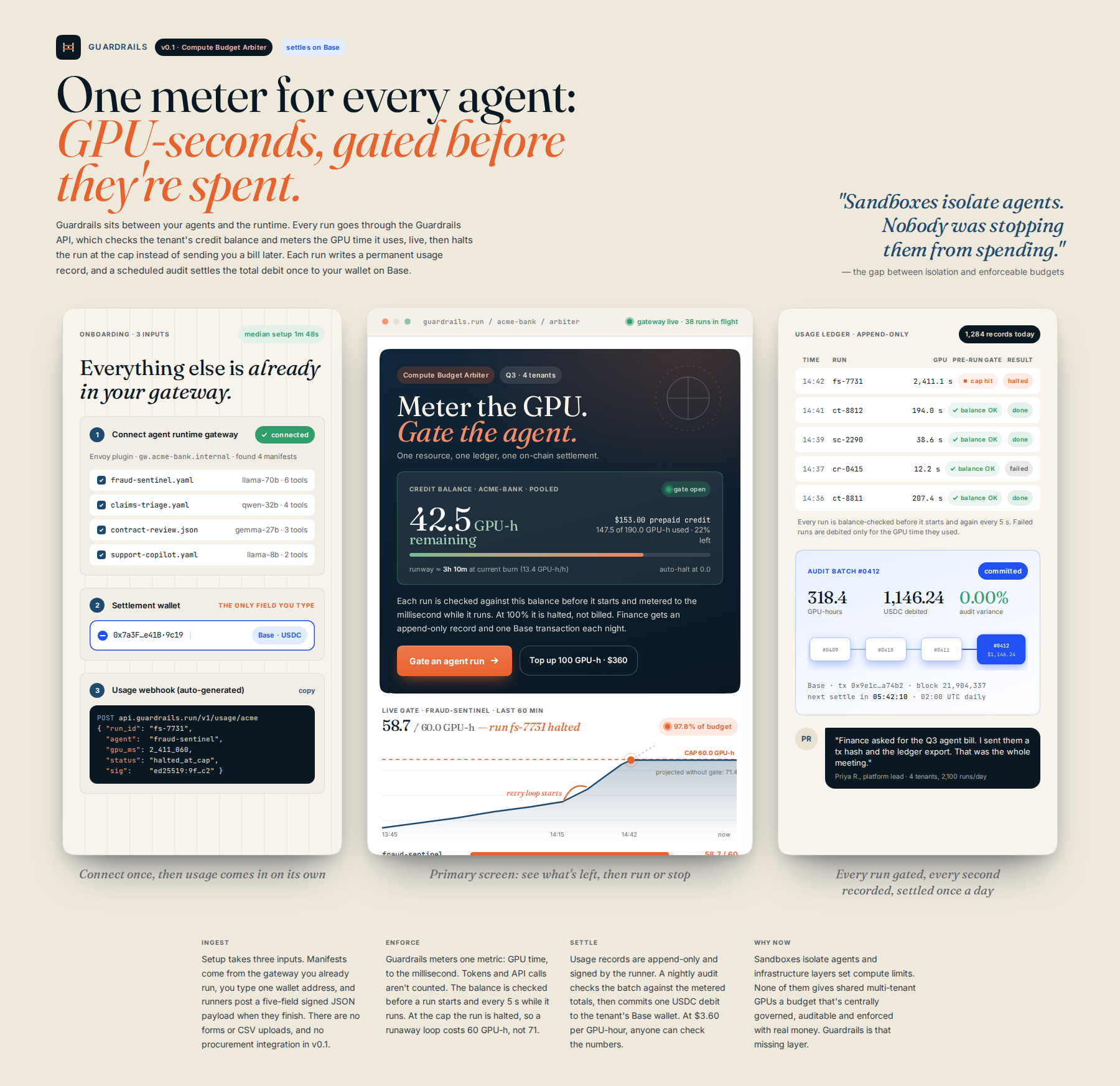
A centralized quota-enforcement layer sits between agent runtimes and compute, metering GPU compute time in real time against pre-purchased credits before execution proceeds. It checks the live balance via an API gateway, logs each session's usage as an immutable record, and reconciles totals on a schedule, with optional on-chain settlement of the debit. This gives multi-tenant enterprise teams auditable, per-project resource isolation on shared infrastructure without relying on after-the-fact billing reports.
Process flow
Who it's for
Multi-tenant enterprise teams running complex, mission-critical AI agents on shared infrastructure.
Why they need it
Large enterprises require guaranteed resource isolation and accountability. They cannot risk one rogue project consuming the entire shared pool of expensive compute resources (like GPU time) allocated to the organization, necessitating a verifiable, consumption-based quota system.
What it is
A SaaS platform called 'Guardrails' that acts as the Compute Budget Arbiter. It sits between the user and the agent runtime, enforcing real-time quotas by tracking a single, quantifiable metric (GPU Compute Time) and managing a centralized credit ledger before committing to any final financial settlement.
How it works
- The developer defines an agent workflow and pre-purchases a compute budget (credits).
- The system calls the agent runner, which first passes through the Guardrails API.
- Guardrails verifies the active credit balance and measures only the GPU Compute Time consumed in real-time against the allocated budget.
- Upon completion or failure, the system logs the immutable usage record.
- At a scheduled interval, Guardrails audits the recorded usage and commits the total debit amount to the user's linked wallet on the Base chain.
Differentiation
Existing sandboxes provide isolation, and foundational layers provide compute boundaries, but they lack a unified, auditable, and economically enforceable resource quota system. Guardrails fills the GAP of 'Real-time, centralized-governance, quota enforcement for a single, high-value resource (GPU Compute Time), with optional on-chain final settlement.'
Implementation sketch
- Define the core usage data schema (usage_id, agent_id, start_time, end_time, total_gpu_seconds, cost_rate) for the centralized ledger.
- Develop a mock API Gateway endpoint that accepts agent requests and performs a synchronous credit check against a centralized in-memory ledger (Phase 1 MVP).
- Build a simple resource profiler wrapper around the sandbox runner that outputs only the total elapsed GPU compute time for billing purposes, ignoring other complex metrics.
- Develop the nightly reconciliation script that consumes the usage ledger and generates the formatted transaction payload for the smart contract settlement (Phase 2).
First step: Create a detailed technical specification (Swagger/OpenAPI) for the 'Usage Ledger' API endpoint, defining the exact JSON payload required to log a single usage session (start/end time, and the single metric: GPU seconds). This is the single most critical artifact to begin development.
Remaining risks
- Vendor Lock-in and Integration Friction (Market Risk) — Focus initial sales efforts on a niche group of early-adopter, multi-cloud or AI-native startups that are actively trying to avoid reliance on single cloud vendors. Build robust, standardized APIs that allow the usage ledger to be easily swapped out for different backend infrastructure providers, maintaining vendor neutrality.
- The 'Billing Arbiter' Dilemma (Operational Risk) — The system's value proposition is that it sits between the user and the compute. If the core compute environment (the sandbox runner) is developed or adopted by a major cloud provider, that provider may simply embed the quota/billing feature directly into their native service, making Guardrails an unnecessary, redundant layer.
- Over-reliance on Single Metric (Scope Risk) — While limiting scope to GPU time is smart, the market may quickly realize that 'GPU time' is insufficient. The risk is that the single metric becomes the only metric, and the next necessary feature (e.g., memory leakage detection, specific API call governance) forces a massive, unplanned scope expansion that breaks the current simplicity.
Watch for: If major cloud providers (AWS, GCP, Azure) announce a new, native feature that explicitly solves 'multi-tenant resource governance for AI agents' using a centralized, auditable billing layer, the market signal suggests the need for an external arbiter is diminishing. Kill criterion: If the first five pilot enterprise clients require the system to integrate with a billing/quota model that is fundamentally different from the centralized credit ledger model (e.g., requiring direct integration with a non-standard internal ERP or accounting system), it indicates the current abstraction layer is too rigid for enterprise reality.
Sources the council used
Real-world evidence that grounded this idea — judge it for yourself.