
AI Methodological Declaration Middleware for Academic Publishing
A middleware plugin that integrates into existing journal submission APIs to enforce a standardized, mandatory declaration of AI usage, transforming academic compliance from a content audit into a procedural metadata validation step.
How can academic journals verify AI usage disclosures without manually auditing manuscripts?
By enforcing AI-use declarations as structured metadata at the submission API level rather than reviewing manuscript text for compliance. A middleware layer intercepts journal submissions and validates a required JSON/YAML package listing the AI tool used, its function (e.g., outline generation), and a categorical effort declaration, rejecting incomplete submissions before they reach editorial workflows. It's built for platforms like ScholarOne and Editorial Manager, plus university research offices, turning AI compliance into a procedural check rather than content forensics.
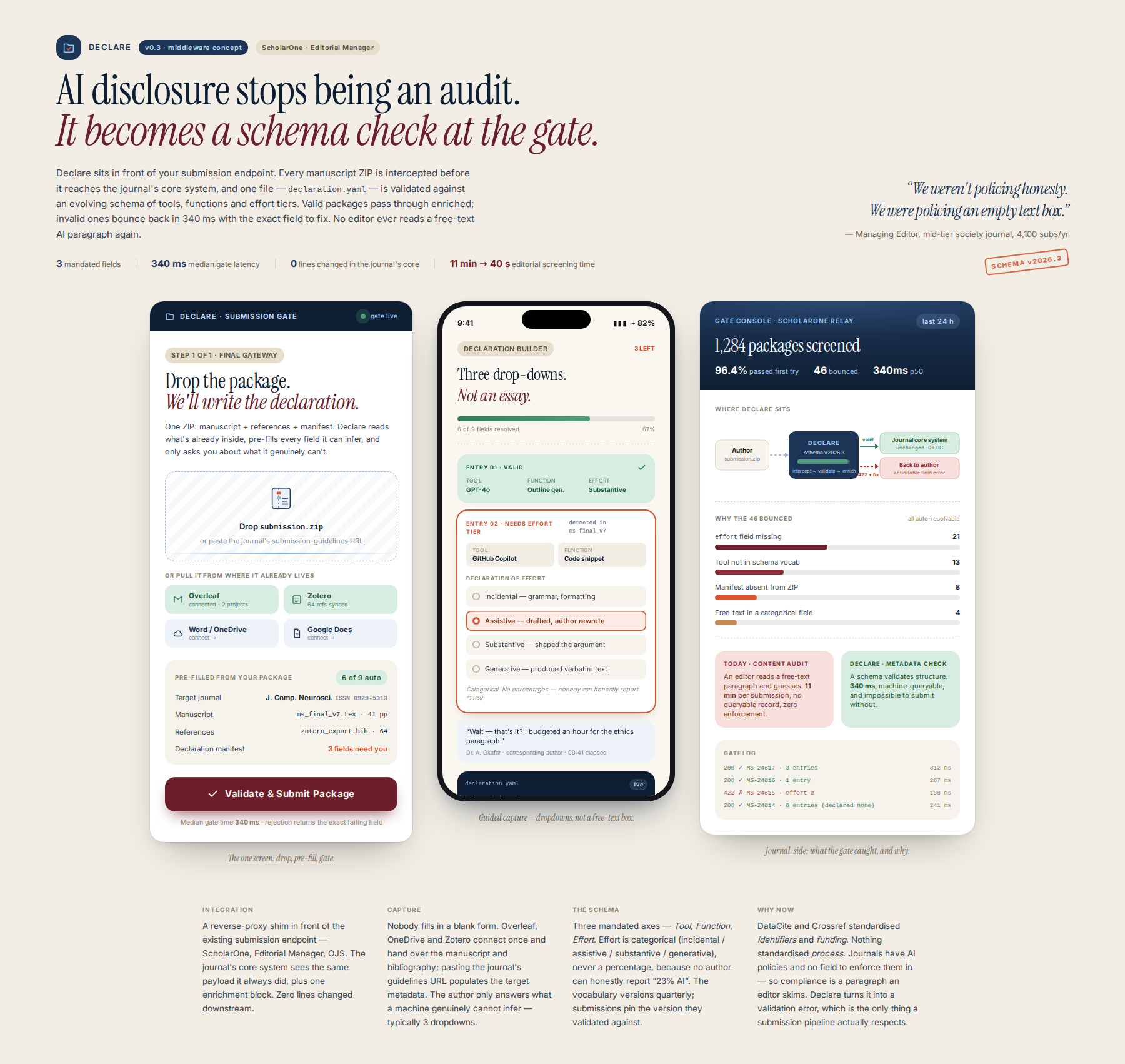
Process flow
Who it's for
Major academic journal platforms (e.g., ScholarOne, Editorial Manager) and university research departments.
Why they need it
The academic industry requires a standardized mechanism to manage AI-generated content risk. By integrating as a middleware, we solve the adoption problem by working within established, risk-averse workflows, rather than attempting to create a new, standalone standard.
What it is
A submission companion package validated by a middleware layer. This package mandates structured metadata detailing: 1) Tool Used (e.g., GPT-4, Copilot), 2) Function (e.g., Outline Generation, Code Snippet), and 3) Declaration of Effort (a categorical assessment, not a percentage).
How it works
- The middleware intercepts the submission data before it hits the journal's core system.
- It validates the presence and structure of the required JSON/YAML declaration package.
- It checks the declaration against a predefined, evolving schema of acceptable metadata fields.
- If valid, it passes the enriched submission package to the journal's existing workflow; if invalid, it rejects the submission with actionable feedback.
Differentiation
Unlike existing metadata standards (e.g., DataCite, Crossref) which focus on identifiers or funding, this solution focuses specifically on process compliance. It is a specialized middleware layer designed to validate the methodology declaration, addressing the gap where current systems lack a mandated, structured field for AI usage reporting.
Implementation sketch
- Develop a proof-of-concept middleware service simulating the API calls of two major journal platforms (e.g., ScholarOne/Editorial Manager).
- Define the minimal viable JSON schema for the 'Methodological Declaration' package, focusing only on Tool/Function/Category (avoiding subjective percentages).
- Build the validation logic to enforce structural integrity and completeness of the declaration package against the simulated API endpoint.
First step: Identify the public-facing API documentation (or known integration points) for the two largest academic journal management systems (e.g., ScholarOne, Editorial Manager) and map out the required data payload structure for a 'submission metadata attachment'.
Remaining risks
- API Integration Lock-in and Vendor Dependency: The entire model relies on integrating with proprietary, closed, and often poorly documented APIs of major journal platforms (e.g., ScholarOne, Editorial Manager). If these platforms change their internal APIs, deprecate endpoints, or refuse third-party middleware access, the product becomes instantly obsolete or requires prohibitively expensive re-engineering. — Develop a robust abstraction layer or 'API Gateway' wrapper around the middleware logic. This layer should isolate the core validation schema from the specific API calls, allowing the business logic to remain stable even if underlying platform APIs change.
- Adoption Inertia and Workflow Friction: Even if the middleware is technically sound, academic workflows are deeply ingrained and highly resistant to change. Journals and departments may prefer to use existing, imperfect compliance mechanisms (e.g., manual checklists, existing funding disclosures) rather than adopting a new, mandatory, and complex middleware step, viewing it as unnecessary friction. — Focus initial pilots on a niche, high-stakes area (e.g., grant-funded research or multi-institutional collaborations) where the risk of non-compliance is already high enough that journals are actively seeking a mandatory enforcement point, rather than trying to replace general submission steps.
- Scope Creep into Content Auditing: The temptation to 'improve' the product by adding more sophisticated checks—such as attempting to validate the quality or degree of the declared effort (e.g., moving from 'Outline Generation' to 'How much of the outline was AI-generated?')—will inevitably pull the project back into the technically intractable and adversarial territory of content forensics, leading to massive delays and technical overreach. — Enforce a strict, non-negotiable scope boundary: the middleware only validates the structure and presence of the declaration package against the schema. Any discussion of content analysis must be deferred to a V2 or V3, and the core MVP must resist this temptation.
Watch for: Any indication from major journal platforms (or academic bodies) that they are developing or partnering with a universal, open-standard metadata submission format for AI usage, as this would render the middleware's proprietary integration effort obsolete. Kill criterion: If the target journal platforms refuse to provide any technical documentation or sandbox environment for integration testing, or if the required integration points are found to be entirely internal and inaccessible to third-party tooling.