
Secure Inter-Agent Protocol for Attested Edge Workflows
A specialized, middleware protocol layer that enables multiple, specialized AI agents to communicate and collaborate securely within existing hardware-enforced Trusted Execution Environments (TEEs) on edge devices, guaranteeing verifiable data isolation for regulated workloads.
How do I guarantee secure data isolation between AI agents on edge devices?
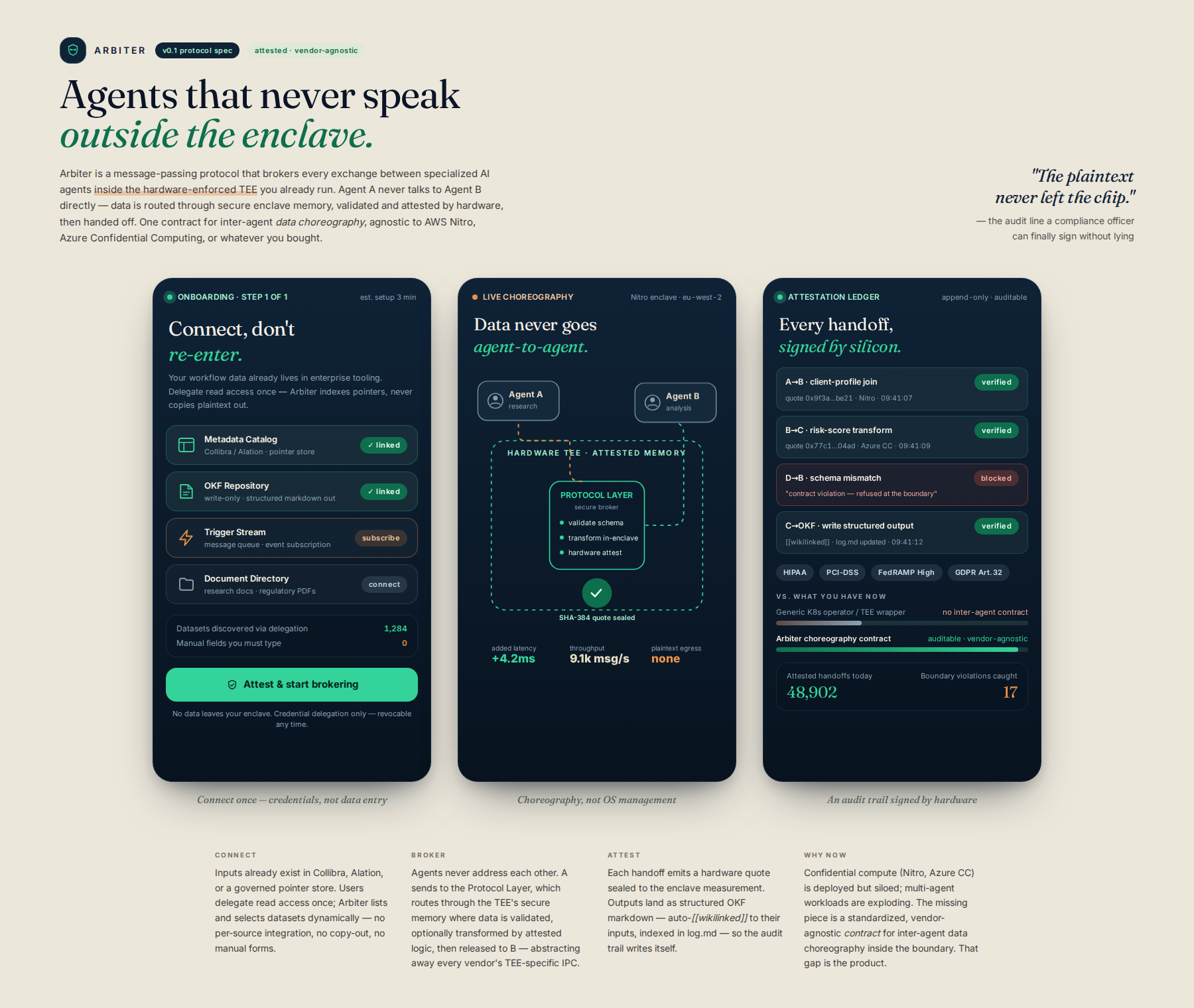
A middleware protocol layer enforces verifiable data isolation by routing inter-agent communication through hardware-enforced Trusted Execution Environments (TEEs). All data exchange is processed and validated within the TEE boundary before being passed between agents, providing cryptographic attestation. This guarantees sensitive data never leaves the secure perimeter—essential for regulated industries like finance and healthcare requiring provable separation of computational assets.
Process flow
Who it's for
Financial institutions, healthcare providers, and defense contractors utilizing existing confidential computing infrastructure (e.g., AWS Nitro, Azure Confidential Computing).
Why they need it
Regulators demand verifiable proof that sensitive data never leaves a defined boundary. Standard containerization fails to provide this guarantee against side-channel attacks. The pain point is the 'audit failure risk' stemming from inadequate, non-attested inter-agent communication channels.
What it is
A standardized, message-passing protocol layer that mandates that all data exchange between agents must be processed, validated, and attested within the boundaries of a hardware enclave, abstracting away the complexity of TEE-specific IPC mechanisms.
How it works
The system acts as a secure broker. Instead of agents talking directly, Agent A sends data to the Protocol Layer. The Protocol Layer routes this data through the TEE's secure memory, where it is validated and potentially transformed by the TEE's attested logic before being passed to Agent B. This moves the focus from 'OS management' to 'secure data choreography.'
Differentiation
Unlike general-purpose local runtimes or cloud services (e.g., existing Kubernetes operators or basic TEE wrappers), this protocol defines the workflow contract for multi-agent interaction within an attested boundary. The gap is the lack of a standardized, auditable mechanism for inter-agent data choreography that is agnostic to the specific TEE vendor, allowing integration across multiple existing hardware providers.
Implementation sketch
- Develop a minimal proof-of-concept service that simulates the TEE boundary (using local process isolation for initial testing) to enforce a strict 'message validation and routing' sequence between two simulated agents.
- Define and implement the core message structure and serialization/deserialization logic for the secure IPC layer, focusing on metadata attestation (source/destination/integrity hash) rather than raw data transfer.
- Create a simple compliance report generator that logs the successful passing of data through the simulated TEE boundary, proving the defined protocol contract was met.
First step: Select one specific, publicly documented TEE SDK (e.g., an Intel SGX sample) and write a minimal 'Hello World' function that successfully passes a structured JSON payload between two separate enclaves, focusing only on the IPC mechanism, ignoring the complex LLM logic for now.
Remaining risks
- Vendor Lock-in and Interoperability Debt — The reliance on TEEs, while necessary for security, forces dependency on specific silicon vendors (Intel, AMD, ARM). The mitigation must be to abstract the protocol layer above the TEE SDKs, ensuring the defined 'workflow contract' (the protocol) remains vendor-agnostic, even if the underlying implementation requires vendor-specific wrappers.
- The 'Protocol Contract' is insufficient for complex reasoning — The current focus is on secure data transfer (choreography). The risk is that real-world multi-agent reasoning requires stateful, iterative computation that cannot be cleanly broken down into discrete, attested message passes. We must validate that the protocol can support complex, multi-step state management (e.g., Agent A computes X, passes state Y, Agent B modifies Y based on Z, and the final result is attested) without violating the stateless nature of the secure channel.
- Compliance Over-specification vs. Actual Need — The solution is designed to satisfy the most stringent compliance requirements (HIPAA, etc.). However, the market might only need assurance for a less severe regulatory risk. The mitigation is to develop a tiered compliance reporting module that allows customers to select the required level of attestation (e.g., 'Level 1: Data at Rest' vs. 'Level 3: Inter-Agent Computation Traceability') to reduce perceived complexity and adoption friction.
Watch for: Any industry partner or compliance officer expressing skepticism about the cost or overhead of running the mandated attestation/validation steps on the live data path, rather than just the theoretical security benefit. Kill criterion: If a major cloud provider (AWS/Azure/GCP) releases a native, fully managed, and easily consumable service that provides the exact 'inter-agent data choreography' protocol layer with comparable or better performance metrics than the proposed middleware, the core differentiation value is immediately neutralized.