
Standardized Compute Proof Aggregation Layer for Agent Settlement
A standardized abstraction layer that aggregates and optimizes verifiable computation proofs (e.g., ZK-proofs) generated by diverse agent compute environments, enabling reliable, low-latency settlement for agentic transactions.
How can AI agents verify that computation was actually done correctly before paying for it?
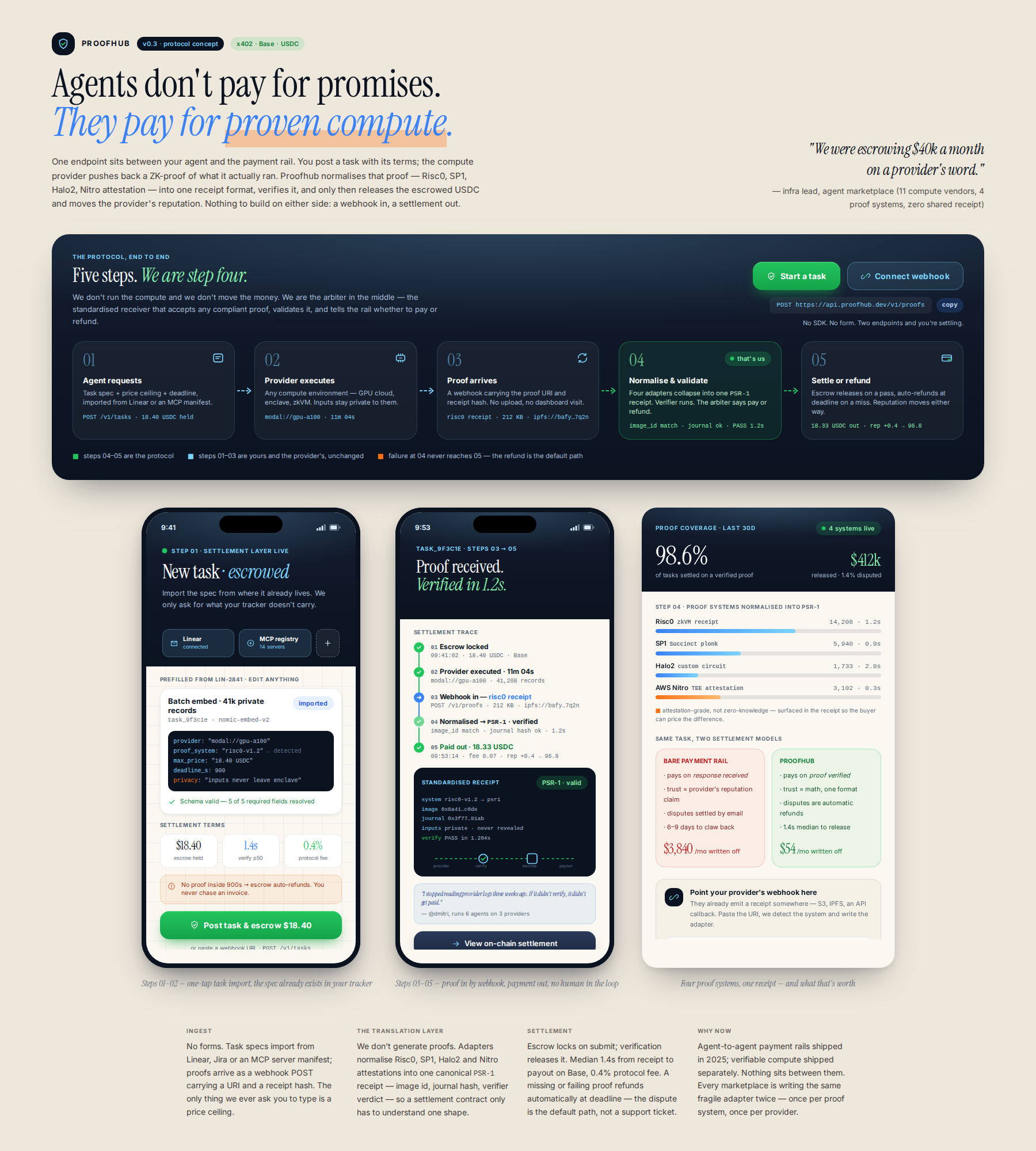
A standardized proof aggregation layer sits between agent execution environments and payment rails, accepting and normalizing ZK-proofs and other verifiable computation outputs into a canonical format for settlement. When a compute provider finishes a task, it submits a proof of correct execution; the protocol validates the proof's structure, releases payment automatically on success, and triggers a refund or dispute if validation fails. It's built for developers monetizing AI agents, MCP servers, and compute providers who need trustworthy, low-latency settlement without building their own proof system.
Process flow
Who it's for
Developers building and monetizing AI agents, MCP servers, and compute providers who need to reliably transact value based on verified computational output.
Why they need it
The current state requires agents to use ad-hoc payment rails and struggle with verifying the integrity of computation across disparate environments. The convergence of autonomous agents and commerce demands a standard way to certify that work was done correctly, without needing to reinvent the proof mechanism itself.
What it is
An infrastructure protocol that sits between agent execution environments and decentralized payment rails. Its core function is not to create the proof, but to act as the standardized receiver and aggregator for proofs of computation integrity (like ZK-proofs) to guarantee settlement.
How it works
- An Agent submits a transaction request (Task X) to the protocol, specifying cost/payment terms.
- The protocol initiates the request to the compute provider/environment.
- The compute provider executes Task X and generates a verifiable proof (e.g., ZK-SNARK proving the correct computation on private data).
- The protocol receives and validates this standardized proof format, acting as the trust arbiter.
- Upon successful validation of the proof, the protocol releases payment to the service provider and adjusts reputation scores. Failure triggers an automated refund/dispute mechanism.
Differentiation
Unlike existing payment rails focused on asset movement, our protocol specializes in 'Computational Proof Settlement.' We are not building the underlying compute or the core payment rails; we are building the universal translation and aggregation layer that accepts and verifies proofs from any compliant compute environment, solving the interoperability and trust gap between diverse verifiable computation standards.
Implementation sketch
- Develop a smart contract skeleton on Base/Solana focused on proof submission/validation state tracking.
- Build an off-chain service layer capable of accepting and normalizing various proof formats (e.g., ZK-proofs, verifiable computation outputs) into a canonical transaction structure.
- Prototype the 'Proof Aggregator' module: a standardized interface that validates the mathematical structure of incoming proofs against required computational parameters, abstracting away the underlying compute details.