
Budget-Constrained Fallback Executor
A specialized infrastructure layer that guarantees an agent workflow completes within a user-defined, non-negotiable cost ceiling by executing a prioritized, deterministic fallback path upon initial budget breach.
How can I guarantee my AI agent workflow never exceeds a hard API cost limit?
A budget-constrained execution layer enforces a non-negotiable cost ceiling by running a prioritized model path and monitoring spend at each step; if cost exceeds the set threshold, it immediately halts and switches to a pre-selected low-cost fallback (like a fine-tuned local model or cheap API endpoint) rather than failing the task. This targets founders of AI-powered apps with hard SLA cost requirements, where overspending or service failure causes direct revenue loss. It differs from general cost optimizers by guaranteeing deterministic budget adherence and logging the exact cost and reason for each fallback trigger.
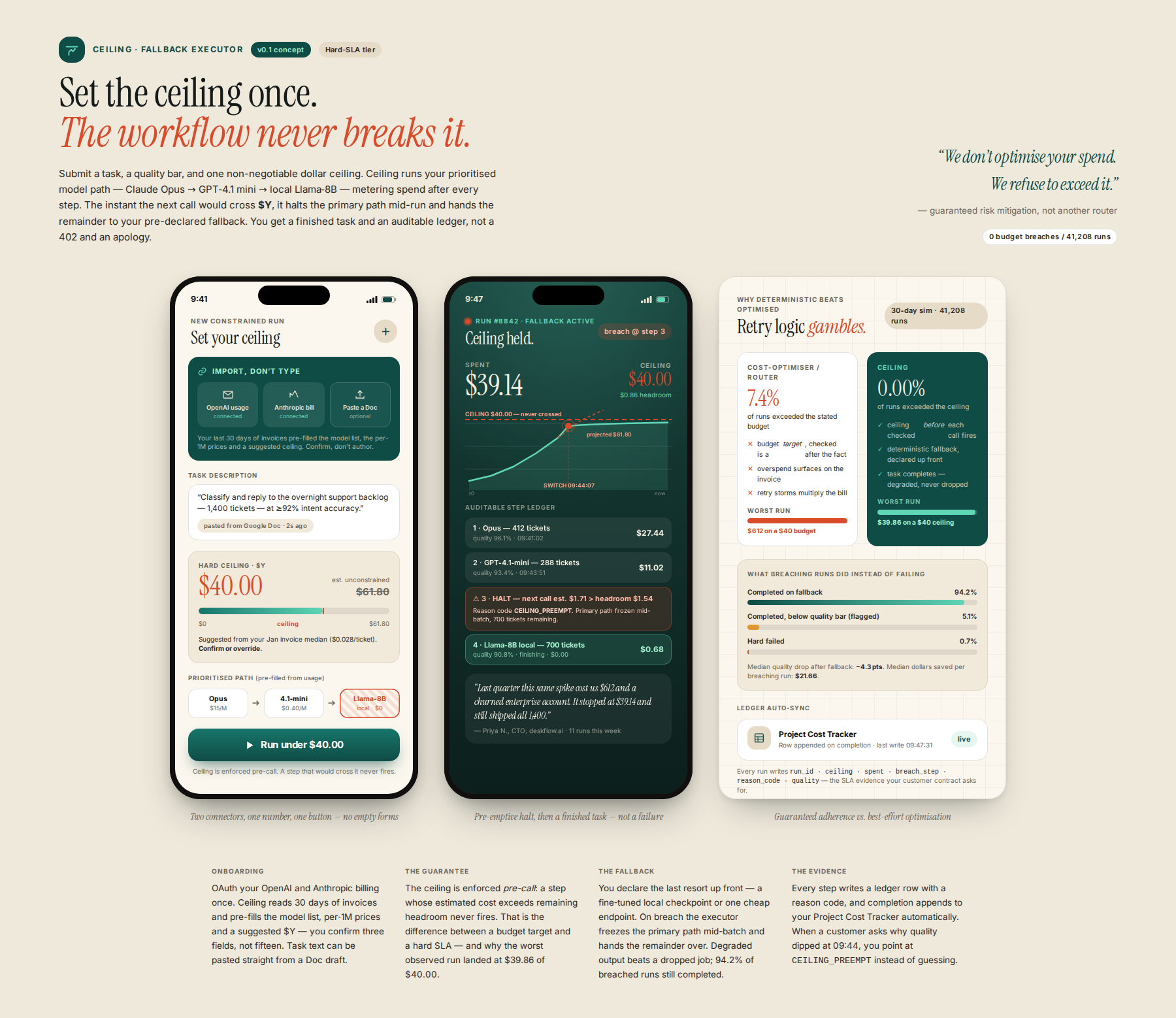
Process flow
Who it's for
Founders of AI-powered apps where operational budget adherence is a hard SLA requirement, and where failure to stay under cost limits causes immediate revenue loss.
Why they need it
The primary pain point is not just cost optimization, but cost risk. Current systems optimize across variables, but they fail to provide a deterministic guarantee of budget adherence. A single unexpected API call or model choice can blow the budget, leading to service failure.
What it is
A constrained execution layer that accepts a task, a set of acceptable models, and a hard budget threshold ($Y). It executes a pre-defined, prioritized path, and if the cost exceeds $Y at any step, it immediately halts and executes a guaranteed, low-cost fallback mechanism (e.g., a fine-tuned local model or a specific, cheap API endpoint) instead of failing entirely.
How it works
- Agents submit a high-level task description, a required performance/quality threshold, and a hard budget constraint ($Y).
- The Engine executes the workflow along a prioritized path (Model A → Model B → Fallback Model) until the required output is achieved or the cost exceeds $Y$.
- If the cost exceeds $Y$ during the primary path, the system immediately switches to the pre-selected, low-cost fallback model/endpoint for the remainder of the task, ensuring operational continuity while respecting the budget.
- It provides granular, auditable logs detailing the cost incurred at each stage and the exact reason for fallback activation.
Differentiation
We shift from 'optimization' to 'guaranteed risk mitigation.' Existing tools are wrappers or general optimizers. Our gap is the deterministic fallback mechanism. We solve the 'what if' scenario: 'What if the primary path overspends?' We guarantee budget adherence first, and if the budget is breached, we do not fail; we automatically transition to a known, low-cost, high-reliability fallback model/endpoint (e.g., a fine-tuned local model or a specific open-source checkpoint) to complete the task within the hard constraint, which is superior to simple failure/retry logic.
Implementation sketch
- Build a proof-of-concept service wrapper that accepts a task, a hard budget, and a fallback policy (e.g., local model endpoint).
- Integrate API hooks to fetch current pricing for the primary model set (e.g., GPT-4o, Claude 3 Opus) and the designated fallback model.
- Develop the core deterministic execution logic: Execute path 1 $\rightarrow$ Check Cost $\rightarrow$ If Cost $\le$ Budget, Success. Else $\rightarrow$ Execute Fallback Path and report final cost.
First step: Select the lowest-cost, highest-reliability fallback model (e.g., a specific Llama 3 8B endpoint) and build a minimal service wrapper that can execute a simple, fixed-length prompt against it, logging the latency and cost for a known input size.
Remaining risks
- The fallback model, while cheap, might be incapable of handling the complexity of the task that the primary, expensive model was intended for, leading to a functionally useless but cost-compliant output. — Implement a quality gate check after fallback activation. If the output from the fallback model fails to meet a minimum structural or semantic coherence score (measured against the initial prompt's required output format), the system should escalate to a 'Requires Human Review' state rather than passing a low-quality result.
- The initial cost estimation for the primary path (Model A $ ightarrow$ Model B) is based on assumptions about token usage or required steps. If the task requires more steps or generates significantly more tokens than anticipated, the fallback mechanism might be triggered too late, or the initial cost check itself might fail due to unforeseen API rate limits. — Refine the initial cost check to be a 'pre-flight simulation' that estimates the maximum cost for a defined, constrained number of steps (e.g., 3 calls maximum) rather than relying on a single upfront estimate. This forces the system to account for multi-step budget exhaustion proactively.
- The 'hard SLA requirement' target market (enterprise) may prefer integrating this logic into their existing orchestration frameworks (e.g., LangChain, proprietary internal tools) rather than adopting a new, external, mandatory middleware layer, leading to adoption friction. — Develop a clear, well-documented SDK/plugin interface that allows existing orchestration frameworks to 'wrap' the Executor's logic, rather than forcing the user to rebuild their entire workflow around the Executor's API calls.
Watch for: A major, high-profile enterprise customer publicly stating that their current internal tooling (even if complex) is sufficient for their risk profile, or if they only express interest in the cost dashboarding feature without engaging with the fallback mechanism. Kill criterion: If the cost of maintaining the real-time pricing oracle/API integration layer (including maintenance overhead for rate limit changes) exceeds 30% of the projected revenue from the first 5 paying customers, the model should pivot to a pure SaaS dashboard/monitoring tool.