
Stateful Agent Workflow Execution Engine (MVP)
A specialized, verifiable compute engine designed to reliably execute complex, stateful, multi-agent workflows for critical industrial use cases. We solve the 'failure-to-completion' problem in advanced AI systems by guaranteeing the successful execution of high-value pipelines.
Why do multi-step AI agent workflows fail partway through in enterprise settings?
They fail because generalized compute resources lose state, hit model version mismatches, or lack retry logic mid-pipeline, turning a single error into hours of wasted human and machine time on regulated tasks like legal review. A dedicated execution engine addresses this by running a defined Workflow Schema inside a sandboxed, managed cluster that handles resource handoffs, failure retries, and atomic state commits, billing only on guaranteed successful completion. It targets enterprise legal, compliance, and R&D teams that need repeatable execution of high-cost, multi-agent processes rather than raw compute time.
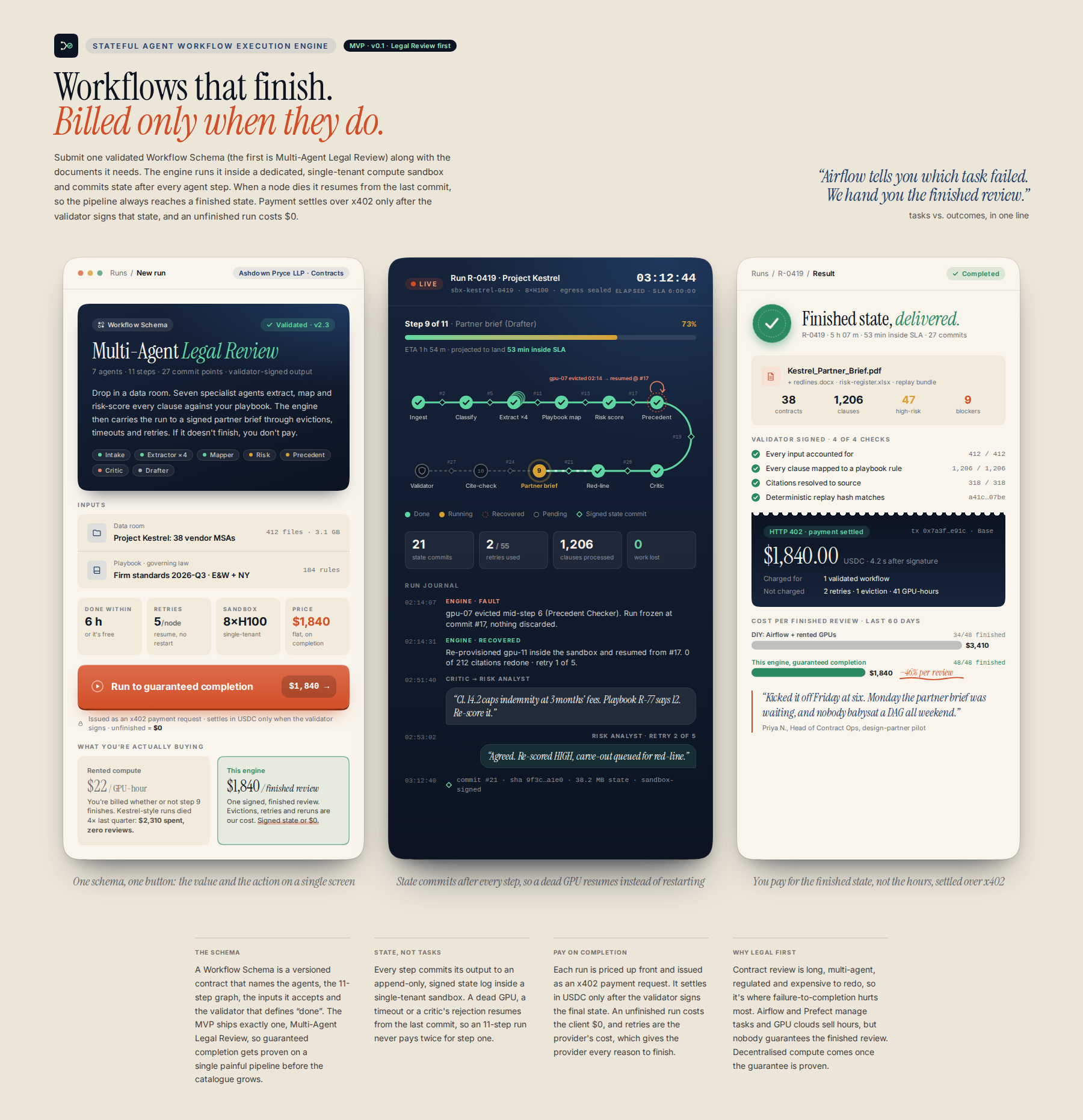
Process flow
Who it's for
Enterprise legal firms, financial compliance departments, and R&D teams requiring guaranteed, repeatable execution of multi-step AI processes for regulated or high-cost tasks.
Why they need it
Current generalized compute resources fail when complex AI agents encounter resource incompatibility, state loss, or specific model version dependencies during multi-step execution. These failures are not theoretical; they represent measurable, high-cost operational delays (e.g., a failed legal review costing hundreds of hours of human labor and machine time). We address the critical operational gap between 'AI research potential' and 'enterprise reliability.'
What it is
A sandboxed, isolated execution environment that takes a single, high-value 'Workflow Schema' (e.g., 'Multi-Agent Legal Review') and orchestrates its run across a dedicated, managed compute cluster. The output is a guaranteed, completed state, not just raw compute time.
How it works
- The user submits a specific, defined Workflow Schema and necessary input data.
- The platform allocates and manages the necessary, verified compute resources within a single, highly controlled environment.
- The core engine executes the entire workflow in a sandboxed, stateful manner, managing resource handoffs, failure retries, and state commits transparently.
- Upon successful completion, the client receives the guaranteed output and the provider/client are billed via the x402 payment rail, solely for the successful execution of the validated workflow.
Differentiation
Unlike general orchestration tools (Airflow, Prefect) that manage tasks or raw compute providers that sell time, our system guarantees the successful, stateful completion of a complex, industry-specific workflow. Our initial focus on a single, high-pain use case (Legal Review) allows us to prove guaranteed reliability first, before tackling the massive complexity of full decentralization. Existing solutions lack the combination of guaranteed state and deep industry workflow specialization.
Implementation sketch
- Focus MVP entirely on one specific, high-pain use case: 'Multi-Agent Legal Review.'
- Build the sandboxed execution engine, prioritizing state management, failure recovery, and atomic state commitment over generalized scheduling.
- Establish a single, controlled compute cluster (Proof of Concept), and implement the x402 billing logic solely for the successful completion of the single pilot workflow.
- Track and publicize key metrics: Failure Rate Reduction (compared to current manual/tooling process), and Measured Cost of Failure (time/money saved).
First step: Secure a partnership with a single, small legal/compliance firm to run 5-10 failed/challenging 'Legal Review' workflows through our current tooling (or a simulated version) to gather hard data on the failure modes, resource bottlenecks, and the measurable cost/time penalty of those failures. This hard data will replace the 'X hours/dollars' placeholder.
Remaining risks
- The 'Cost of Failure' is not high enough, or the pain is diffuse. The assumption that complex AI failures lead to catastrophic, measurable business losses (X hours/dollars) may be wrong. If the target industry (e.g., legal) currently has internal, if clunky, processes that are good enough and already account for failure, the ROI for a premium, guaranteed execution layer evaporates. — Shift the initial sales pitch from 'solving failure' to 'accelerating the baseline.' Prove that the system not only prevents failure but significantly reduces the average time-to-result even in successful runs, making the cost of speed the primary selling point. Build verifiable performance benchmarks against current manual/tooling processes.
- Vendor Lock-in/Integration Complexity. While the MVP de-scopes decentralization, the system is still deeply dependent on integrating external, rapidly evolving, third-party AI models (LLMs, specialized libraries). Managing dependency hell, version drift, and ensuring atomic state commitment across multiple, non-standardized external APIs (e.g., OpenAI, Claude, internal models) creates a brittle, high-maintenance technical debt that threatens reliable uptime. — Build a robust, standardized abstraction layer (an 'Adapter Layer') around every external model or library used. This layer must abstract away versioning and API changes, allowing the core workflow engine to remain stable even if the underlying AI components are swapped or updated. Treat the adapter layer as the most critical piece of infrastructure.
- Competitive Response from Hyperscalers. The core value proposition—guaranteed stateful execution—is a feature that major cloud providers (AWS, Azure, GCP) are already heavily investing in (e.g., Step Functions, specialized container runtimes). If a hyperscaler integrates this guarantee into their enterprise AI suite, they could offer the same functionality at a massive scale and lower cost, eliminating the need for a specialized, niche player. — The defense must be the 'Data Moat.' Do not compete on execution guarantee; compete on the unique, proprietary failure data and workflow schemas derived from the initial enterprise contracts. The value must be the deep, domain-specific knowledge of how the workflow must fail, which the cloud providers lack.
Watch for: Any indication that the target enterprise client is willing to accept a 'best-effort' execution guarantee rather than demanding a 'guaranteed completion' SLA. If the client accepts probabilistic success, the entire value proposition collapses. Kill criterion: If, after securing the first 3-5 contracts, the system cannot consistently maintain state and recover from failure across the diverse set of required external models/libraries, even within the controlled, single-cluster MVP environment. Reliability must be 100% for the core value to exist.