
EU Material Composition Comparator for SMEs
How can I quickly verify if my product's materials comply with EU directives?
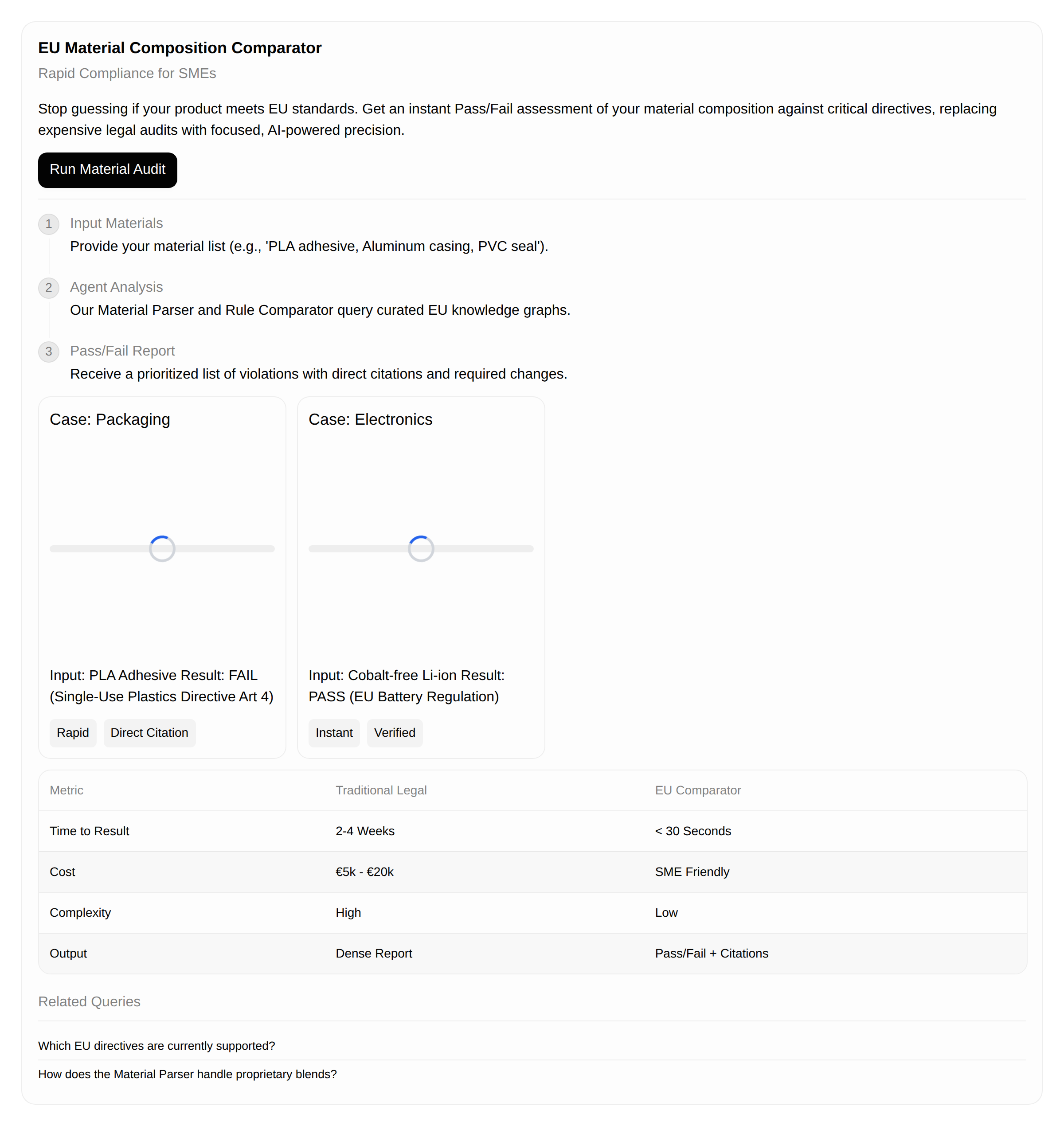
An AI tool provides a rapid Pass/Fail assessment of your product materials against specific EU regulations by querying a curated knowledge graph. You input your materials, and the system outputs a prioritized compliance report with exact citations to the violated regulations and required material changes. This eliminates the need for expensive legal databases or consultants, delivering compliance answers in minutes rather than days.
Process flow
Who it's for
SMEs (Small to Medium Enterprises) manufacturing or importing goods intended for the European Union market.
Why they need it
SMEs face immediate, high-stakes risks from complex and evolving EU regulations. They do not need a full compliance roadmap; they need a fast, definitive 'Go/No-Go' check on their core product materials against known legal thresholds to avoid immediate market rejection.
What it is
A focused, agent-orchestrated 'Material Compliance Comparator' that ingests a limited set of structured, public regulatory rules and compares them against a user-provided material list, outputting a simple, prioritized Pass/Fail report with direct citations.
How it works
The system operates on a narrow scope: the user inputs a product's material list (e.g., 'PLA adhesive, Aluminum casing, PVC seal'). Specialized agents—the 'Material Parser' and 'Rule Comparator'—query a small, curated knowledge graph built from 2-3 specific EU directives. The system outputs a clear, actionable, prioritized list of compliance failures, citing the exact rule violated and the required material change.
Differentiation
Existing solutions like general market intelligence reports (Euromonitor) are too broad. Specialized legal databases are prohibitively expensive and difficult to query programmatically. This tool fills the gap by providing a highly constrained, rapid, and focused comparative assessment (Pass/Fail) on a single, critical regulatory axis, making the complex problem digestible for the time-poor SME owner.
Implementation sketch
- Scope Lock: Focus MVP solely on comparing material composition against the EU Single-Use Plastics Directive (SUPD).
- Data Ingestion: Manually curate and structure the key material constraints from the SUPD into a simple, queryable JSON/CSV schema (e.g., {'material': 'PVC', 'violation': True, 'rule_section': 'Article 15'}).
- Agent Refinement: Build the 'Rule Comparator' agent to accept a product material list and iterate through the structured rules, outputting only the specific violation details.
- UX: A simple, guided workflow: 'What product are you selling?' -> 'What materials are in it?' -> 'Show Compliance Status.' The output must be a simple colored Pass/Fail summary.
First step: Manually identify the top 5 most frequently used materials in a target product category (e.g., coffee cups) and map the explicit material restrictions/prohibitions from the current draft of the EU SUPD into a structured, machine-readable YAML file.
Remaining risks
- The 'Pass/Fail' assessment is only as good as the initial, manually curated dataset. If the scope is expanded even slightly (e.g., adding a second EU directive or a new material type), the entire system breaks down because the initial data structure was built for a single, narrow use case. — Build the data layer with explicit, modular schema definitions (e.g., using an ontology layer) that allow for the addition of new regulatory constraints (e.g., 'SUPD v2.1') without requiring a full re-architecture of the core comparison agent.
- The 'Pass/Fail' output, while simple, is inherently misleading to a non-expert SME owner. A 'Fail' status triggers panic and panic-buying of expensive consulting services, while a 'Pass' status offers no strategic advantage, leading to user skepticism about the tool's true value. — Integrate a mandatory 'Contextual Next Step' field alongside every failure. Instead of just stating 'Fail,' the output must suggest the minimum next action (e.g., 'Failure due to PVC. Next step: Consult supplier for certified PLA alternative and check local recycling guidelines').
- The system assumes the user knows their material list accurately. If the user provides an incomplete or incorrect material list (e.g., forgetting a sealant or adhesive), the 'Pass/Fail' assessment will be falsely positive, leading to catastrophic compliance failure for the user. — Implement a mandatory 'Material Discovery Prompt' that forces the user to consider common failure points (e.g., 'Do you use any adhesives, coatings, or inks?'). This shifts the burden from perfect user input to guided user thinking.
Watch for: Any initial user request that requires cross-referencing materials against a non-EU regulation (e.g., US FDA guidelines, China CCC standards). This will immediately expose the brittle nature of the current, hyper-narrow scope. Kill criterion: If the first 10 pilot users are unable to articulate a clear, high-value use case that only requires the single, pre-defined EU directive (SUPD) and a simple material list, it indicates the pain point is not the check, but the missing roadmap that the tool cannot provide.
Sources the council used
Real-world evidence that grounded this idea — judge it for yourself.
- reddit.com
- reddit.com
- reddit.com
- bluespice.com
- mimrgrowthlab.com
- v7labs.com
- cubesoftware.com
- nerdwallet.com