
Cognitive Data Aggregator & Pattern Tracker (CDAPT)
How can I identify patterns in my cognitive health by combining journaling with health data?
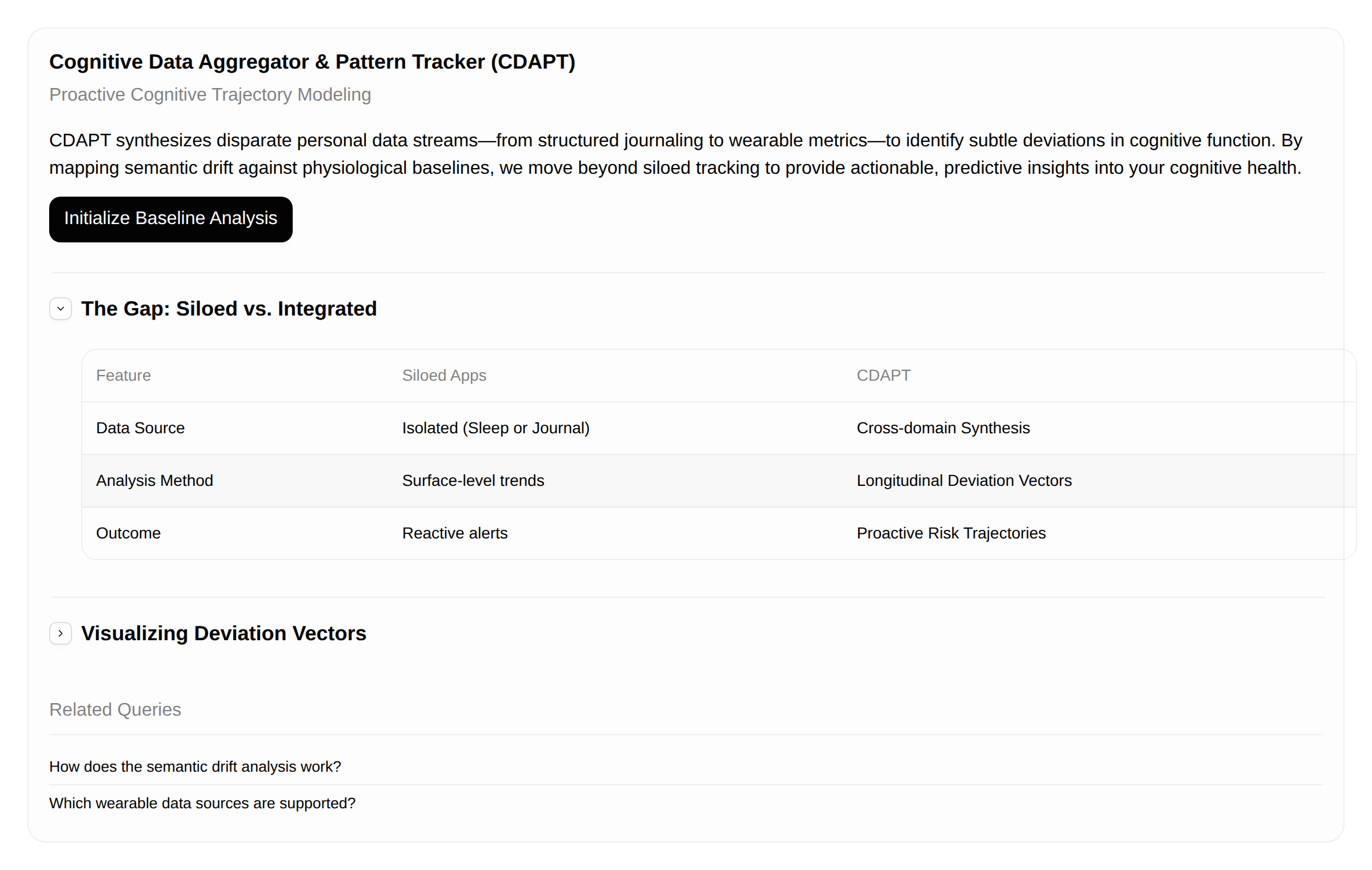
An AI platform can aggregate your structured recall entries (from memory prompts) alongside personal health data like sleep logs to detect cognitive patterns. The system analyzes text for semantic drift and recall consistency while correlating these with health metadata trends (e.g., poor sleep patterns), surfacing risk trajectories when patterns emerge. This moves beyond isolated tracking to synthesized, actionable cognitive insights by connecting multiple data sources.
Process flow
Who it's for
Individuals managing complex personal health records, caregivers, and proactive wellness users concerned with cognitive trajectory.
Why they need it
The core pain remains the invisibility of cognitive decline. However, we broaden the 'why' by recognizing that the management of these complex, multi-source personal health records is itself a major source of user friction, creating a need for an integrated data layer.
What it is
A guided application that ingests structured textual inputs (memory recall prompts) alongside metadata from other personal data sources (e.g., sleep/activity logs) to calculate longitudinal deviation vectors against a personalized baseline.
How it works
The system ingests structured text logs and associated metadata. An agentic loop analyzes the textual data for pattern deviation (semantic drift, recall consistency) and correlates these deviations with longitudinal metadata trends (e.g., 'Did poor sleep correlate with lower semantic density in recall?'). When a pattern emerges, it surfaces a 'risk trajectory' and suggests data-driven prompts to investigate the correlation.
Differentiation
Existing solutions are siloed: s1 handles finance, s2 handles B2B AP, and s5 are general assistants. We fill the GAP of proactive, cross-domain longitudinal state modeling by synthesizing structured cognitive recall data with the general complexity management of personal health data into a single, actionable, predictive layer. We move beyond simple aggregation by applying predictive pattern modeling.
Implementation sketch
- Phase 1 (MVP Focus): Build the structured journaling interface. Implement the core AI prompt engine for 1-2 defined memory domains, accepting text input.
- Phase 2: Develop the initial metric calculation layer. Calculate basic longitudinal metrics (e.g., vocabulary complexity, topic drift) from structured text inputs only.
- Phase 3 (V2): Integrate metadata correlation. Allow manual or API-linked input of one secondary data stream (e.g., sleep duration/quality) to correlate with Phase 2 metrics, flagging simple cross-domain correlations.
First step: Build a simple spreadsheet/mock-up interface in Figma that requires manual input of 10 structured memory recall entries (date, prompt, response text) and 1 corresponding sleep metric (score/duration). The goal is to visualize the process of correlation before writing complex AI logic.
Remaining risks
- Data Privacy, Security, and Regulatory Burden (HIPAA/GDPR): Handling highly sensitive, longitudinal cognitive and biometric data creates an immediate, existential regulatory risk. A single breach or misclassification could halt development entirely, regardless of product utility. — Design the architecture from Day 1 to be privacy-by-design, utilizing federated learning or on-device processing where feasible. Focus initial deployment on highly controlled, research/pilot environments with explicit legal counsel involvement before any commercialization attempt.
- User Adoption Fatigue and Data Burden: Requiring users to maintain structured, high-effort inputs (structured journaling) and link multiple data streams (sleep, activity) creates a high barrier to entry. Users may abandon the system due to cognitive load, leading to an insufficient dataset to train or validate any predictive model. — De-emphasize the 'data input' aspect in early marketing. Instead, focus the MVP pitch on the insight derived from the data, making the input feel like a guided, low-effort 'check-in' rather than a mandatory data entry task.
- Correlation vs. Causation Fallacy: The system is designed to find correlations between metrics (e.g., poor sleep $ ightarrow$ low semantic density). However, the platform has no causal mechanism. Users and clinicians may over-rely on these correlations, leading to incorrect diagnoses or unnecessary interventions based on spurious patterns. — The output must be rigorously framed as 'Pattern Observation' or 'Potential Correlation,' never as 'Diagnosis.' Integrate mandatory disclaimers and require human expert review/confirmation before any 'risk trajectory' is flagged as actionable.
Watch for: If early user feedback repeatedly indicates that the process of data collection (prompting, logging, linking) is more burdensome or confusing than the perceived benefit of the resulting insights, the entire value proposition collapses. Kill criterion: If the initial pilot group cannot consistently generate a minimum viable dataset (e.g., 3 months of structured inputs + 1 secondary stream) that demonstrates a statistically significant, repeatable deviation pattern, the core predictive modeling component (the 'Digital Twin' aspect) is ungrounded and should be scrapped in favor of a simpler, single-domain monitoring tool.
Sources the council used
Real-world evidence that grounded this idea — judge it for yourself.