
Policy-Governed Agent Runtime Sandbox (Internal Microservice Focus)
A policy-enforced execution layer for multi-agent systems, guaranteeing audited, controlled, and non-leaking interaction only with predefined, internal enterprise APIs and microservices.
How can enterprises let AI agents call internal APIs without risking data leaks?
A policy-governed agent runtime sandbox routes every outbound agent call through a controlled proxy that validates it against whitelisted internal service contracts before execution. The agent submits its task plan and required credentials, a policy engine checks target service, payload schema, cost limits, and scope, and credentials are injected only at runtime via a decentralized key vault. Any call violating policy halts execution immediately. It targets enterprises running mission-critical agents against proprietary internal microservices, where workflow tools and key managers alone can't enforce these guarantees.
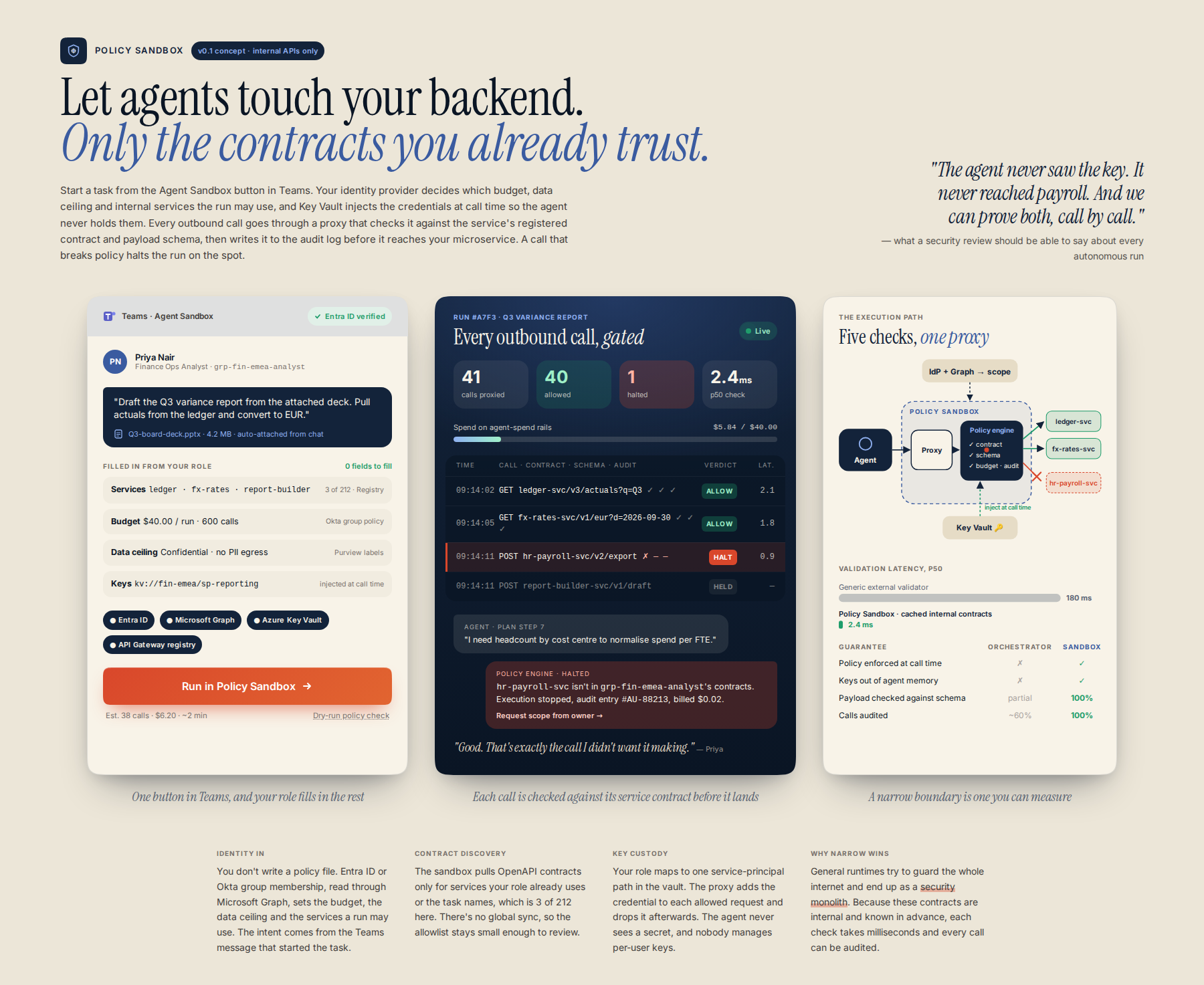
Process flow
Who it's for
Enterprises deploying mission-critical autonomous agents that must interface with proprietary, internal backend systems.
Why they need it
Complex agent coordination introduces systemic operational risks, especially regarding data exfiltration and unauthorized access to internal APIs. We solve the operational gap where simple workflow tools lack cryptographic guarantees, and key managers fail to control agent behavior or output.
What it is
A secure, auditable runtime environment (The 'Policy Sandbox') that acts as an execution gateway, strictly validating and governing all outbound calls only to whitelisted, internal microservices.
How it works
- Agent submits a task plan and required resources (keys, budget, scope) to the Sandbox.
- The Sandbox checks the task against 'Policy Guardrails' (user-defined operational constraints, cost limits, and allowed internal service contracts).
- Credentials are resolved and injected only at runtime via a decentralized Key Vault.
- The agent executes within the isolated environment; all outbound calls are routed through a controlled proxy.
- The Policy Engine validates the target service contract, validates the payload schema against the internal API definition, and audits the transaction before allowing the request. If the call violates policy, execution halts, and the transaction is billed via the agent-spend rails.
Differentiation
We fill the gap between simple workflow orchestration and true operational safety by combining three critical elements: decentralized key custody, flow management, and policy-enforced, contract-validated internal API control. Unlike general purpose runtimes, our narrow focus on internal, known contracts makes the security boundaries highly measurable, mitigating the 'security monolith' risk and addressing the latency concerns of external API validation.
Implementation sketch
- Develop the sandbox kernel focusing initially on establishing a secure proxy gateway strictly enforcing communication only with whitelisted internal service endpoints.
- Integrate a decentralized key resolution mechanism (Leveraging blockchain/ZKP principles) for non-custodial credential access.
- Implement the Policy Engine to enforce strict internal contracts: validating the target service, enforcing JSON/API schema contracts, and billing via the agent-spend rails.
First step: Draft the API contract definition language (or pseudo-code) that the Policy Engine must ingest to validate both the required API endpoint and the expected request/response JSON schemas, using a simple internal microservice example (e.g., a 'User Profile Service').
Remaining risks
- The 'Internal Only' Scope Trap (Limited Market Applicability). By focusing exclusively on internal microservices, the solution risks being perceived as too narrow. Many high-value agentic tasks require integrating with external, public APIs (e.g., weather data, public financial feeds, specialized industry APIs) that are outside the defined 'internal contract' scope, limiting the total addressable market. — Develop a clear, phased roadmap for controlled external expansion. The MVP should be framed as 'Internal First, External Next,' and the Policy Engine must be architected to handle a distinct, higher-risk policy profile for vetted external endpoints, rather than treating them as an afterthought.
- Policy Definition and Maintenance Overhead (Operational Friction). The core value relies on the continuous, accurate definition and maintenance of API contracts (schemas, endpoints, permissions) for every single internal service. This creates a massive, non-technical operational burden. If the cost and time required for the enterprise's DevOps/Security teams to maintain the policy guardrails exceeds the perceived benefit of the security, adoption will stall. — Build tooling that automates policy ingestion. The system must be able to consume standard industry specifications (like OpenAPI/Swagger definitions) directly from the internal service repositories, minimizing manual policy definition and allowing the Policy Engine to generate initial guardrails automatically.
- Agentic Drift and Intent Misalignment (The 'Why' Failure). The current focus is on technical enforcement (Did the API call match the schema?). However, the system does not govern the intent or logical consequence of the agent's actions. An agent could execute a technically perfect, policy-compliant sequence of calls that, when combined, leads to a catastrophic business outcome (e.g., draining a non-critical budget account or generating a legally non-compliant report). — Introduce a higher-level 'Business Outcome Guardrail' layer. This layer must assess the cumulative risk and logical coherence of the entire workflow plan before execution, flagging sequences that are technically valid but strategically nonsensical or dangerous.
Watch for: Any early signal that the enterprise client views the Policy Sandbox as a necessary cost center (due to policy maintenance overhead) rather than a value-generating feature. If the conversation shifts from 'How fast can we implement this?' to 'How much will it cost us to maintain the policies?', the idea is failing. Kill criterion: A major prospective client refuses to commit resources to the policy definition phase, stating that the required manual effort to map and maintain all internal API contracts is prohibitive, regardless of the security benefits.
Sources the council used
Real-world evidence that grounded this idea — judge it for yourself.