
Agent Computation Rail: Protocol-Level Verifiable Proof Settlement Layer
A specialized middleware orchestration layer that guarantees the atomicity and verifiable integrity of complex, constrained computations (derived from off-chain reasoning) before committing the final state change to a blockchain settlement rail.
Can a smart contract trust an off-chain calculation before settling it on-chain?
Yes, by requiring a zero-knowledge proof of the computation before settlement, not just verified input data. A constrained workflow (e.g., a collateralization ratio from specific oracle inputs) runs off-chain, and the orchestration layer generates a ZK-proof confirming the result was derived correctly from those inputs; the settlement contract verifies this proof and only then finalizes the state change. This targets institutional DeFi protocols needing auditable proof that multi-step financial logic, including LLM-derived reasoning, is mathematically sound, not just that the underlying data was available.
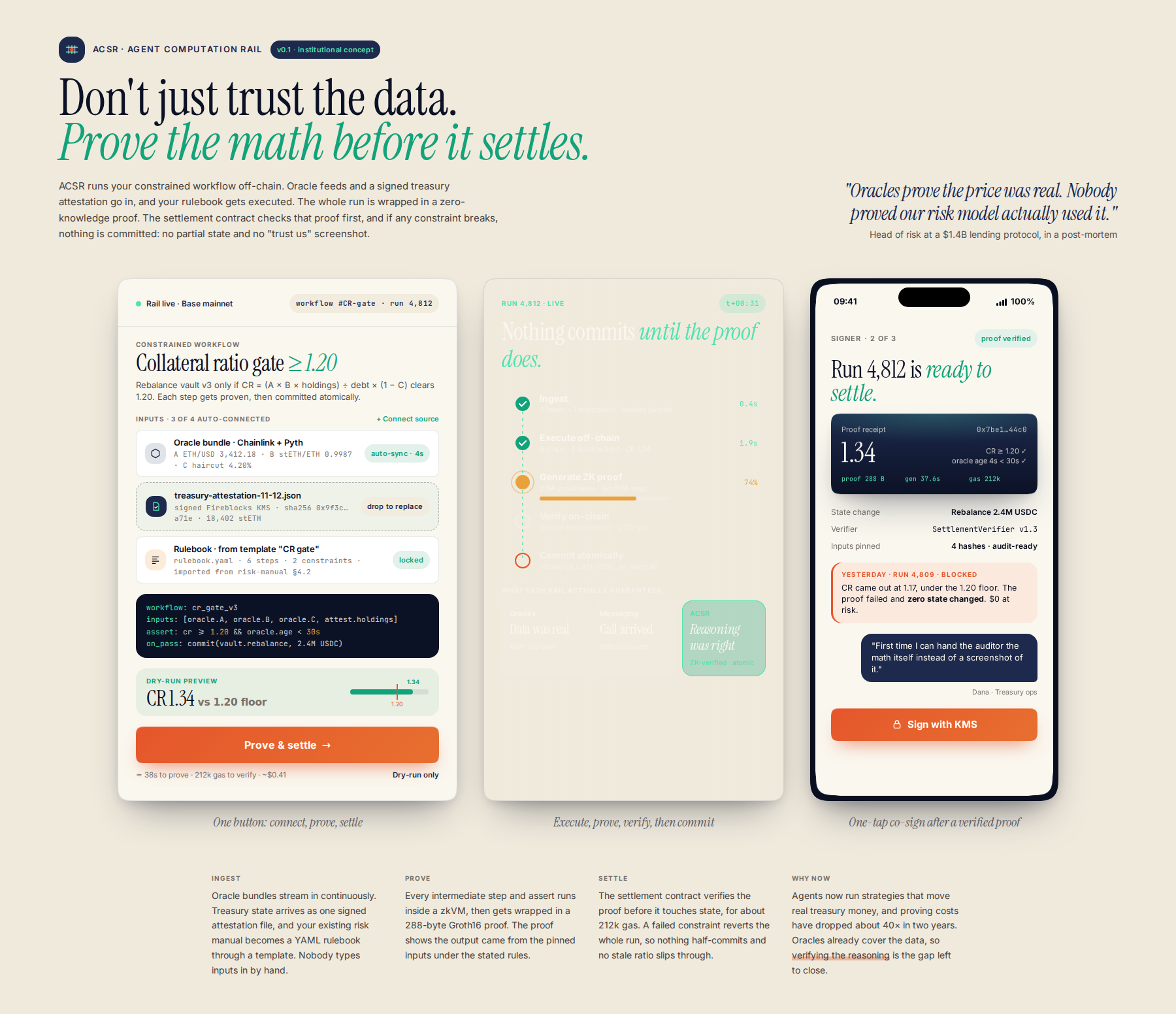
Process flow
Who it's for
Sophisticated DeFi protocols and institutional players requiring mathematically verifiable, auditable proof of complex, multi-step calculations (e.g., advanced risk modeling, constrained algorithmic arbitrage) to minimize systemic risk on-chain.
Why they need it
Current DeFi systems treat data availability (oracles) and execution reliability (message passing) as separate problems. They fundamentally fail to solve computational trust: the verifiable proof that complex, multi-step logic—especially involving LLM-derived reasoning or financial formulas—is mathematically sound and honest. Failure to verify the computation itself leads to systemic, unquantifiable risk.
What it is
The Agent Computation & Settlement Rail (ACSR). It acts as a secure, stateful layer that accepts a defined, constrained computation workflow. It executes the workflow off-chain, mandates the generation of a Zero-Knowledge Proof (ZKP) of the computation's integrity, and only commits the final state change to the blockchain if the proof is successfully verified.
How it works
The user defines a constrained computational workflow (e.g., 'Calculate the collateralization ratio using Oracle Inputs A, B, and the current market rate C, ensuring the result is > 1.2'). The ACSR executes this, and crucially, wraps the entire process into a ZK-Proof. This proof mathematically confirms that the final state change was derived correctly from the initial, verifiable inputs, regardless of the complexity of the intermediate steps. The settlement smart contract verifies the ZK-Proof first, ensuring computational integrity and atomicity, before finalizing the state change.
Differentiation
We shift the focus from merely guaranteeing data availability (standard oracles) or execution reliability (message passing) to guaranteeing Computational Trust. Unlike existing solutions, our core mechanism is the mandatory generation and verification of a ZK-Proof of Computation. This uniquely solves the gap of proving the integrity of the reasoning (the computation) rather than just the availability of the data (the API call).
Implementation sketch
- MVP Scope: Focus solely on a single, constrained, quantifiable financial ratio (e.g., calculating a collateralization ratio or a specific risk metric) that relies on 2-3 verifiable, on-chain oracle inputs. This minimizes ZK complexity.
- Build the 'Orchestration Core': The stateful backend manages the workflow execution and resource allocation, ensuring deterministic input flow.
- Integrate the 'Proof Generator': A dedicated module that takes the final, constrained computation state and generates the required ZK-Proof (e.g., using Circom/Snarkjs) for the specific circuit.
- Implement the 'Settlement Hook': The smart contract is modified to first verify the provided ZK-Proof against the defined circuit, and only if the proof validates, does it finalize the state change on the blockchain.
First step: Define the simplest possible constrained computation (e.g., calculating a simple weighted average based on three oracle inputs) and find a framework (e.g., Circom) to generate the initial ZK-SNARK circuit definition for that specific ratio. This proves the technical feasibility of the core mechanism.
Remaining risks
- Input Integrity vs. Computation Integrity: The ZKP only proves that the final calculation was performed correctly based on the inputs provided. It does not prove that the inputs (e.g., oracle data, market prices) themselves were accurate, timely, or free from manipulation at the source. If the inputs are compromised, the resulting state change is mathematically sound but financially catastrophic. — The system must mandate a multi-layered, consensus-driven input verification mechanism (e.g., requiring inputs to be validated by three distinct, decentralized oracle sources with differing methodologies) before the data is fed into the ZKP circuit.
- The Computational Scope Trap: The MVP scope is intentionally constrained to a simple ratio to prove feasibility. However, the inevitable market demand will push the system toward proving the integrity of complex, multi-variable, non-linear, or iterative computations (e.g., full risk model simulations). Scaling ZK circuits for arbitrary, multi-step logic quickly becomes computationally prohibitive and economically unviable. — The product roadmap must define a clear, technical boundary on the type of computation allowed (e.g., restricting all circuits to linear algebra or specific graph traversal algorithms) rather than just limiting the number of inputs, maintaining feasibility at scale.
- Developer/Integration Friction: The technical barrier to entry remains extremely high. Requiring a developer to understand, define, and implement ZKP circuits for a simple function is far beyond standard DeFi development practices. This limits the user base to only the most specialized institutional actors, severely restricting adoption. — Develop a robust, high-level SDK and API layer that completely abstracts the ZKP complexity. The developer should interact with the system as if they were simply calling a function (e.g.,
ACSR.calculate_ratio(A, B, C)), while the underlying layer handles all circuit definition and proof generation automatically.
Watch for: A significant reduction in the cost or time required for ZKP proof generation (Proving Time/Cost). If the cost of generating the proof approaches or exceeds the monetary value of the transaction being secured, the model becomes economically non-viable and will fail to gain traction. Kill criterion: If a major competing protocol successfully solves the problem of verifiable computational trust using a mechanism that is significantly cheaper, faster, or more generalizable than ZK-SNARKs (e.g., a novel proof system or a highly efficient trusted execution environment that solves the core trust gap), the unique value proposition of the ACSR is immediately invalidated.
Sources the council used
Real-world evidence that grounded this idea — judge it for yourself.