
The Benchmark-Driven Embedding Arbitrator (BDEA)
A highly specialized, benchmark-first middleware layer that solves the single most expensive and critical bottleneck in RAG workflows: selecting the optimal, cost-effective embedding model for a constrained domain (e.g., financial reports).
How do I choose the cheapest embedding model that still hits my RAG recall target?
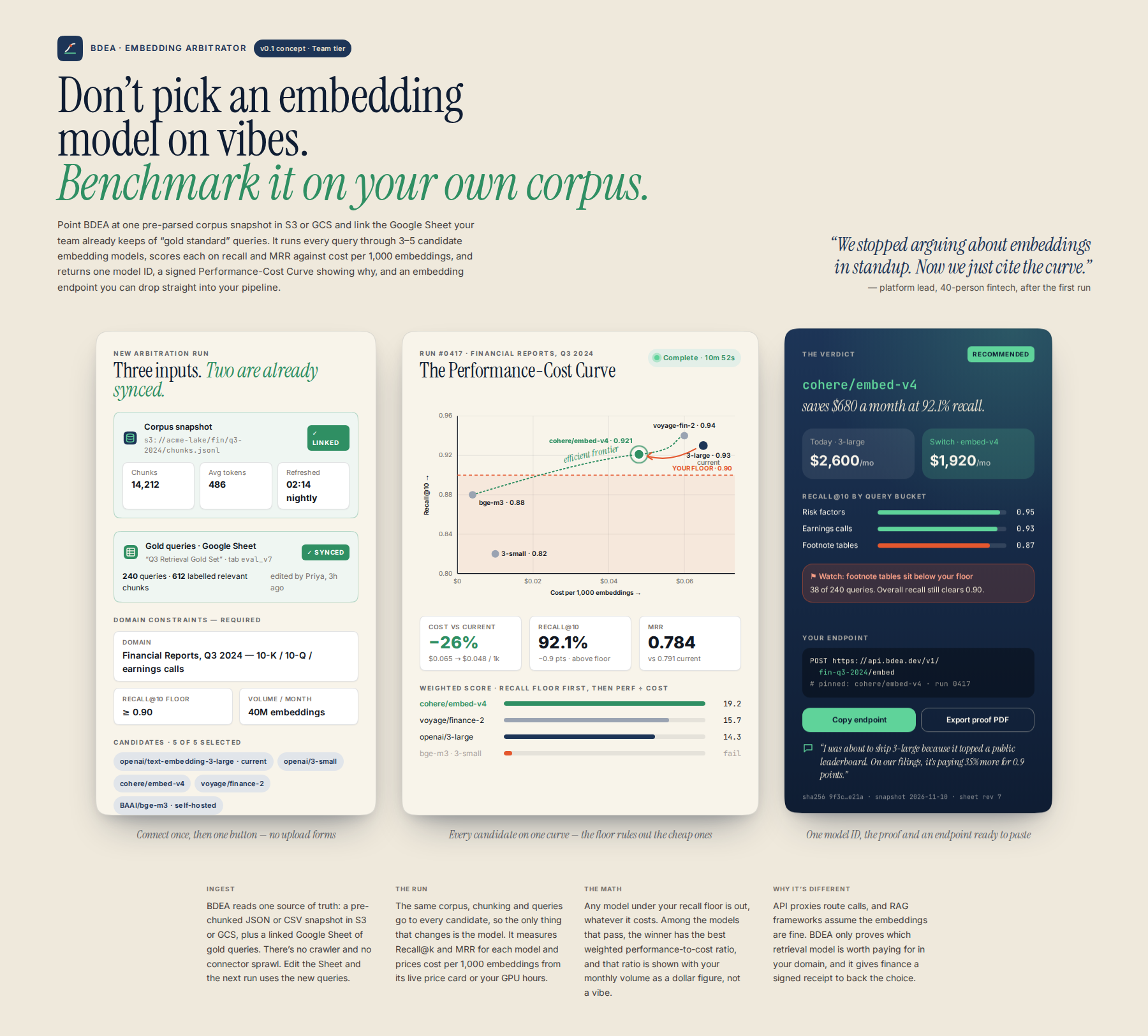
A benchmark-first arbitration layer answers this by running a set of 'gold standard' queries against a target corpus (e.g., financial reports) through several candidate embedding models like OpenAI, Cohere, and BGE. For each model it measures retrieval performance (Recall or MRR) against unit cost per 1,000 embeddings, then applies a weighted performance-to-cost score to recommend the single model that meets a required recall threshold at the lowest cost. It's built for developers of enterprise RAG systems in domains like finance or legal, where unverified embedding choices create both retrieval-quality and cost risk.
Process flow
Who it's for
Developers building enterprise-grade, data-intensive applications where retrieval quality and cost are paramount (e.g., legal, finance).
Why they need it
The performance and cost of RAG are currently bottlenecked by the embedding step, which is non-deterministic and highly expensive. Developers cannot reliably choose between proprietary, open-source, or commodity embedding models to guarantee both measurable retrieval performance (e.g., recall) and verifiable cost reduction. Current solutions ignore this primary financial and technical risk.
What it is
The BDEA is a specialized microservice that acts as a quantitative benchmark engine. It does not optimize the entire RAG flow; it focuses solely on running comparative benchmarks against a corpus using multiple embedding models (e.g., OpenAI, Cohere, BGE) to generate a verifiable 'Performance-Cost Curve.' This curve dictates the single best model choice for a given domain, minimizing total operational cost without sacrificing required retrieval quality.
How it works
- The developer provides the corpus and the target domain constraints (e.g., 'Financial Reports, Q3 2024').
- The BDEA executes a controlled, multi-model benchmark run: It takes a predefined set of 'gold standard' queries and runs them through the corpus using 3-5 candidate embedding models.
- For each model, it measures two metrics: a) Retrieval Performance (e.g., Mean Reciprocal Rank or Recall Score) and b) Unit Cost (Cost per 1,000 embeddings).
- The BDEA uses a weighted scoring mechanism (e.g., prioritizing Recall > 0.85) to select the model that provides the highest performance-to-cost ratio.
- The developer receives the recommended model ID, the benchmark data proving the cost savings, and the optimized embedding API endpoint, which is then used to build the final RAG pipeline.
Differentiation
Unlike general-purpose arbiters that merely proxy API calls, or general RAG frameworks that assume embedding quality, the BDEA is a dedicated quantitative benchmarking service. It solves the critical gap of proving the financial viability of the retrieval step. We do not optimize the synthesis (which is downstream); we solve the foundational 'Retrieval Quality' problem by providing verifiable, domain-specific proof of cost reduction (e.g., 'Model X saves 25% on embeddings compared to Model A while maintaining 92% recall'). This measurable, benchmark-driven approach is unique and necessary for enterprise adoption.
Implementation sketch
- Build a FastAPI microservice endpoint: /api/v1/benchmark_embedding(corpus_id, domain_profile).
- Develop a 'Benchmark Runner' module: This module must handle the secure ingestion of a test corpus and a set of 'gold standard' queries. It must programmatically interact with candidate embedding APIs and measure both embedding cost and retrieval performance (e.g., cosine similarity against known ground truth vectors).
- Implement the 'Performance-Cost Scorer': A simple scoring engine that takes the measured Recall Score and the Unit Cost, and outputs a definitive recommendation (Model ID + Usage Instructions) that maximizes efficiency based on domain-defined thresholds.
First step: Draft a small, contained proof-of-concept script (Python/LangChain) that takes a publicly available, small domain dataset (e.g., a set of 10 financial press releases) and programmatically runs the same 5 queries through three different embedding APIs (OpenAI, Cohere, BGE) to generate a simple comparison table of Cost vs. Average Cosine Similarity. This validates the core benchmark loop.
Remaining risks
- Benchmark Staleness and Dependency Drift. The core value proposition relies on the stability of external APIs (OpenAI, Cohere, BGE, etc.). If any major provider changes its pricing structure, deprecates a model, or experiences a sudden, unannounced performance degradation, the 'Performance-Cost Curve' becomes immediately invalid, rendering the service useless until manually updated. — Introduce a continuous, low-cost monitoring layer that tracks key dependency metrics (e.g., API rate limits, pricing changes, and public performance benchmarks) and proactively alerts the user dashboard when a critical dependency deviates by more than a defined threshold (e.g., >15% cost increase or >10% recall drop). This transforms the service from a static benchmark tool into a dynamic risk monitor.
- The 'Domain Profile' Trap. The success of the BDEA is hyper-specific to the corpus and domain provided. If the user attempts to generalize the recommended model (Model X for Finance) to a slightly different domain (e.g., Legal Contracts), the benchmark results will provide false confidence, leading to catastrophic retrieval failure. The risk is building a highly successful, but non-transferable, single-use utility. — The service must force the user to define and validate the boundaries of the domain profile (e.g., requiring the inclusion of a specific, small set of domain-specific vocabulary or jargon lists). The output recommendation must include a 'Domain Boundary Warning' that explicitly states the model's applicability is limited to the exact profile tested.
- Integration Friction. The BDEA provides a recommendation, but the developer must still manually integrate that model ID and its usage parameters into their actual RAG stack (vector store setup, chunking strategy, etc.). The friction of taking the 'optimal recommendation' and implementing it into a complex, existing pipeline is a massive operational hurdle that could negate the cost savings. — __
Watch for: If the initial user base requires significant hand-holding or manual intervention to translate the 'Performance-Cost Curve' into an actionable, production-ready integration plan, the signal is that the service is a brilliant academic tool, but not a viable product. Kill criterion: If the service cannot reliably prove a quantifiable, measurable cost reduction (e.g., >15% savings) compared to a leading proprietary model (like OpenAI) on a standardized, publicly available, and diverse benchmark dataset (e.g., a widely known legal or scientific corpus), the core financial value proposition is unsubstantiated and must be abandoned.
Sources the council used
Real-world evidence that grounded this idea — judge it for yourself.