
Veritas: Decentralized, Low-Latency Compute Orchestration Layer for Protocols
A decentralized, pay-per-use compute service that guarantees maximum throughput and minimal latency for mission-critical LLM inference, enabling high-volume automation in financial and payment protocols.
How can payment and financial protocols get fast, low-latency LLM inference without vendor lock-in?
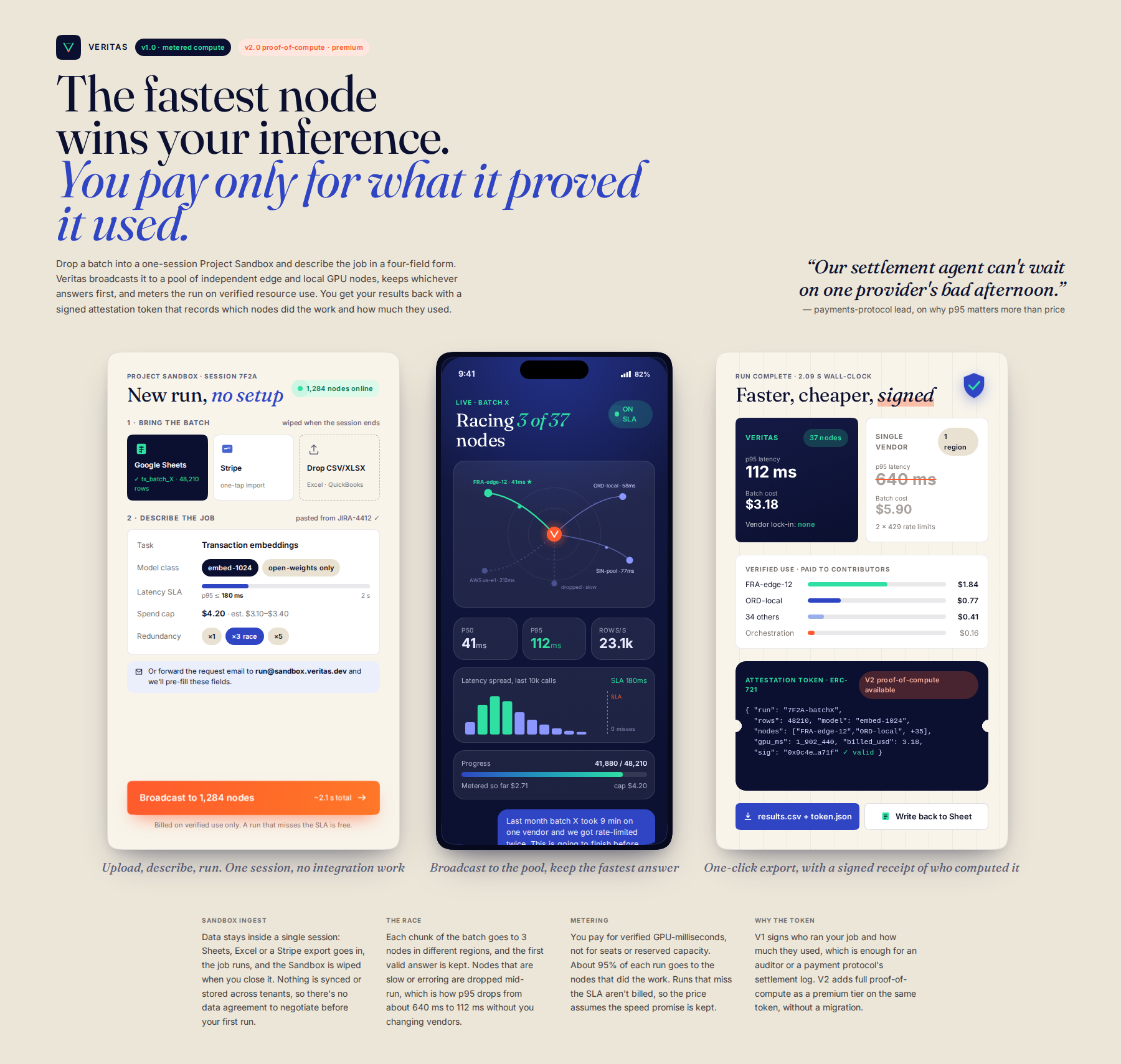
A decentralized compute orchestration layer can meet this need by aggregating LLM inference capacity from distributed node operators and routing each task to the fastest available node. It works for payment protocol builders, high-volume SaaS companies, and financial services: a task payload is broadcast to a pool of diverse compute sources, the result is returned from whichever node responds fastest, and usage is verified and billed per resource consumption. An optional signed attestation token can later confirm the source and veracity of the computation, layering verifiable proof on top of the core speed-focused service.
Process flow
Who it's for
Payment protocol builders, high-volume SaaS companies, and financial services requiring real-time, portable computation.
Why they need it
High-volume computing requires maximizing throughput and minimizing latency. Current reliance on centralized, unverified, or vendor-locked compute introduces unacceptable operational risk and operational bottlenecks. We solve this by providing a decentralized, performance-optimized inference layer first.
What it is
A 'Veritas' layer that acts as a standardized intermediary, aggregating the fastest available LLM inference capacity from diverse, distributed compute sources.
How it works
- A user/agent submits a task payload (e.g., 'Generate transaction embeddings for batch X').
- The agent platform broadcasts the task to a pool of diverse, local/edge compute resources (addressing vendor lock-in).
- The orchestrator immediately aggregates the result from the fastest node(s) and returns the output (Primary Focus: Speed & Efficiency).
- The orchestrator validates the usage and charges the user based on the verified resource consumption and node pool contribution (Core Value).
- The result is delivered with a signed Attestation Token (ERC-20/NFT) guaranteeing the source and veracity of the resource consumption, allowing for a V2.0 upgrade to full proof-of-compute.
Differentiation
We address the immediate market need for speed and portability first. While competitors offer either performance or distribution, we provide a two-tiered, unified service: 1) Low-latency, decentralized compute (primary value) and 2) Optional, verifiable proof (premium V2.0 service). This significantly de-risks the initial offering by focusing on the most critical, immediate pain point: performance-driven risk mitigation.
Implementation sketch
- Build the core 'Veritas' smart contract on Base/USDC, responsible for payment and resource consumption tracking.
- Develop the core inference API: focus solely on aggregating the fastest, most efficient result across the node pool. This is the MVP.
- Establish the initial node onboarding protocol, focusing on basic API integration and resource reporting (speed metrics) rather than complex cryptographic proof generation.
- The agent-facing API must clearly distinguish between 'Result Only' (MVP) and 'Result + Attestation' (V2.0), allowing users to choose based on their latency requirements.
First step: Create a detailed technical specification and proof-of-concept API contract for the 'Result Only' path. This involves defining the minimum required input/output schema and the resource reporting metrics (latency, cost, throughput) necessary for the initial smart contract payment logic.
Remaining risks
- Network Effect Failure (The Cold Start Problem): The platform is entirely dependent on attracting both a critical mass of high-quality, reliable node operators (supply) and high-volume, mission-critical payment protocols (demand). If either side fails to scale rapidly, the service remains an expensive, unusable intermediary, lacking the liquidity needed to justify the decentralized complexity. — Focus initial efforts on forming exclusive partnerships with 1-2 major payment consortia or institutional DeFi protocols, guaranteeing a minimum initial transaction volume and providing anchor tenants to attract node operators.
- Incumbent Feature Parity (The Moat Erosion): Large, centralized cloud providers (AWS, Azure, Google) or specialized compute networks are highly motivated to replicate the 'speed and portability' layer. If they can offer comparable low-latency aggregation and resource reporting with significantly lower overhead or better enterprise integration, the core value proposition of 'decentralization' becomes an unnecessary complexity and cost. — Instead of competing on raw speed, focus the differentiation on providing immutable, auditable proof of resource provenance and verifiable resource consumption tracking that centralized competitors cannot easily replicate or legally guarantee.
- Regulatory Classification and Liability: By handling mission-critical financial computations (e.g., transaction embeddings), the service crosses into highly regulated territory. If a computation fails, or if the aggregation process introduces a systemic error, the platform could be deemed a financial intermediary or an executor of regulated activity, leading to crippling compliance costs and legal liability far exceeding the revenue potential. — Structure the service contract and legal wrapper to strictly position the platform as a neutral, verifiable utility layer (like a specialized API gateway) that merely aggregates and reports resource usage, explicitly avoiding taking on liability for the computational logic or the financial outcome.
Watch for: A sustained period where the cost of the 'Veritas' service (including smart contract fees, node aggregation overhead, and resource tracking) approaches or exceeds the efficiency gains provided by the decentralized computation, indicating that the overhead is negating the primary value proposition. Kill criterion: If the platform cannot secure a foundational, paying client (e.g., a specific payment rail or protocol) that commits to a minimum viable transaction volume (e.g., $X million USD) within 12 months of the MVP launch, proving the initial market need is flawed or the value capture mechanism is insufficient.
Sources the council used
Real-world evidence that grounded this idea — judge it for yourself.
- hackernoon.com
- hackernoon.com
- startupfortune.com
- markaicode.com
- arxiv.org
- decentralizedinference.org
- developer.nvidia.com