
Intent Orchestration Layer for Complex Data Assembly
A secure, AI-driven intent layer that translates complex, multi-source information goals into fully simulated, auditable data assembly plans, allowing non-technical users to validate data integrity and structure before execution.
How can non-technical users safely combine data from multiple APIs without risking bad or incomplete results?
An intent orchestration layer lets users describe a data goal in plain language and get a simulated, auditable assembly plan before any real retrieval happens. The system decomposes the request into a structured data graph (e.g., metadata lookup, API calls, calculations), runs it against sandboxed sources to preview the resulting payload, lineage, and failure points, and requires explicit user approval before producing a final output. It's aimed at general users assembling complex multi-source data, such as NFT metadata or DeFi protocol state, who currently must manually wire APIs and validate schemas themselves.
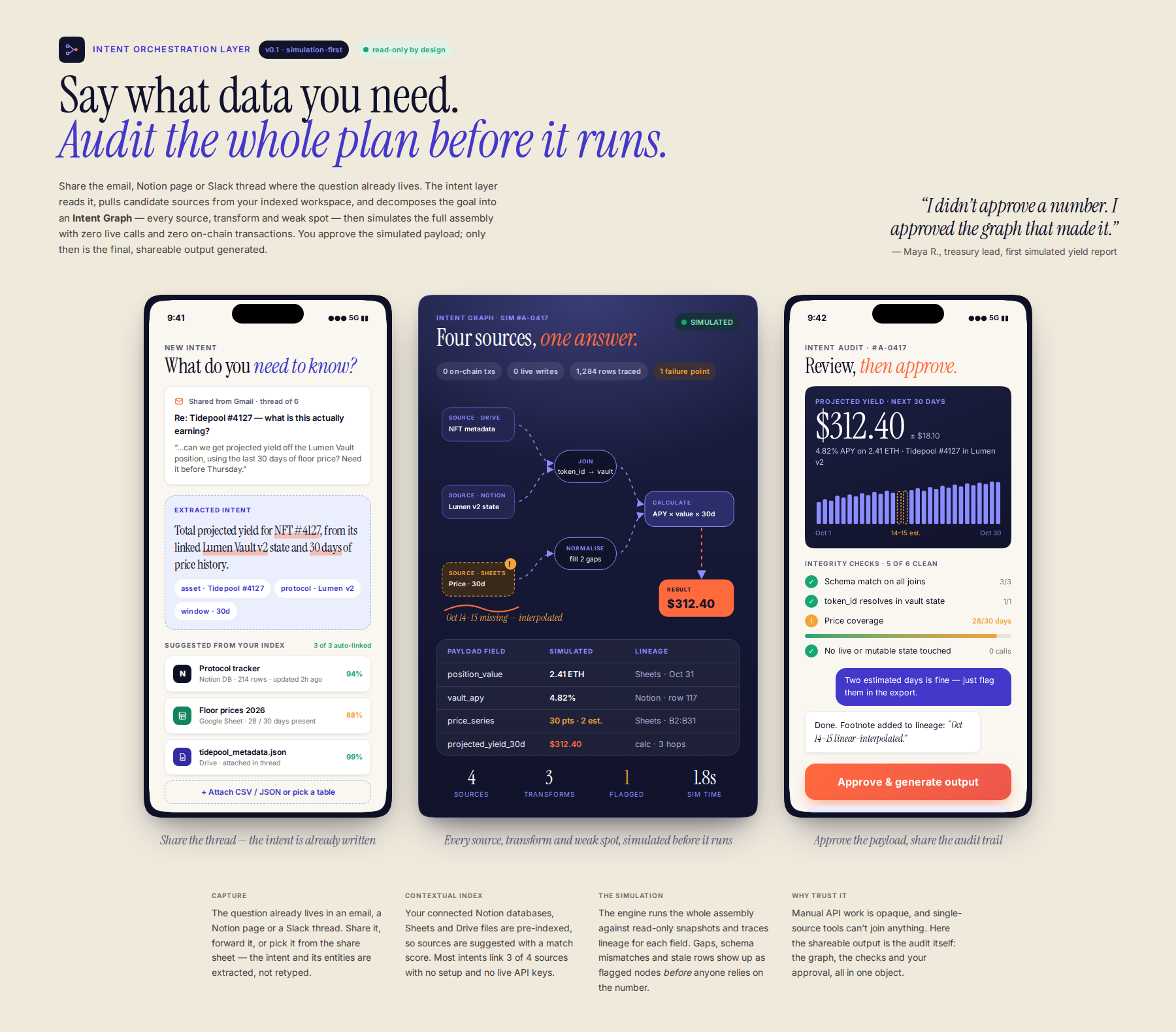
Process flow
Who it's for
General users/adopters needing to synthesize complex, multi-source data (e.g., NFT metadata, DeFi protocol state, historical feeds).
Why they need it
The current experience for complex data retrieval and assembly is fragmented, requiring users to manually connect APIs, interpret disparate data schemas, and manually validate the final payload. We solve the data complexity barrier by providing absolute trust through transparent, simulated data auditing.
What it is
A secure, front-end 'Intent Simulation' layer that accepts natural language data intents and decomposes them into a full, simulated 'Intent Graph' visualization. This layer simulates the entire data retrieval and assembly sequence, showing all data sources, transformations, and potential failure points without interacting with live, mutable state or triggering any on-chain transactions.
How it works
- User inputs a high-level data intent (e.g., 'Show me the total projected yield for this NFT based on its linked protocol state and last 30 days of price history').
- The LLM core interprets the intent, validating feasibility and decomposing it into a structured, multi-step data graph (e.g., Query NFT Metadata -> Call Protocol API -> Fetch Historical Price -> Combine/Calculate).
- The system runs a dedicated 'Simulation Engine' against the specified data sources. This engine simulates the data flow, calculates the resulting data payload, and generates the detailed intent graph.
- The UI presents the entire simulation—the source nodes, the transformation logic, the calculated result, and the data lineage—to the user. The user must explicitly review and approve this simulated data payload before the system generates a finalized, ready-to-use data output.
Differentiation
Existing solutions are either manual API consumption or limited to single-source data retrieval. Our solution is the first to decouple complex data planning from manual execution. We solve the data trust gap by providing a fully simulated, auditable 'Intent Audit'—users get the power of automated data planning without the risk of complex, opaque, or incomplete data assembly.
Implementation sketch
- Build the core agent logic (LLM) to parse a complex data intent into a structured, JSON-formatted data graph.
- Develop the 'Simulation Engine' layer that executes the graph against sandboxed API calls and mocked data sources (critical focus). This engine must validate data schema compatibility and calculate the projected final data payload.
- Design the UI/UX to visually represent the entire data flow, showing the source nodes, the transformation steps, and the full, itemized resulting data structure, making the 'pre-simulation audit' the central feature.
- Implement secure state management to generate a 'ready-to-use' data payload, which the user must confirm manually before the system allows external usage.
First step: Define a mock API endpoint that simulates retrieving complex, multi-schema metadata (e.g., combining an NFT URI payload with a linked DeFi protocol state object). Ryan should build a test script to pass this mock data through a basic JSON transformation function, proving the ability to assemble a structured 'data payload' from disparate sources.
Remaining risks
- The 'Garbage In, Garbage Out' problem at scale. The system's reliability depends entirely on the integrity, consistency, and availability of external, third-party APIs (metadata URIs, DeFi protocol endpoints, etc.). If a single source API changes its schema, becomes rate-limited, or returns stale data, the entire 'Intent Graph' simulation will fail or, worse, generate a confidently incorrect payload, leading to a complete loss of user trust. — Implement a robust 'Source Health Scoring' system. Every external data source used in a simulation must be tracked for uptime, schema drift, and historical accuracy. The UI must display a clear 'Data Confidence Score' for the final payload, flagging the result if any critical source falls below a pre-defined reliability threshold.
- The 'Technical Overload' risk. While the pivot successfully removed financial risk, the core value proposition still requires the user to audit a complex, multi-step 'Intent Graph' showing data lineage, transformations, and multiple sources. This level of technical depth may still overwhelm the general crypto user, turning the sophisticated audit tool into a confusing academic exercise. — Prioritize abstraction in the UI/UX. Do not force the user to review the full graph by default. Instead, present the final, synthesized data payload first, alongside a high-level, natural language summary of why the data is correct and which sources contributed to the key figures. The 'Intent Graph' should be a drill-down feature, reserved only for advanced users who explicitly request the audit.
- Commoditization and Differentiation Erosion. The concept of 'data orchestration' is a mature, highly competitive field (ETL pipelines, GraphQL resolvers, specialized data backends). By focusing too heavily on the 'Intent Graph,' the solution risks being perceived as merely a complex, expensive wrapper around existing data integration tools, rather than a novel, indispensable AI layer. — The differentiation must be anchored in the intent understanding and data synthesis, not the graph itself. The pitch must shift from 'We build the graph' to 'We understand the underlying financial/data question and synthesize the answer, even when the data sources don't know how to talk to each other.' Focus on the ability to synthesize novel insights from disparate data points, not just assemble them.
Watch for: Any signs that the team is spending more time building the simulation engine's technical robustness (e.g., handling specific API edge cases) than refining the user experience's ability to abstract away the underlying complexity. If the solution requires the user to understand the 'data lineage' to trust it, the core value proposition is failing. Kill criterion: If the team cannot demonstrate a clear, non-technical value proposition that is significantly better than simply asking a specialized data scientist to write a custom script connecting the necessary APIs, the project lacks true market differentiation and should be abandoned or radically narrowed.
Sources the council used
Real-world evidence that grounded this idea — judge it for yourself.