In-Process Agent Governance Kernel (IAGK)
A mandatory, low-latency, in-process library module that enforces structural separation, resource quotas, and verifiable execution paths for mission-critical, production-grade AI agentic workflows.
How can enterprises enforce resource limits and safety boundaries on AI agents in production?
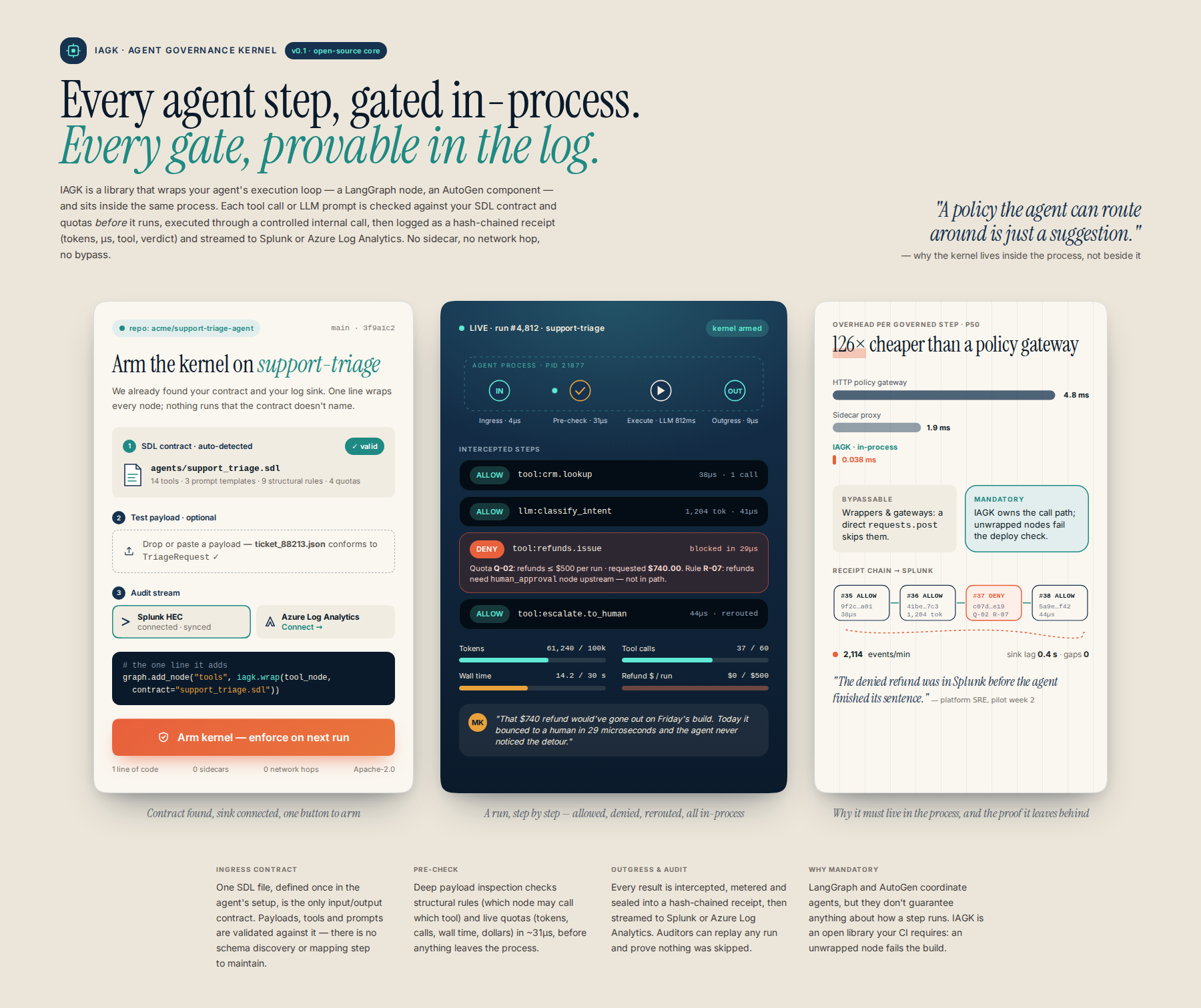
A dedicated in-process governance kernel can intercept every agent step—a tool call or LLM prompt—to enforce quotas and structural rules before execution. It wraps the agent framework's execution loop (e.g., a LangGraph node or AutoGen component), running a pre-check on each request against rate limits and structural validation, then logging auditable metrics like tokens and compute time on output. This is aimed at enterprise teams running mission-critical agentic systems that need verifiable, low-latency governance without the overhead of an external proxy.
Process flow
Who it's for
Enterprise development teams building production-grade, mission-critical AI agentic systems that require verifiable governance and resource accountability.
Why they need it
These complex agent systems face critical scaling, security, and cost management issues. Developers lack a standardized, mandatory, and low-overhead runtime layer to guarantee structural separation and enforce resource quotas, making reliable deployment too risky and expensive to trust without specialized internal controls.
What it is
An 'Agent Governance Kernel'—a specialized, high-performance library module that runs within the agent orchestration framework's process space. It intercepts inputs and manages the execution of individual, contained steps (e.g., a single tool call, a single LLM prompt) at the lowest possible overhead.
How it works
It operates as a specialized wrapper module integrated directly into the agent framework's execution loop (e.g., as a custom LangGraph node or AutoGen component).
- Ingress: The framework calls the Kernel module with a request payload (an agent step).
- Pre-Check: The Kernel performs deep payload inspection, verifying the request against quotas and structural rules.
- Execution: If approved, the request is routed to the underlying execution mechanism (LLM API/tool) via a controlled internal call.
- Outgress: The Kernel intercepts the result, logs detailed, auditable metrics (tokens, compute time, tool calls, success/failure), and returns the result to the calling framework, minimizing external network latency.
Differentiation
Current frameworks provide coordination but lack a mandatory, standardized, in-process runtime layer guaranteeing structural separation and verifiable governance. Unlike proprietary solutions or boilerplate wrappers, IAGK is designed as a modular, open-source library module that is explicitly mandatory for deployment. We fill the GAP of Verifiable Structural Safety and Mandatory Low-Latency Runtime Governance for complex agents. Our focus is providing the guarantee of the execution environment itself, baked into the process memory.
Implementation sketch
- Refactor the concept from an external proxy/gateway to an in-process Python/Rust library module to eliminate network latency and overhead.
- Develop a minimal viable module that intercepts and enforces structural separation and rate limiting specifically for the most common single agent step: the external tool call invocation.
- Build an immutable, local audit log mechanism (e.g., using SQLite or a dedicated internal metrics service) to track metrics for every step without requiring immediate blockchain interaction.
- Focus the MVP on proving reliable, low-latency interception of synchronous, single-step agent processes to de-risk the core technical value proposition.
First step: Write a proof-of-concept Python class that wraps a standard LLM API call function (e.g., OpenAI client) and implements a simple, in-memory rate-limiting counter and a structural validation check (e.g., ensuring the input payload contains a mandatory 'user_id' and 'step_type' field) to validate the core latency and structural integrity concept.
Remaining risks
- State Explosion and Context Drift: While the MVP de-risks single, synchronous steps, the core challenge remains managing the cumulative, long-running state of a complex agent workflow. The Kernel must track resource usage, structural integrity, and context across dozens of asynchronous, interdependent steps without introducing massive memory overhead or becoming a single point of failure that corrupts the workflow state. — Design the Kernel to operate with a clear separation of concerns: the core governance logic must be stateless and idempotent, relying only on the immediate input/output payload and a dedicated, external, highly resilient metrics store (e.g., Redis) for state tracking, rather than managing the state itself.
- Framework Dependency Hell: The Kernel requires deep, specialized integration into multiple, rapidly evolving agent orchestration frameworks (LangGraph, AutoGen, etc.). Each framework has unique internal execution paths, making the Kernel a massive maintenance burden. The risk is that the Kernel becomes obsolete or too complex to maintain as the underlying AI tooling ecosystem fragments and changes. — Instead of attempting deep integration into every framework's internal API, the Kernel should expose a simple, standardized, and highly stable 'Execution Contract' that all frameworks must pass through, treating the Kernel as a mandatory, standardized external service layer within the process memory boundary.
- The Performance Tax: Even in-process, deep payload inspection, structural validation, and detailed metric logging introduce CPU overhead. Under massive, concurrent enterprise load, this overhead could accumulate into an unacceptable performance tax, causing the solution to be bypassed or rejected by performance-critical users, regardless of its governance value. — Implement the Kernel using highly optimized, low-level languages (Rust/C++) and prioritize performance profiling for the most common use cases (e.g., simple tool calls) above all else. Governance checks should default to 'fail-safe' (blocking) only when structural violations are detected, otherwise, they should be highly optimized for near-zero overhead.
Watch for: If the overhead introduced by the Kernel's validation/logging process scales non-linearly with the complexity of the payload (e.g., deep JSON structure, large tool inputs) rather than linearly with the number of steps (calls), the solution will fail to deliver the promised low latency. Kill criterion: If the measured end-to-end latency increase for a simple, single-step tool call (the core use case) consistently exceeds 5-10 milliseconds under simulated high-concurrency load, the technical viability of the 'low-latency' claim is compromised, requiring a fundamental shift in architecture (e.g., offloading governance to specialized hardware/edge compute).
Sources the council used
Real-world evidence that grounded this idea — judge it for yourself.