
Niche Compliance Ledger: GAAP Cost Allocation for R&D AI Usage
A specialized data-piping service that takes pre-processed, raw AI usage metrics and normalizes them into a single, auditable ledger format specifically tailored for generating GAAP-compliant cost allocation reports for multi-departmental R&D teams.
How can finance teams turn AI token and compute usage into GAAP-compliant R&D cost reports?
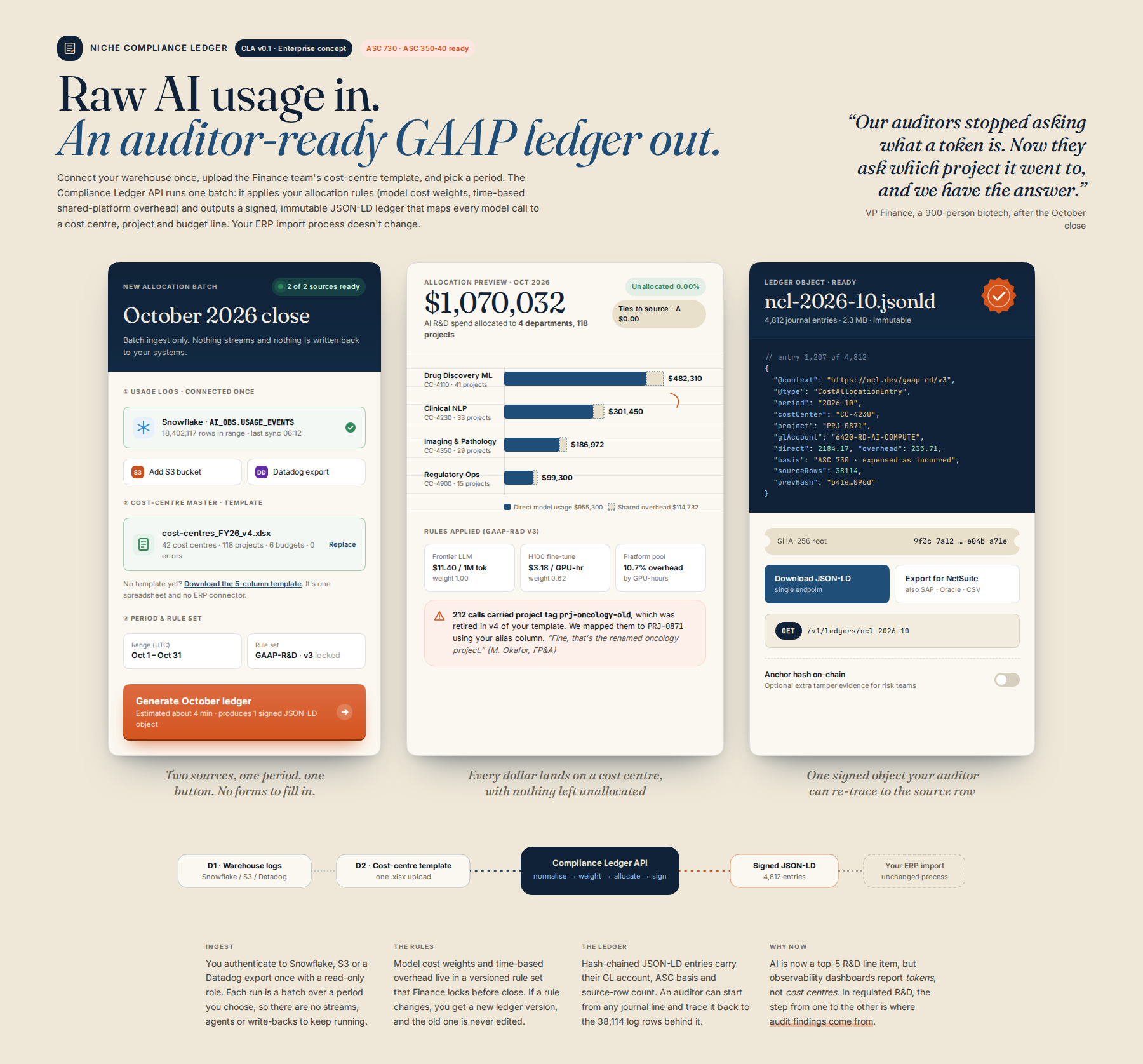
Yes: a compliance ledger layer can normalize raw AI usage metrics into standardized, auditable financial data. It ingests structured usage logs (tokens, GPU-hours) and applies predefined financial rules, such as time-based overhead allocation and model-specific cost weights, to map consumption to cost centers, project codes, and allocated monetary costs. The output is an immutable, traceable ledger built for direct import into ERP and accounting systems. It targets enterprise finance teams, CTOs managing R&D budgets, and AI platform operators in regulated industries.
Process flow
Who it's for
Enterprise Finance Teams, CTOs overseeing R&D budgets, and AI Platform Operators in highly regulated industries.
Why they need it
While general observability tools exist, they fail to translate technical metrics (tokens, compute hours) into the standardized, auditable financial data required by corporate accounting standards (GAAP/IFRS). The current gap is the lack of a trusted, specialized layer that converts raw usage into an immediate, actionable financial compliance report.
What it is
A Compliance Ledger API (CLA) that accepts structured usage logs and outputs a standardized, immutable data object (e.g., JSON-LD) that directly maps resource consumption to specific cost centers, projects, and departmental budgets, adhering to a defined accounting standard.
How it works
- The client/platform is responsible for the initial data capture (e.g., via existing logging infrastructure).
- The CLA ingests this structured usage log stream.
- The CLA applies predefined financial rules (e.g., time-based overhead allocation, model-specific cost weights) and normalizes the data into the compliance-specific ledger format.
- The client consumes this ledger via a dedicated API endpoint, which is designed for seamless import into existing ERP/accounting systems.
Differentiation
Existing observability tools focus on metrics (usage volume) and reporting (dashboards). We focus on financial compliance and data interoperability. Unlike general billing platforms, we solve a highly narrow, high-pain compliance problem: translating raw technical usage into a certified, GAAP-compliant cost allocation report, thereby mitigating audit risk for enterprise clients. The crypto element is now a secondary, optional feature for risk management, not the core value.
Implementation sketch
- Define a narrow, high-value MVP scope: Solving cost allocation for 'R&D Model Training' under GAAP standards.
- Develop a simple, robust API endpoint that accepts a structured JSON payload (pre-processed usage data, not raw logs).
- Build the core transformation logic: Mapping technical metrics (tokens, GPU-hours) to required financial fields (Cost Center ID, Project Code, Allocated Monetary Cost).
- Create a specific output connector/wrapper that mimics the data structure required by a single, major target ERP (e.g., NetSuite's API schema) to prove value.
First step: Conduct 5-7 informational interviews with Finance Managers or Controllers at mid-sized tech companies. The goal is not to sell, but to understand the exact data fields, required schemas, and specific pain points involved in generating a GAAP-compliant R&D cost report for AI usage, thereby defining the mandatory output schema.
Remaining risks
- Regulatory Drift and Scope Creep: The core value relies on adhering to current GAAP/IFRS standards for R&D. However, accounting standards are not static. A change in tax law, accounting principle (e.g., IFRS 16 treatment of compute resources), or the definition of 'R&D' itself could invalidate the entire ledger schema, requiring a massive, unplanned overhaul of the core logic. — Structure the transformation logic around configurable 'Standardization Profiles' rather than hard-coded rules. The service should be designed to ingest a 'Standardization Mandate' (e.g., 'Current GAAP R&D Profile v3.1') which dictates the rules, allowing the system to be updated by simply swapping the profile, rather than rewriting the code.
- The 'Black Box' Accountability Failure: By acting as the mandatory financial translator, the service assumes the role of an arbiter of financial truth. If a client's internal audit team or a CFO distrusts the system—viewing it as an opaque, third-party mechanism dictating cost allocation—they may reject it, regardless of its technical accuracy. The risk is that the solution is viewed as a reporting tool, not an audited truth source. — Do not market the output as 'The Truth.' Instead, market it as an 'Audit Preparation Tool.' The system should generate a fully transparent, traceable audit trail that shows how the final number was derived, linking every monetary value back to the original raw usage metric and the specific rule applied, thereby allowing the client to maintain ultimate accountability.
- Integration Over-reliance: While the scope is narrowed to one ERP (e.g., NetSuite), the client's internal financial systems are often highly customized and messy. The assumption that the output schema will map cleanly to the target ERP's API is likely false. The integration point will become a bespoke, high-maintenance project that requires deep, expensive, and non-core knowledge of the client's internal IT landscape. — Treat the ERP connector as a 'Proof of Concept' rather than a core feature. The MVP should focus on generating a universally readable, standardized file format (e.g., an XBRL or highly structured XML/JSON-LD) that is designed for manual import or API consumption by a dedicated internal client integration team, deferring the complex, bespoke ERP connector until a major paid milestone.
Watch for: If the primary target customer (Finance/Audit teams) continues to treat the problem as a 'developer/CTO problem' (i.e., a mere data pipeline issue) rather than a 'CFO/Audit Committee problem' (i.e., a compliance risk), the solution will fail to gain traction because the necessary executive buy-in will never materialize. Kill criterion: If the initial informational interviews reveal that the required data fields and compliance rules are themselves highly variable and dependent on the client's internal, non-standardized business logic (e.g., 'Our company only allocates R&D costs based on the seniority of the developer who ran the prompt, not the time spent'), the effort is fundamentally impossible to standardize and the value proposition collapses.
Sources the council used
Real-world evidence that grounded this idea — judge it for yourself.