Standardized, Cost-Aware Agent Runtime SDK
A pluggable, standardized SDK and containerized runtime environment that provides indie developers with a reliable, low-friction, and cost-aware execution context for deploying complex AI agents, abstracting away the complexities of API calls and resource budgeting.
How can I stop AI agents from running up unexpected API token costs?
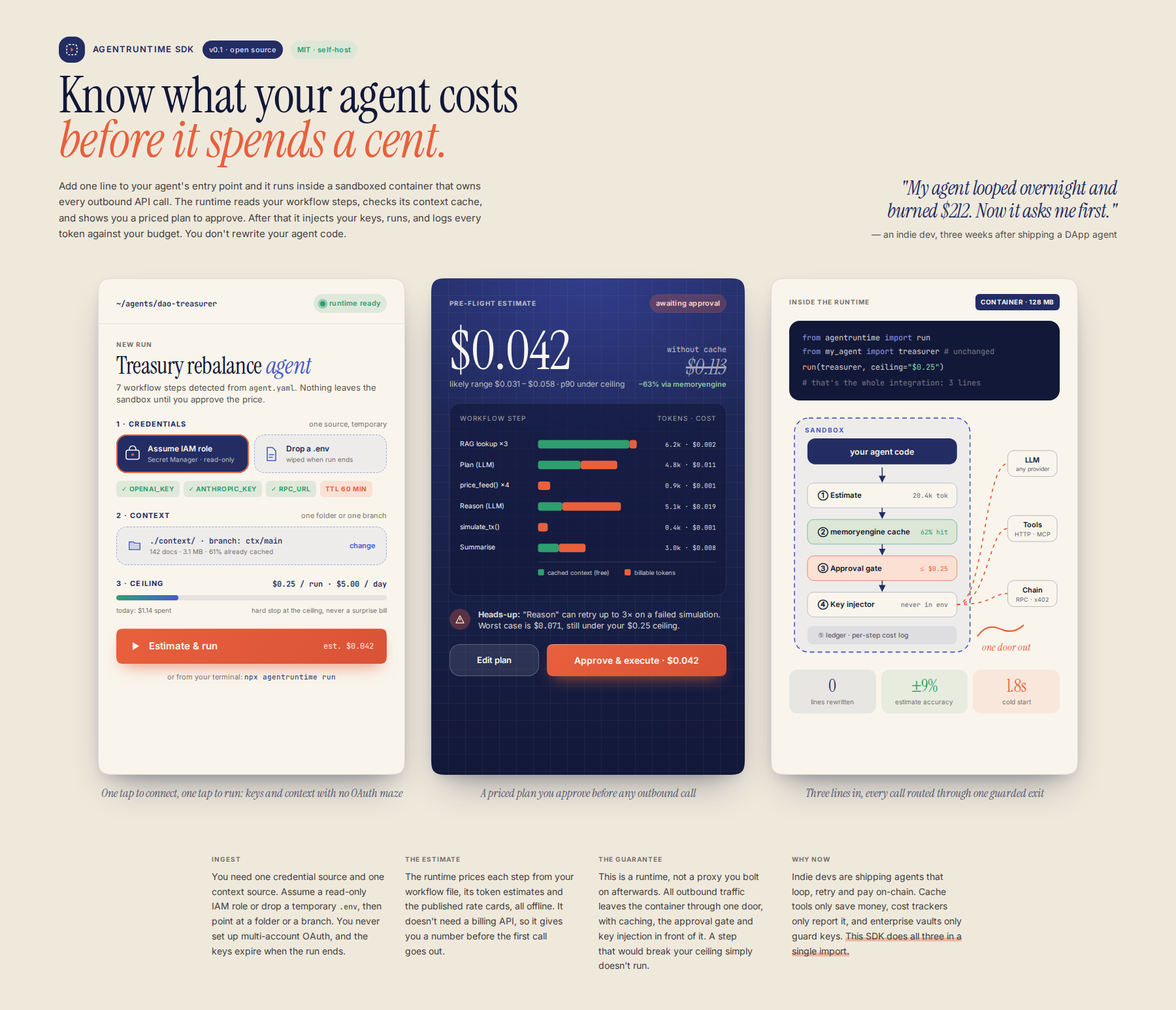
A standardized, cost-aware agent runtime SDK addresses this by wrapping agent execution in a sandboxed container that intercepts every outbound API call. It estimates token usage per workflow step, checks a caching layer for already-available context, and surfaces a cost prediction with a confirmation step before executing calls, logging consumption for billing afterward. It's built for indie developers deploying AI agents and DApps who need reliable, budget-constrained execution without managing infrastructure or proxy layers themselves.
Process flow
Who it's for
Indie developers building AI agents and DApps who require reliable, standardized, and cost-controlled deployment methods without deep infrastructure knowledge.
Why they need it
The primary pain remains the financial opacity and instability of agent deployments. Developers waste time debugging 'massive, unexpected API token costs' and struggle with the 'widest gap between advertised price and real price' because current agent logic is too fragmented and non-standardized to manage resources efficiently. They need a single, reliable layer of execution guarantee.
What it is
An open-source, standardized SDK (AgentRuntime SDK) and associated containerized runtime environment. This environment forces agents to execute within controlled boundaries, providing mandatory context caching, real-time cost estimation, and secure credential injection, without requiring the developer to manually wrap every line of their existing agent code.
How it works
The developer integrates the AgentRuntime SDK into their project's entry point. The SDK initializes the agent within a sandboxed container, which manages all outbound API calls. The runtime first calculates the estimated resource needs based on the agent's defined workflow steps (e.g., RAG lookups, tool calls). It then intercepts the request flow to check the memoryengine for cached context. Before execution, it provides a clear, estimated cost prediction and a warning/confirmation dialog, which, upon approval, executes the call, logs consumption, and tracks the cost for post-execution billing.
Differentiation
We shift the focus from a complex 'proxy' or 'billing gateway' to a standardized 'runtime environment.' This is superior because it solves the integration friction (Critic's point) by making adoption easier. Unlike existing caching tools or simple cost trackers, we provide a full execution guarantee by standardizing the execution flow. Unlike enterprise vaults, it is designed specifically as a lightweight, pluggable SDK for rapid DApp deployment, making cost-estimated, reliable execution the core, simple value proposition.
Implementation sketch
- Define the initial scope: Focus only on the SDK/Runtime wrapper and cost estimation, completely deferring the smart contract/blockchain payment layer.
- Develop the core
AgentRuntimelibrary (e.g., in Python) that provides standardized methods for agent execution, ensuring all API calls pass through the controlled execution path. - Implement the
memoryenginelogic within the SDK to detect and log context cache misses, allowing the SDK to calculate token savings before the call. - Build the cost estimation module: Intercept the request payload and calculate token usage based on the current API rate card, presenting the estimate to the developer before execution.
First step: Create a minimal viable SDK wrapper (e.g., AgentRuntimeClient) in Python that accepts a simple function call (the agent's core logic) and wraps it within a try...except block, logging the start and end tokens used, simulating the cost calculation without calling any external APIs yet.
Remaining risks
- The 'Estimation vs. Guarantee' Problem: Even with the SDK, the core value proposition relies on cost estimation. Because agent logic is non-deterministic (e.g., conditional loops, external tool calls, API rate changes), the estimate will inevitably fail or be inaccurate in complex, real-world scenarios. This forces the product to be marketed as 'Best Effort,' which severely weakens the perceived value and reliability needed for mission-critical DApps. — Shift the marketing narrative from 'Cost Guarantee' to 'Cost Visibility and Constraint.' Instead of promising perfect prediction, the SDK should focus on providing highly accurate, real-time monitoring and enforcing strict, user-defined execution limits (e.g., 'Do not exceed 5,000 tokens or 3 tool calls'). This manages expectations and focuses the value on control, not prediction.
- Vendor Lock-in and API Fragmentation: While standardizing the runtime is beneficial, the SDK will inevitably become tightly coupled to the API structures of the initial major providers (e.g., OpenAI, Anthropic). If the market rapidly shifts to a new model provider or a specialized, non-standard API endpoint (e.g., a niche vector database API), the SDK will require immediate, high-effort updates, creating a maintenance bottleneck and making it difficult for developers to adopt the tool for novel use cases. — Design the SDK using a highly abstract and modular 'Tool/API Adapter' pattern. The core execution engine should only handle the flow (read context, call tool, summarize result), while all actual API interaction (token counting, request formatting, error handling) must be delegated to pluggable, replaceable adapter modules. This makes the SDK itself agnostic to the underlying service.
- Developer Inertia and Adoption Friction: The SDK solves the problem of 'manual wrapping,' but it introduces a new, mandatory dependency into the developer's workflow. If the initial developer experience (DX) is clunky, requires boilerplate setup, or adds noticeable latency, developers will revert to their existing, messy, custom solutions, viewing the SDK as another piece of necessary, but annoying, middleware overhead. — Prioritize the 'Zero-Config' experience. The initial version must be designed to require less than five lines of code to wrap a basic agent function. The documentation and onboarding must heavily emphasize the 'drop-in' nature of the SDK, making the marginal cost of adoption near zero compared to the marginal benefit of cost control.
Watch for: If the initial developer feedback shows that the cost estimation module (the core technical differentiator) cannot reliably handle a common, multi-step agent workflow (e.g., RAG lookup -> tool call -> summarization) without significant manual debugging or workarounds, the technical feasibility of the entire premise is compromised. Kill criterion: If the market fails to show strong, measurable demand for the standardization aspect. If developers are only asking for a simple cost tracker and are indifferent to the runtime structure, it means the core pain point is financial opacity, not architectural complexity, and the SDK is over-engineering the solution.
Sources the council used
Real-world evidence that grounded this idea — judge it for yourself.