
MVP Spec: Guaranteed Inference Compute Rail (Fixed-Length Jobs)
A focused, mission-critical infrastructure layer guaranteeing minimum compute throughput for fixed-length AI inference jobs by dynamically orchestrating a mixed resource pool (decentralized + centralized fallback).
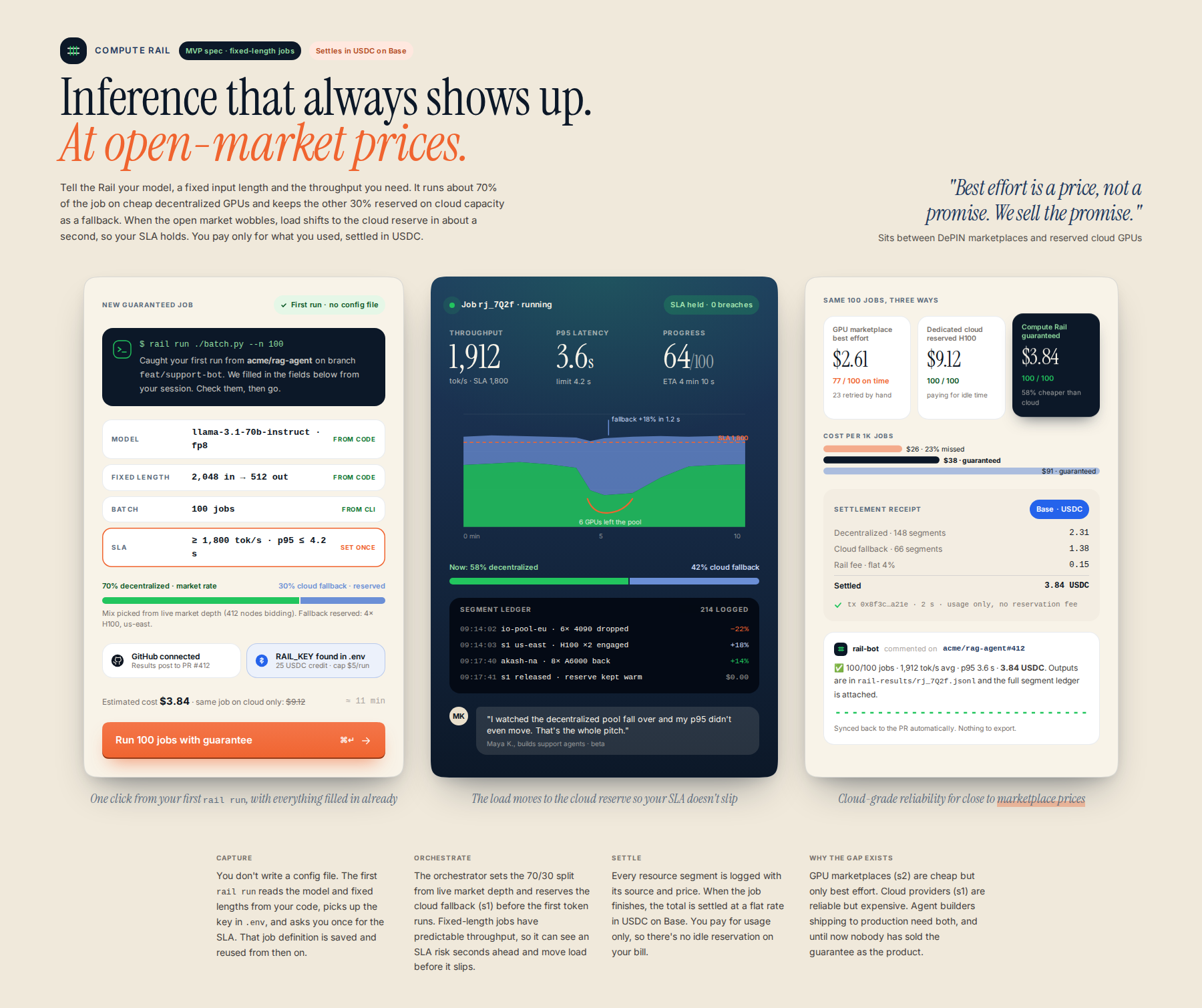
Process flow
Who it's for
AI Developers building production-grade, mission-critical agentic applications (e.g., RAG agents, fixed-prompt chatbots) that cannot tolerate compute failure.
Why they need it
The inherent variability and 'best effort' nature of decentralized compute marketplaces lead to unacceptable failure rates and unpredictable costs for production AI agents. We are solving the critical gap between 'best effort' compute and the guaranteed SLA required for enterprise deployment.
What it is
A specialized orchestration service that takes a defined job requirement (Model X, fixed input length, guaranteed throughput Y) and guarantees execution by managing a mixed resource mix (e.g., 70% decentralized, 30% cloud fallback). The service handles the complexity of resource sourcing and load balancing, abstracting it entirely from the developer.
How it works
- The developer submits a job request specifying the required SLA and model/job parameters (e.g., 'Run 100 fixed-step inference job').
- The orchestrator determines the optimal mixed resource mix (70/30) based on real-time market data and reserves capacity on the guaranteed cloud fallback.
- The system executes the job, dynamically shifting the load between the two sources to maintain the SLA, and logs every resource segment consumed.
- Upon completion, the platform calculates the total compute cost (usage only) and settles the funds via a simple, fixed-rate settlement rail (USDC on Base).
Differentiation
This differs from standard Decentralized GPU Marketplaces because we provide a built-in, guaranteed fallback mechanism, transforming 'best effort' into a guaranteed SLA. It differs from dedicated Cloud Providers by maintaining a significant portion of cost efficiency through the decentralized market, thus filling the gap between guaranteed reliability and cost-optimized infrastructure.
Implementation sketch
- Mock the
agentcollectiveAPI endpoint to accept fixed job parameters (Model ID, Target Steps). - Develop a dedicated microservice that simulates real-time data ingestion from
flop-network-trackingand cross-references it with a fixed, reserved capacity contract to calculate the optimal 70/30 ratio. - Build the core load-balancing logic (the state machine) that simulates job execution, allocating load across the two sources and handling failure/failover logic within the defined fixed-job boundary.
- Implement a simplified smart contract wrapper on Base solely to receive the final, auditable compute cost settlement, ignoring complex accounting for the MVP.
First step: Draft the API contract and data model for the fixed-length job submission. This involves defining the exact JSON payload required by the orchestrator (e.g., {model_id: 'Llama3', required_steps: 100, target_sla_throughput: 'X tokens/sec'}).
Remaining risks
- Market inertia and developer vendor lock-in. Even with a perfect technical solution, developers building complex pipelines are highly resistant to switching infrastructure, especially if their current cloud setup (AWS/GCP) is deeply integrated into their CI/CD and monitoring tools. — Focus initial sales efforts not on the technology, but on the risk mitigation (SLA guarantee) for existing mission-critical customers. Build robust, out-of-the-box integration templates for major agent frameworks (e.g., LangChain, AutoGen) to minimize the perceived integration effort.
- Scope Creep to Variable/Multi-Step Reasoning. The MVP successfully solves fixed-length inference. However, the real value in agentic systems comes from variable-length, multi-step reasoning (e.g., complex RAG retrieval and iterative planning). Guaranteeing an SLA for these variable, non-deterministic workloads is exponentially harder than guaranteeing fixed throughput. — Treat the fixed-length job as a 'lighthouse' feature. Simultaneously, dedicate resources to modeling and guaranteeing the latency of the orchestration itself, rather than just the compute throughput. Start solving the 'state management' guarantee, which is the foundation for variable-step agents.
- Commoditization of the Guarantee. If major cloud providers (AWS, Google) realize the value of the guaranteed fallback model, they may integrate similar functionality or acquire a competing decentralized rail. This could eliminate the cost-efficiency and differentiation derived from the mixed-source model. — Maintain a strong moat around the data layer and the optimization logic—the specific algorithm that determines the optimal 70/30 mix based on proprietary real-time market signals. This data intelligence must be harder to replicate than the fallback mechanism itself.
Watch for: A major cloud provider (AWS, GCP) announcing a new compute service that offers a guaranteed SLA for AI inference, even if it's initially priced higher than the current mixed-source model. This signals that the market is ready to accept the 'guarantee' and validates the core problem, forcing us to race on cost parity. Kill criterion: If the market cannot find use cases where the cost savings (from the decentralized portion) are demonstrably significant enough to offset the perceived risk and integration effort compared to simply paying a premium to a single cloud provider for a guaranteed SLA.
Sources the council used
Real-world evidence that grounded this idea — judge it for yourself.