
Dynamic Reputation Gateway for Agentic Systems
A high-throughput, verifiable reputation layer that uses behavioral anomaly detection to govern API access, providing enterprise-grade security and trust scores for the emerging agent economy.
How can I secure API access for autonomous AI agents beyond static API keys?
Static API keys and tokens only verify identity, not ongoing behavior, so a dynamic reputation gateway continuously scores agents based on real-time call volume, resource use, and deviation from stated intent. A scoring engine updates a Trust Score in a fast internal database (Redis/Postgres) on every request, gating access by threshold without blockchain-level latency; an optional staking and audit layer handles severe violations asynchronously. It's built for developers running high-volume, mission-critical agent-powered APIs who need dynamic trust verification rather than one-time credential checks.
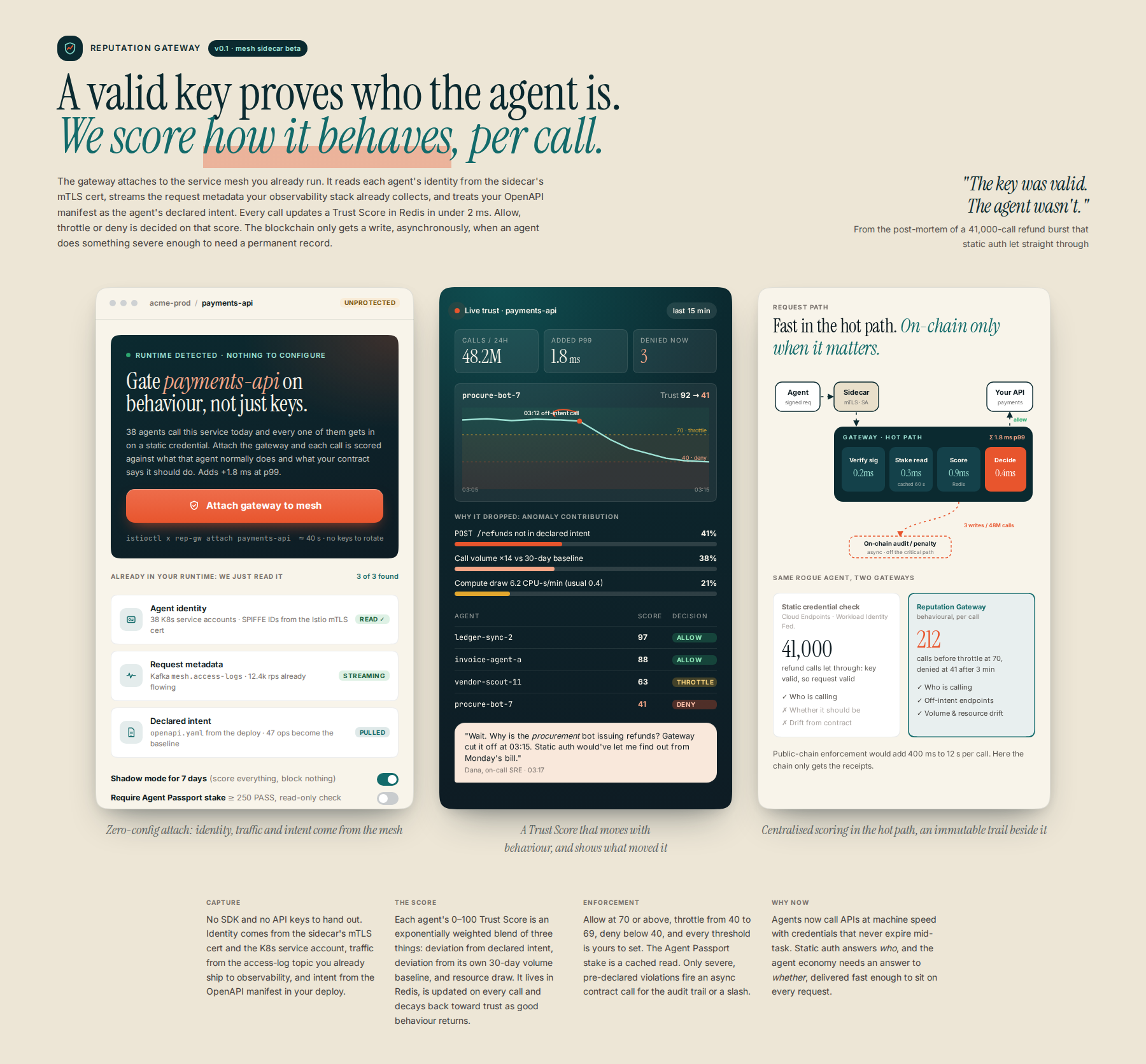
Process flow
Who it's for
Developers building mission-critical, high-volume agent-powered applications who require superior security and dynamic trust verification for their API endpoints.
Why they need it
The current security landscape relies on static credentials (API keys, tokens) which are insufficient against sophisticated, autonomous agents. Agencies need a standardized, dynamic mechanism to verify not just who the agent is, but how it is behaving. By focusing on behavioral reputation, we provide immediate, scalable security without the latency or complexity of mandatory blockchain enforcement.
What it is
The Reputation Gateway is a centralized, high-speed service that continuously monitors agent behavior against established baselines. It assigns and updates a 'Trust Score' using a fast, permissioned database. This score is derived from real-time metrics (call volume, resource consumption, deviation from stated intent). The blockchain layer is relegated to an optional, asynchronous audit log and initial staking proof, dramatically simplifying the core access path.
How it works
- Setup: The API owner configures the Gateway and optionally requires the agent to stake an Agent Passport token for initial identity verification (read-only check).
- Real-Time Request: The agent sends a request with a cryptographic signature to the Gateway.
- Validation (Core): The Gateway verifies the signature and checks the agent's initial staked status (fast read).
- Scoring (Core): The Scoring Engine processes call metadata, volume, and behavioral anomalies, updating the Trust Score in a high-speed, internal database (e.g., Redis/Postgres).
- Access Decision (Core): The Gateway determines access based on the current Trust Score threshold.
- Compliance/Audit (Optional): Only in cases of severe, pre-defined violations (e.g., legal mandate, massive resource drain) is an asynchronous transaction triggered to the smart contract, updating the immutable audit trail or enforcing a penalty. This keeps the critical path fast and scalable.
Differentiation
Unlike current cloud solutions like 's2' (Google Cloud Endpoints) or 's4' (Workload Identity Federation), which are limited to static credential verification, our system provides a dynamic, behavioral reputation layer. Our gap is not merely 'ownership proof,' but 'superior behavioral anomaly detection.' By making the real-time scoring centralized and high-speed, we eliminate the critical latency and complexity associated with using a public blockchain as the core enforcement mechanism, making the solution viable for high-throughput enterprise adoption.
Implementation sketch
- Phase 1 (Weeks 1-2): Build the core Gateway endpoint (Cloudflare Worker or similar) focused solely on cryptographic signature verification and fast score reading from a centralized cache (Redis).
- Phase 2 (Weeks 3-4): Develop the initial Scoring Engine prototype. This backend service will ingest simulated call metadata (volume, time, resource usage) and update a simple, time-series reputation score in a high-speed database, determining access based on a simple threshold.
- Phase 3 (Weeks 5+): Integrate the optional blockchain layer. This will be limited to an asynchronous write-only service that logs the event of a critical score drop, rather than participating in the real-time scoring loop, significantly de-risking the architecture.
First step: Draft the technical specification and API contract for the core Gateway endpoint (e.g., using OpenAPI/Swagger) that accepts the signature and the Agent Passport ID, allowing a mock scoring service to read the initial status via a simple REST call.
Remaining risks
- Adversarial Evasion and Data Drift: The core value proposition relies on the scoring engine accurately modeling 'normal' agent behavior. Sophisticated, malicious agents will inevitably develop strategies (e.g., slow, patterned attacks, distributed resource usage) specifically designed to bypass the defined behavioral baselines, leading to 'data drift' where the model becomes obsolete and ineffective. — Implement a continuous red-teaming and feedback loop. The system must allocate resources for adversarial AI testing and incorporate a mechanism for agents to submit anonymized 'behavioral profile updates' that the scoring engine can integrate into its training data, ensuring the model remains adaptive rather than static.
- **Regulatory and Legal Ambiguity of 'Abuse': The system's power to unilaterally downgrade an agent's Trust Score and restrict access based on ** — Partner early with legal and compliance experts in target jurisdictions. Instead of enforcing arbitrary rules, focus the system on providing verifiable metrics of risk (e.g., 'Deviation from stated intent exceeded 3 standard deviations') and mandate a clear, auditable, and multi-party dispute resolution process before any punitive action is taken.
- The 'Cold Start' Problem for Reputation: For any new agent or API endpoint, the Trust Score is initially unknown. During this 'cold start' phase, the system must either grant overly permissive access (undermining security) or overly restrictive access (killing adoption). The initial onboarding experience is a critical failure point. — Institute a tiered onboarding process. New agents should start in a 'Sandbox' or 'Observation' mode, where they are limited to low-volume, read-only endpoints and are monitored intensely. The Trust Score should only begin to accumulate positive weight after passing a mandatory, verifiable 'Proof of Intent' challenge.
Watch for: Any early indication that enterprise clients are more concerned with the operational complexity of integrating the scoring engine (e.g., data pipeline setup, latency measurement) than with the security benefits of the Trust Score itself. This indicates the solution is viewed as an unnecessary infrastructure burden rather than a core security feature. Kill criterion: The inability to demonstrate a clear, measurable, and economically viable path to differentiating the Trust Score from a highly optimized, rate-limited, and geo-fenced solution offered by a major cloud provider (AWS/GCP/Azure) in a real-world, proof-of-concept deployment.
Sources the council used
Real-world evidence that grounded this idea — judge it for yourself.