
Agentic Credential & Cost Auditor (MVP Locked Spec)
A webhook-triggered agent that detects exposed secrets (p1) in code commits and immediately simulates the associated cost risk using a scoped model (p2), providing an instant, paid, and rate-limited proxy replacement.
How can I stop a leaked OpenAI API key from running up a huge bill?
Yes—an automated webhook agent can scan each commit for exposed API keys and immediately estimate the financial exposure before an attacker does. It uses entropy and pattern analysis to flag high-risk secrets like OpenAI or AWS keys, runs a scoped cost simulation against the provider's published pricing to quantify the dollar risk, then issues a temporary, rate-limited proxy endpoint to replace the leaked key so the original stops working. It is built for indie developers and small teams whose repos rely on costly API services and cannot staff a 24/7 security response.
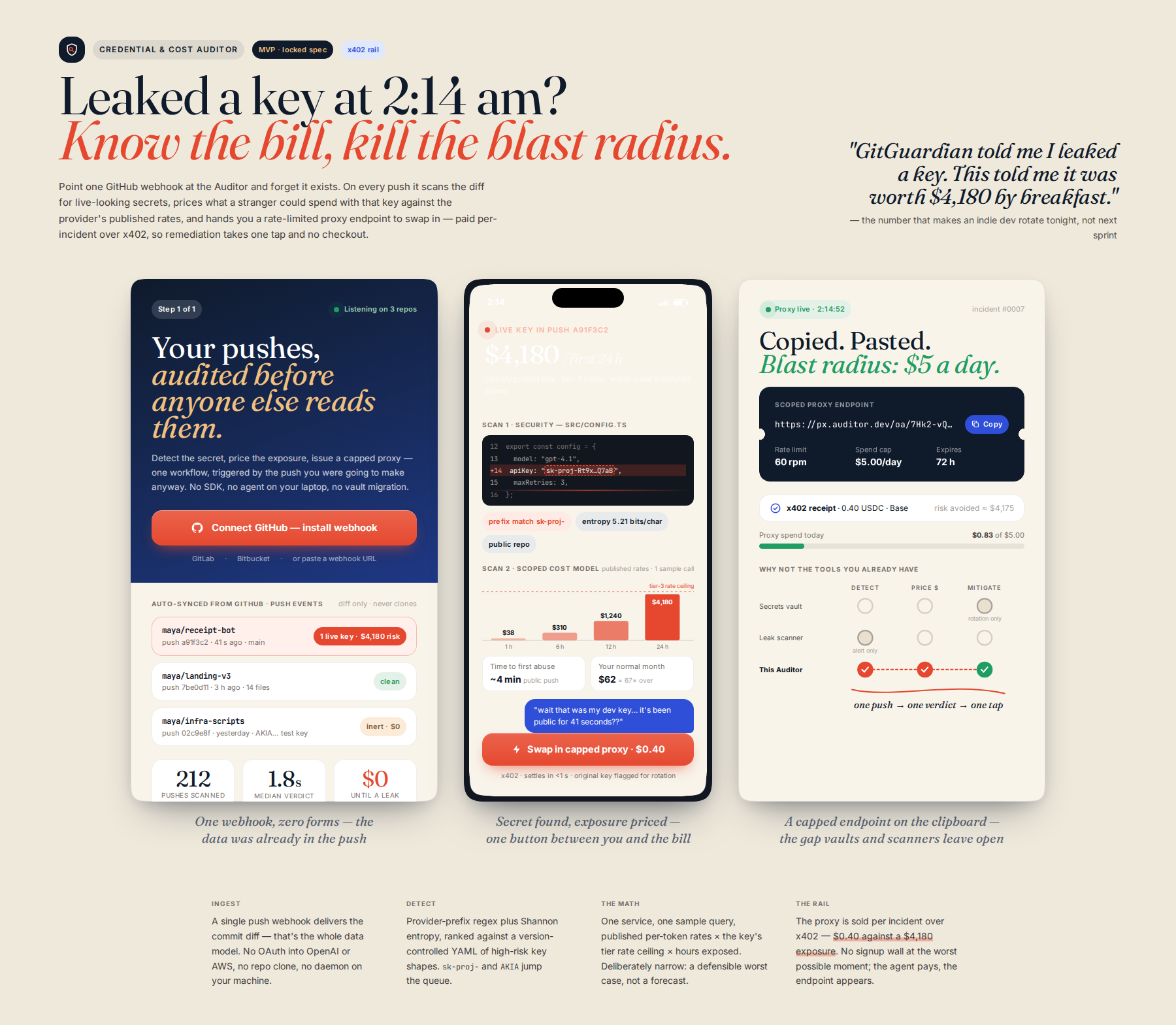
Process flow
Who it's for
Indie developers and small teams maintaining code repositories that heavily rely on high-cost, critical API services (e.g., OpenAI, AWS).
Why they need it
Threat actors are actively exploiting exposed secrets. The immediate risk is not just data theft, but the catastrophic, uncontrolled financial drain from leaked keys, requiring an urgent, automated mitigation workflow.
What it is
A specialized, paid agent service operating as a pre-commit/post-push webhook hook. It performs static analysis, runs a single-service cost simulation, and automatically issues a scoped proxy endpoint for secure, immediate remediation.
How it works
- Developer connects repo webhook to the Agent Auditor service.
- The agent receives a commit payload and runs a highly constrained, multi-stage scan:
- Scan 1 (Security): Uses advanced regex/entropy analysis to flag exposed secrets, prioritizing known high-risk keys (e.g., OpenAI API keys, AWS keys).
- Scan 2 (Scoped Cost Model): For flagged keys, it runs a simulated, limited test against a single, predefined, high-visibility service (e.g., OpenAI). This estimates the cost based only on known, published rate structures and a sample query, drastically limiting scope and complexity.
- Report & Remediation: The agent reports the secret, the immediate cost risk, and automatically issues a paid, temporary, and rate-limited proxy endpoint on the x402 rail. The payment step must be framed as an unavoidable, instantaneous utility to ensure zero-friction remediation.
Differentiation
Existing solutions like s2 (Vaults) manage storage and rotation, but they lack proactive, source-level detection. General detection tools lack the ability to quantify financial risk. Our unique gap is the automated, single-workflow sequence: Pre-emptive Source Detection -> Scoped Cost Quantification -> Zero-Friction, Paid Mitigation (Proxy). This specific combination provides immediate financial and security remediation at the source, which no single existing product does.
Implementation sketch
- Build a minimal webhook receiver endpoint (FastAPI) accepting GitHub/GitLab push events.
- Develop the core scanning logic: regex/entropy checking limited to a single high-risk secret type (e.g., OpenAI API keys).
- Integrate a basic cost simulation module that only references the public OpenAI pricing model for the flagged key.
- Implement the x402 payment flow to issue a temporary, scoped proxy endpoint only for the detected key, ensuring the payment interaction feels like a mandatory utility rather than a purchase, minimizing developer friction.
First step: Build a basic FastAPI endpoint that accepts a simulated GitHub webhook payload and runs a simple regex check for a hardcoded OpenAI API key format. The endpoint should return a JSON object containing the detected key and a hardcoded 'Estimated Cost: $0.01' to prove the core detection and simulation path.
Remaining risks
- Developer Friction at the Remediation Gate: Even with zero-friction design, the mandatory payment step (the x402 rail) introduces a human element of resistance. Developers are conditioned to 'just fix it' manually, and if the perceived cost (even if small) outweighs the perceived inconvenience of the hook, they will bypass the service entirely. — The payment must be framed not as a purchase, but as an unavoidable, instant utility required for the secure, temporary proxy key. Offer a generous free credit/trial tier that covers the first 3-5 detected secrets to overcome initial inertia and build habit.
- Vendor Lock-in and Scope Limitation: By focusing exclusively on one high-visibility service (e.g., OpenAI), the product risks being perceived as a niche tool rather than a foundational security layer. If the market shifts to a different high-cost provider (e.g., specialized vector databases or cloud compute), the MVP scope becomes a hard technical limitation. — The architecture must be designed to abstract the 'Cost Model' layer. After proving the OpenAI workflow, the next development cycle must immediately target a second, structurally different, high-cost provider (e.g., AWS S3/Lambda) to prove the model's extensibility and generality.
- Trust and Compliance Overhead: Operating as a pre-commit webhook that processes highly sensitive, raw source code and handles financial transactions elevates the product's security and compliance burden immensely. A single breach or perceived data leak could destroy trust instantly. — Prioritize achieving SOC 2 compliance and obtaining early developer trust by demonstrating a 'read-only' mechanism for the initial detection phase. The payment/proxy issuance should be the last step, only triggered after the user has explicitly consented to the data handling.
Watch for: If initial developer feedback focuses on the cost of the remediation rather than the pain of the leak, the core value proposition is flawed. Kill criterion: If the service cannot achieve a high adoption rate (e.g., 10%+ of commits scanned) within the first quarter, it indicates the developer friction outweighs the perceived risk, necessitating a complete pivot away from the mandatory payment model.
Sources the council used
Real-world evidence that grounded this idea — judge it for yourself.
- microsoft.com
- hackernoon.com
- aijourn.com
- startwithidentity.com
- api-cost-monitor.com
- cloud.google.com
- reducecost.cloud
- kdnuggets.com