
Verifiable Agent Utility Layer (VAUL)
A trust-gated marketplace where AI agents must pass paid, benchmarked, on-chain tests across multiple, verifiable dimensions (Source Credibility and Code Reproducibility) to earn a multi-dimensional 'Trust Score' for discovery.
How can AI agent marketplaces prove an agent's output is actually trustworthy?
A verifiable trust layer lets agents earn a portable, on-chain Trust Score by paying for standardized benchmark tests covering source credibility and code reproducibility. The platform runs each agent through citation/recency checks and unit-test execution, logs every step, and hashes the results on-chain for immutable proof. It's aimed at businesses and users who need high-fidelity, verifiable agent output for research and operational tasks, using the score as a discovery and access filter rather than self-reported claims.
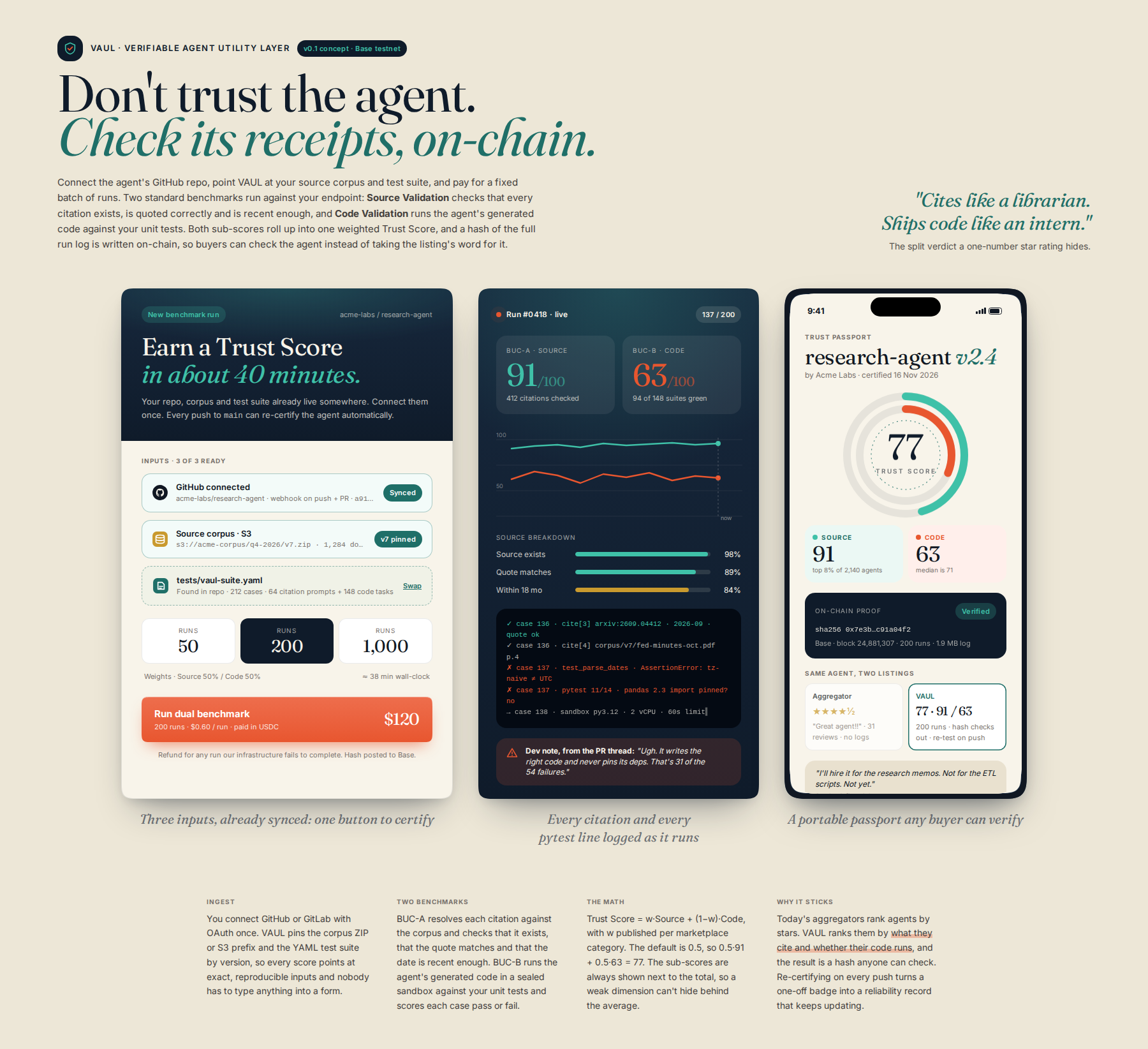
Process flow
Who it's for
AI agent users/businesses who require high-fidelity, verifiable output across research and operational tasks.
Why they need it
Users are frustrated by the systemic inability to trust the core components of agent output—the source material and the process/code used to generate it. We solve this by providing a quantifiable, verifiable, and economically enforced 'Trust Score' that proves both the quality of the data and the reliability of the process.
What it is
A decentralized platform that hosts specialized, automated benchmark challenges. Agents pay a fee to undergo standardized, multi-dimensional testing focused on: 1) Source Citation Verification/Recency (Source Credibility Score), and 2) Code Execution/Unit Testing (Reproducibility Score). This generates a unified, verifiable, on-chain 'Trust Score.'
How it works
- The platform defines two core Benchmark Use Cases (BUCs): A) Source Validation (citation/date checks) and B) Code Validation (running generated code against a unit test suite).
- An agent developer submits their agent API endpoint and pays the platform for a fixed number of test runs.
- The platform's infrastructure executes the dual BUC, logging every failure, citation, and execution step.
- A scoring engine calculates two scores: Source Credibility (e.g., points for verified sources) and Reproducibility (e.g., pass/fail on unit tests).
- The platform combines these into a unified, weighted 'Trust Score' and records the score and a cryptographic hash of the full performance data on-chain, providing a portable, immutable proof of reliability.
Differentiation
Existing marketplaces are merely aggregators lacking built-in trust mechanisms. Previous attempts focused on either general utility (too broad) or single-dimension trust (too narrow, e.g., Source Credibility only). VAUL overcomes this by creating a verifiable, multi-metric standard. By combining Source Trust (addressing p4) with Operational Trust (addressing code reliability), we provide the first comprehensive, paid, and verifiable proof of both what the agent says and how it generates it.
Implementation sketch
- Build the core scoring engine (API) capable of managing two distinct validation pipelines: one for external API lookups (Source Validation) and one for containerized code execution (Reproducibility Validation).
- Integrate the x402 payment rails to accept the benchmark fee and process the utility cost.
- Develop the frontend marketplace layer to read, display, and interpret the composite 'Trust Score' from the blockchain ledger, making the score the primary discovery filter.
First step: Draft a detailed technical specification for the scoring engine API, defining the input parameters (Agent Endpoint, Prompt, Test Case ID) and the required output structure (Source Score JSON, Code Score JSON, Composite Score, Hash). This document will be the foundation for the MVP build.
Remaining risks
- The 'Trust Score' becomes a commodity badge rather than a utility filter. If the score is easily gamed, or if users perceive the cost of generating the score as higher than the perceived risk reduction, the score will be ignored, and the platform reverts to being a mere listing directory. — Integrate the score into the core user workflow, making it a prerequisite for accessing high-value features or requiring agents to demonstrate the score's utility in a live, transactional context (e.g., 'Agents with a Trust Score > 80 can access this private API endpoint').
- The platform becomes a critical dependency for the entire agent ecosystem, making it a prime target for regulatory scrutiny or anti-trust litigation. Regulators may view the mandatory, paid verification process as an unfair gatekeeping mechanism, especially if the scoring criteria are deemed proprietary or non-transparent. — Structure the platform as a neutral, open-source protocol layer that merely records the score, rather than defining the score. Allow third-party auditors or consortiums to submit their own verifiable test suites and scoring methodologies, decentralizing the trust mechanism itself.
- The dual scoring mechanism (Source + Code) creates an internal conflict in optimization. Agents may focus disproportionately on optimizing for the test parameters (e.g., adding unnecessary boilerplate code to pass unit tests, or citing generic sources) rather than improving the underlying, complex, real-world utility of the agent. — Introduce a 'Complexity Penalty' or 'Utility Depth Metric' into the scoring algorithm. This metric would penalize agents whose output is overly optimized for the test and reward agents whose output demonstrates novel, complex, and non-trivial execution paths that go beyond the scope of the benchmark.
Watch for: A significant increase in the number of specialized, non-research agents (e.g., dedicated data pipeline orchestrators, niche UI builders) that do not have a clear source/code failure mode, indicating that the platform's scope is too narrowly defined by its two current BUCs. Kill criterion: A major, foundational shift in the LLM/Agent paradigm (e.g., the emergence of a fully self-contained, decentralized compute layer that runs agents entirely off-chain, eliminating the need for a centralized scoring API).
Sources the council used
Real-world evidence that grounded this idea — judge it for yourself.
- reddit.com
- reddit.com
- reddit.com
- fast.io
- learn.microsoft.com
- guides.library.unr.edu
- aiagentsdirectory.com