
Verticalized Agent Compute Optimizer for Structured Data Extraction
A specialized, centralized compute layer designed to optimize complex, multi-step data extraction workflows within a single high-value vertical (e.g., legal documents). It dynamically selects the optimal model combination (e.g., T-Flash vs. Gemini) to achieve the highest accuracy at the lowest cost, providing a verifiable usage ledger.
How can AI agent systems cut cost and improve accuracy for legal document data extraction?
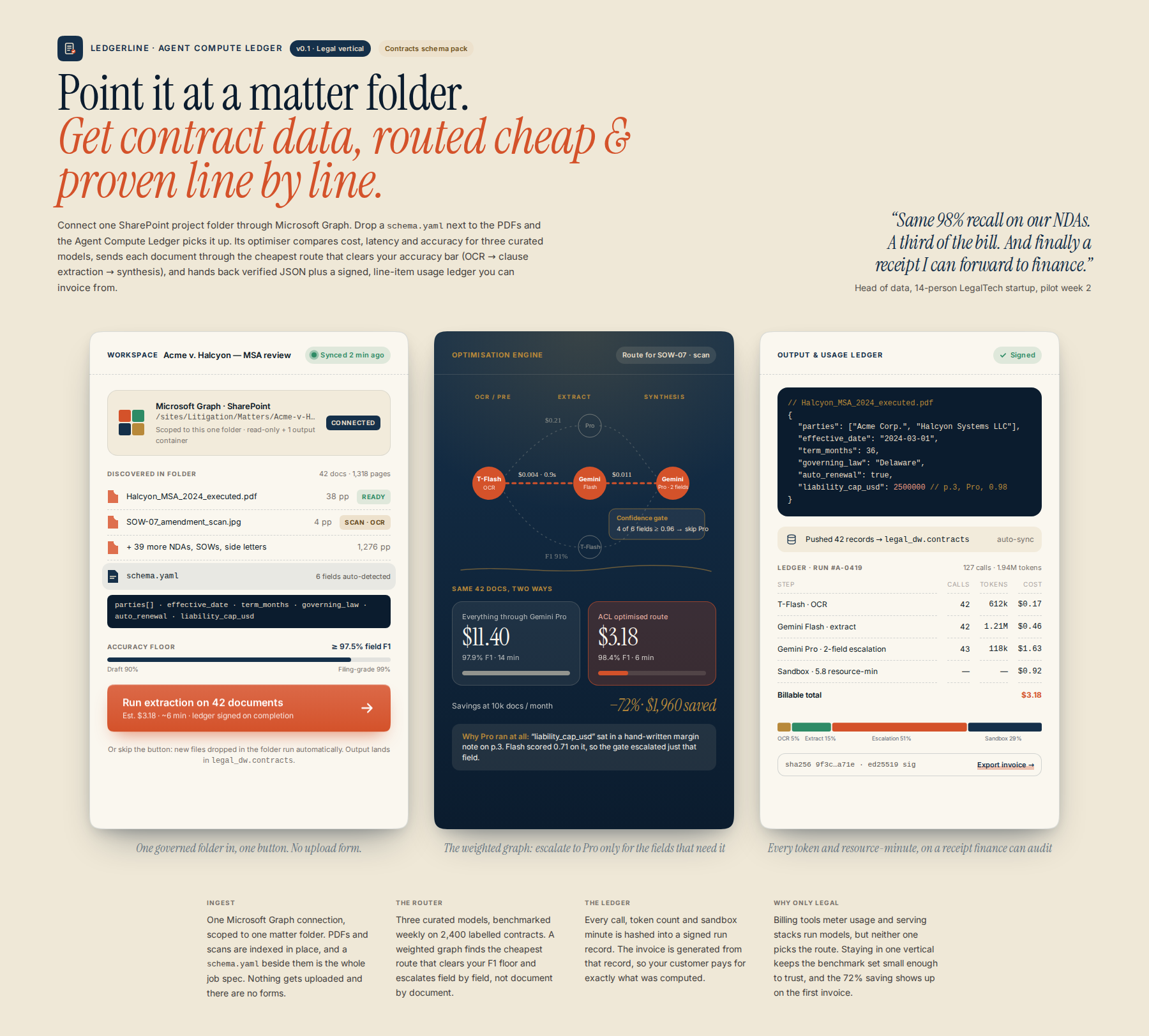
A verticalized compute layer solves this by dynamically routing a document and extraction schema through the optimal sequence of 2-3 specialized models, rather than relying on one general-purpose model. For example, one model handles OCR and pre-processing, a second performs intent extraction, and a third synthesizes the final structured output, with every API call, token, and resource minute logged in an auditable usage ledger. This approach is aimed at LegalTech and FinTech founders, data extraction engineers, and enterprise AI developers who need predictable costs and verifiable accuracy from semi-structured documents like contracts.
Process flow
Who it's for
LegalTech/FinTech App Founders, Data Extraction Engineers, and Enterprise AI Developers.
Why they need it
The core pain is not general agent scaling, but the difficulty of achieving high-accuracy, cost-effective data extraction from complex, semi-structured documents. Current solutions treat model choice and execution as separate problems, leading to unpredictable costs and inconsistent reliability. We solve the 'Model Selection and Optimal Pathing' problem for a defined, high-value use case.
What it is
A specialized, centralized Agent Compute Ledger (ACL) that acts as a dedicated intermediary execution environment. It takes a document and an extraction schema as input, executes the task using an Optimization Engine, and outputs a structured, verifiable data JSON along with a detailed usage log.
How it works
- The client submits a document (PDF/Image) and a target schema (e.g., 'Extract Contract Parties and Dates') to the ACL API.
- The ACL's Optimization Engine queries a limited, curated set of performance metrics (cost, latency, accuracy benchmarks) for 2-3 specific models.
- The Engine builds a weighted graph and executes the task in a sandboxed environment, routing the prompt through the optimal sequence (e.g., Model A for OCR/Pre-processing → Model B for Intent Extraction → Model C for Final Synthesis).
- The system captures a detailed, auditable log of every API call, token usage, and resource minute.
- The client receives the structured data and a billable invoice based on the verifiable usage log.
Differentiation
Existing solutions are siloed. 's1' handles macro billing but not real-time execution optimization. 's3' and 's4' manage workflow or serving, but fail to provide the holistic, cost-aware optimization layer for a defined vertical. The ACL fills the GAP by tightly coupling model selection, execution, and verifiable accounting for a specific, high-value use case, drastically reducing the initial scope complexity and proving the core value proposition.
Implementation sketch
- Define the MVP vertical: Legal/Financial Document Data Extraction (e.g., extracting parties/dates from contracts).
- Build the core routing engine ('Optimizer') to accept a document and a prompt, and return a weighted graph considering only 2-3 target models (e.g., T-Flash-2, Gemini Pro).
- Integrate a secure sandbox environment capable of executing the multi-step process and capturing all metadata (token count, latency, etc.) for the defined vertical.
- Develop the centralized billing API that accepts the execution log and generates an auditable invoice, proving the usage and cost structure for the client.
First step: Select a single, publicly available, high-value document type (e.g., a sample NDA) and define the exact 5-10 fields that must be extracted. Then, build a minimal proof-of-concept script that manually runs this extraction task through the two chosen models (A and B) and logs the resulting cost and measured latency for direct comparison.
Remaining risks
- Vendor Lock-in and API Volatility: The entire system relies on 2-3 external, proprietary APIs (OpenAI, Gemini, etc.). These providers can change pricing, deprecate features, or restrict access at any time, instantly breaking the core optimization logic and financial model. — Design the model integration layer using a highly abstracted adapter pattern. The system must treat model providers as interchangeable services, allowing for rapid switching or temporary disabling of a provider without requiring a full code overhaul. Maintain active partnerships and monitoring of provider roadmaps.
- The 'Last Mile' Data Variability: Even within a defined vertical (LegalTech), the input data (PDFs, scans, handwritten notes, mixed formats) can introduce unpredictable noise and complexity that the optimization engine cannot handle, causing the system to fail or degrade accuracy despite optimal model selection. — Invest heavily in the pre-processing and data cleaning layer. The MVP must incorporate a robust, failure-tolerant data ingestion pipeline that attempts to standardize the input document before the optimization engine runs, and flags the data quality issue to the user rather than attempting a flawed execution.
- Commoditization by Platform Giants: Once the 'Optimizer' function is proven, large platform players (AWS, Microsoft, Google) will integrate similar optimization and ledger features into their existing enterprise suites, potentially rendering the specialized, standalone ACL redundant or forcing the product into a perpetual arms race against massive R&D budgets. — __
Watch for: When enterprise users begin prioritizing 'seamless integration into existing compliance/CRM workflows' over 'best-in-class optimization.' This signals that the pain point is not the cost of computation, but the difficulty of integrating the computation into their existing, regulated operational stack. Kill criterion: If the team cannot demonstrate, using a sample set of real-world, messy documents, that the optimized process can reliably beat the cost and accuracy of the single, best-in-class model (e.g., Gemini Pro) by a measurable margin, the core value proposition of 'optimization' is invalidated.
Sources the council used
Real-world evidence that grounded this idea — judge it for yourself.
- news.ycombinator.com
- huggingface.co
- cloudzero.com
- payments.ca
- blog.nebulablock.com
- developers.redhat.com