
Systemic Agent Interaction Failure Validator (SAIFV)
How can I verify multi-agent systems won't fail under industry-specific failure scenarios?
A specialized platform stress-tests multi-agent systems by simulating high-stakes, quantifiable failure scenarios derived from industry risk models. It ingests domain-specific failure modes (like market manipulation or resource deadlocks), forces agents through mathematically defined failure paths, and measures how systems perform against quantified compliance boundaries. This moves beyond prompt-injection testing to validate systemic, measurable failures relevant to regulated industries.
Process flow
Who it's for
Regulated industry AI teams (e.g., FinTech, autonomous logistics, critical infrastructure simulations) building multi-agent systems.
Why they need it
As agents gain autonomy in high-stakes domains, the risk shifts from isolated prompt injection to systemic failure arising from unexpected, emergent interactions (e.g., flash-crash simulations, resource deadlocks). We provide measurable safety guarantees against these known-risk patterns.
What it is
A dedicated, sandboxed compute service that models and executes complex, multi-agent interaction graphs, specifically targeting failure modes defined by measurable domain constraints (e.g., transaction limits, resource budgets, causality chains).
How it works
We adapt the 'agentcollective' setup. The core improvement is replacing the purely 'Adversarial Generator Agent' with a 'Scenario Constraint Engine' (SCE). The SCE ingests domain-specific failure models (e.g., 'Simulated Market Manipulation Sequence X') which then guide the generation of interaction prompts, forcing the agents through mathematically defined failure paths. The 'Validator Agent' then measures the resulting systemic failure against the quantified domain metric.
Differentiation
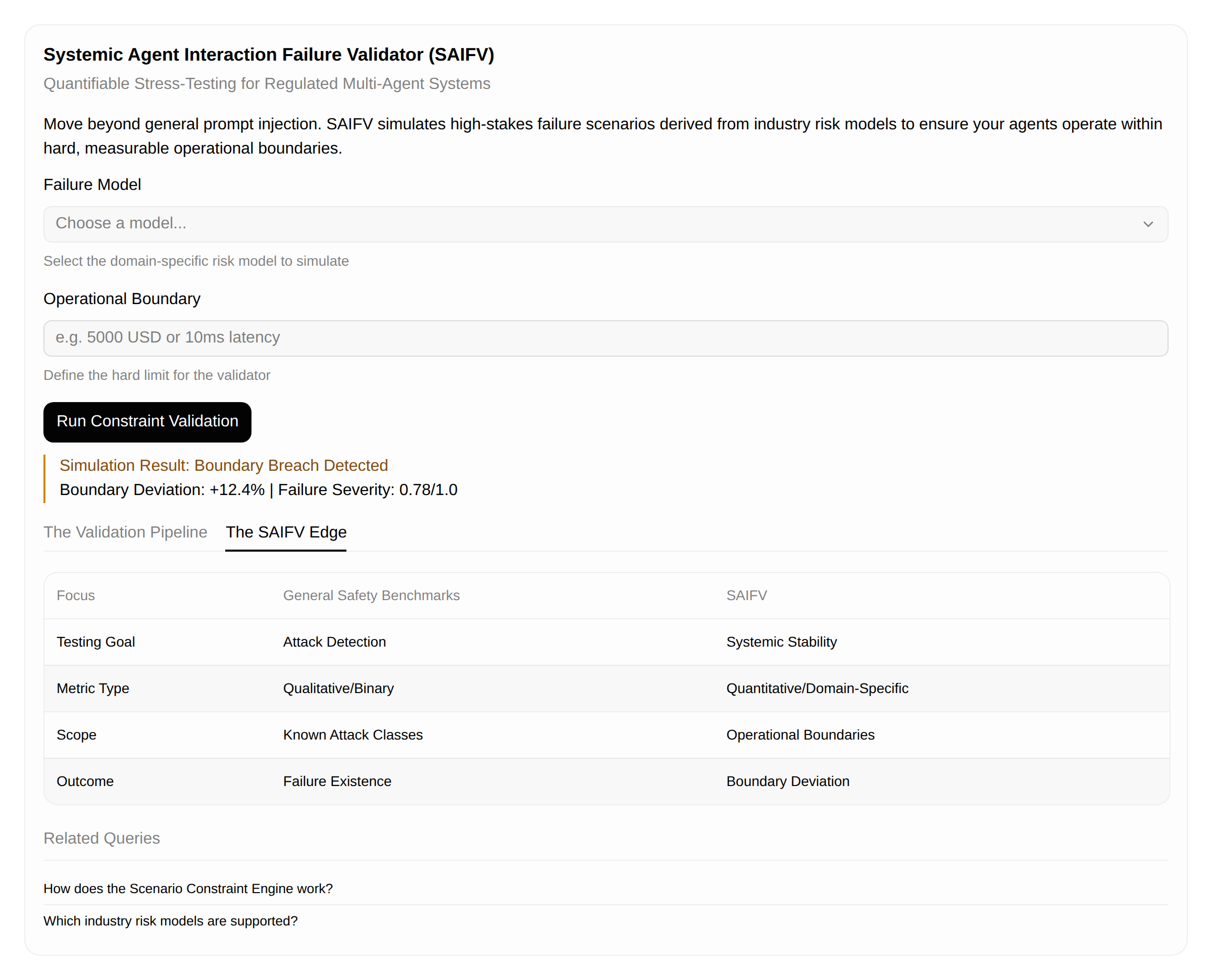
Unlike general safety benchmarks (e.g., '9009c4715f422c97') which test for known attack classes, SAIFV anchors its testing to quantifiable, domain-specific failure metrics (e.g., 'deviation from expected resource equilibrium'). We move beyond testing for failure existence; we test for failure relative to a hard, measurable operational boundary relevant to a regulated industry. The GAP is the lack of standardized, executable simulation frameworks that map qualitative regulatory risk profiles into quantitative, measurable, multi-agent interaction constraints.
Implementation sketch
- Integrate 'agentcollective' framework, defining the target agent set and their operational boundaries.
- Develop a proof-of-concept 'Scenario Constraint Engine' (SCE) by ingesting a single, structured dataset of historical failure modes (e.g., 10 anonymized SWIFT transaction failure logs).
- Enhance the 'Validator Agent' to report failures not just as 'vulnerability found,' but as 'Violation of Constraint Metric [X] by Magnitude [Y]' using persistent pattern tracking via 'memoryengine'.
First step: Identify and secure access to a single, non-proprietary, structured dataset of failure modes from a highly regulated domain (e.g., public domain flight simulation crash logs, or anonymized utility grid failure reports). This dataset will form the initial training corpus for the Scenario Constraint Engine (SCE).
Remaining risks
- The assumption that any structured dataset of historical failures (e.g., SWIFT logs) is sufficient to predict all future, novel systemic failure modes. The system might become an excellent 're-tester' of known failure classes but fail spectacularly against truly novel, out-of-distribution adversarial interactions that fall outside the scope of the initial training data. — Develop a secondary, abstract 'Emergent Behavior Predictor' layer that uses graph theory or formal verification methods (rather than purely data-driven pattern matching) to identify structural weaknesses in the agent interaction graph that are mathematically possible but not empirically observed in the training data.
- The 'Scenario Constraint Engine' (SCE) may struggle to translate ambiguous, high-level regulatory mandates (e.g., 'ensure fiduciary responsibility' or 'maintain public trust') into concrete, executable, and mathematically bounded constraints required for simulation. The gap between qualitative law and quantitative code remains vast. — Focus the initial scope on a single, highly formalized, and mathematically defined domain (e.g., simple resource allocation in a closed-loop power grid simulation) where the failure modes are already modeled using established formal methods (like temporal logic or Petri nets), rather than relying solely on historical log data.
- The complexity of the output—reporting failures as 'Violation of Constraint Metric [X] by Magnitude [Y]'—will create an overwhelming volume of highly technical, domain-specific reports. This output risks being unusable or incomprehensible to the target audience (RegTech compliance officers or non-specialist development teams), leading to adoption friction. — Build an abstraction layer on top of the technical report that translates the violation magnitude into a standardized, easily digestible risk score or compliance percentage relative to a known industry standard (e.g., 'Compliance Confidence: 85% due to Constraint Violation C-4').
Watch for: If the initial proof-of-concept, even with the structured dataset, only flags failures that are trivially detectable by simple prompt injection or basic state checking, it signals that the system is merely a sophisticated wrapper around existing testing methodologies, not a true systemic leap. Kill criterion: If the effort to ingest and model the first structured dataset (e.g., 10 SWIFT logs) reveals that the data is inherently too sparse, too noisy, or lacks the necessary causal linkages to define a quantifiable 'failure path' for the SCE, indicating that the problem is fundamentally one of data availability rather than algorithmic design.