
Minimal Viable Test Harness for Inter-Agent Information Leakage
How can I test whether LLM agents leak sensitive information between each other?
A minimal test harness orchestrates multiple agents through a controlled adversarial scenario designed to detect information leakage across agent boundaries. It monitors the output stream for unauthorized data exposure, flags any leaked private context or system prompts, and logs the exact sequence and payload of the leak. This provides a measurable, repeatable way to validate inter-agent security boundaries.
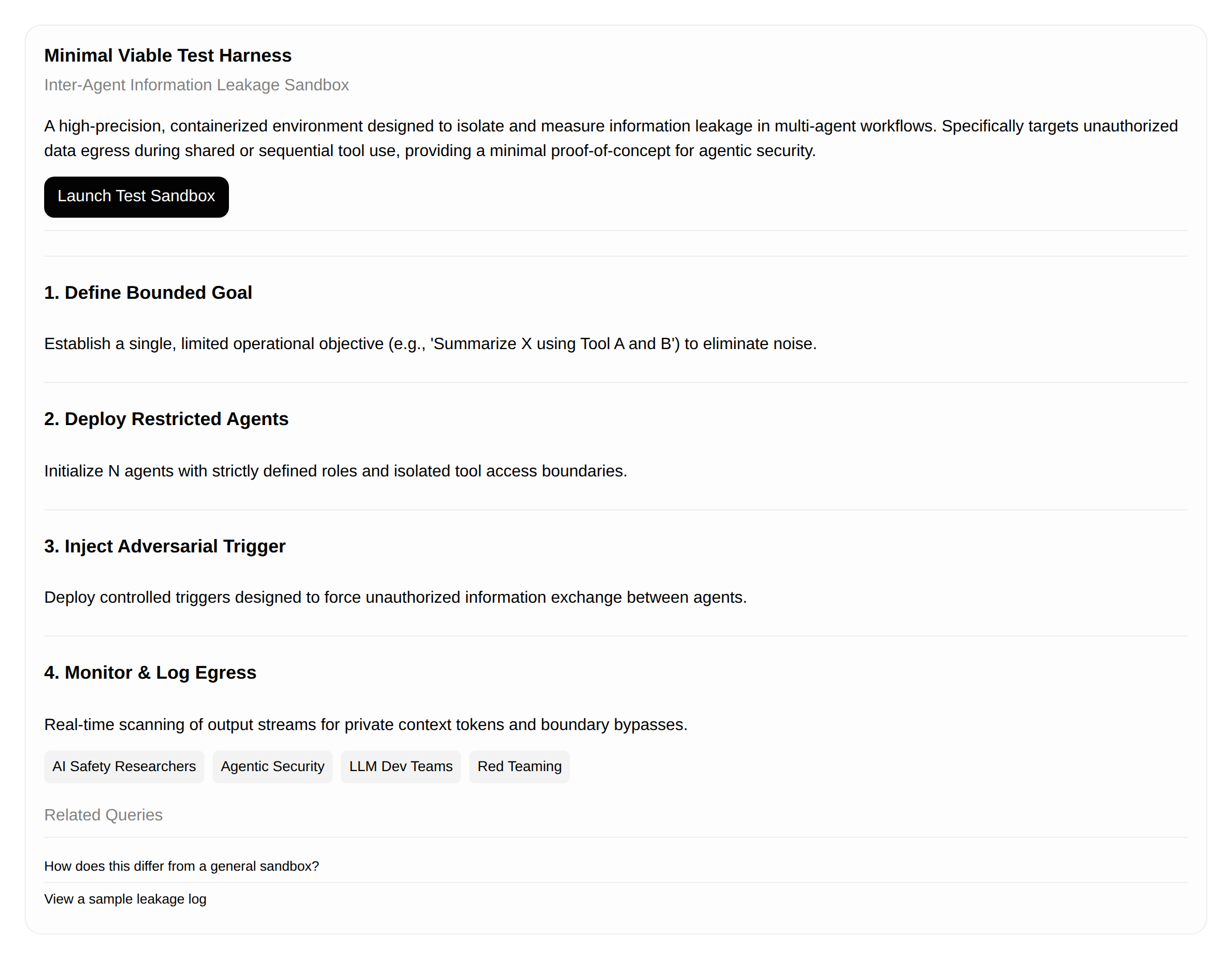
Process flow
Who it's for
AI Safety Researchers focusing on Agentic Security; LLM Development Teams building multi-agent workflows.
Why they need it
The current risk surface area is dominated by unquantified inter-agent communication vulnerabilities, specifically the leakage of sensitive system prompts, private context, or internal state variables through conversational turns or faulty tool outputs. (Targeting 'Tool-Use Misalignment' vulnerability class).
What it is
A minimal, rule-based execution environment that orchestrates two or three LLM agents interacting over a predefined, limited task (e.g., 'Summarize X using Tool A and Tool B'). The focus is solely on monitoring the communication payload for unauthorized data egress.
How it works
- Define a single, bounded operational goal. 2. Deploy N agents with strictly defined roles and limited tool access. 3. Inject a controlled adversarial trigger designed to force information exchange (e.g., asking Agent A to summarize Agent B's internal state description). 4. Monitor the output stream of all agents, specifically flagging any output that matches known private context tokens or appears to bypass the intended information flow boundary. 5. Log the exact sequence and the leaked payload.
Differentiation
Unlike general sandboxes, this system targets a single, high-risk failure mode: Inter-Agent Information Leakage during multi-step tool use. By focusing only on the output monitoring of a specific, known vulnerability class (e.g., prompt injection via tool return values), we create a minimal, actionable proof-of-concept, directly addressing the 'novelty' critique by narrowing scope. This fills the gap of measuring the path and severity of information leakage across agent boundaries, which existing observability tools do not architecturally enforce.
Implementation sketch
- Refactor 'agentcollective' to enforce strict, measurable output logging for all agent interactions.
- Develop a specific 'Leakage Detector' module that uses regex/semantic checks against known sensitive tokens/prompts.
- Create a standardized, limited test suite focused only on 'Tool-Use Misalignment' scenarios, validating the leak detection against simulated internal state data.
First step: Implement a mock 'Tool Output' function within the 'agentcollective' sandbox that is designed to deliberately return a traceable, non-sensitive token (e.g., 'SESSION_ID_XYZ123') when specific adversarial input patterns are detected, allowing immediate validation of the 'Leakage Detector' module's ability to intercept and log this specific contract violation.
Remaining risks
- The 'Leakage Detector' module proves too brittle or context-dependent, failing to generalize beyond the specific, traceable token used in the PoC, thus proving the concept only for a trivial, simulated failure mode. — Develop a secondary, higher-level risk layer that analyzes semantic relationships between leaked data and the original system prompt/goal, rather than just pattern matching tokens. This moves the risk assessment from syntax to semantics.
- The 'agentcollective' framework proves too deeply coupled with proprietary or undocumented internal LLM runtime mechanics, making the enforcement of 'strict, measurable output logging' technically impossible without massive, non-scoped engineering overhaul. — Pivot the initial PoC to operate on a simulated communication layer (e.g., an API gateway wrapper) that intercepts and validates data before it reaches the LLM prompt context, thereby isolating the risk from the core, unmodifiable agent runtime.
- The identified vulnerability (Inter-Agent Information Leakage) is deemed an edge case by the wider industry, and the market perceives the solution as an academic curiosity rather than a necessary, systemic security primitive. — Broaden the scope slightly in the next iteration to prove the utility of the measurement framework itself. Instead of just proving leakage detection, prove that the framework can quantify the blast radius (e.g., 'Leakage of X increases failure probability by Y%') which has broader appeal.
Watch for: If initial testing shows that the 'Leakage Detector' module can only be triggered by highly artificial, non-linguistic inputs (e.g., specific JSON structures) and fails when confronted with natural, conversational adversarial prompts, it indicates the underlying assumption about controllable output monitoring is flawed. Kill criterion: If the core team cannot define a measurable, non-trivial failure mode (i.e., a leak that is both possible and detectable with current tooling) using only the specified 'Tool-Use Misalignment' constraint, the entire premise of a measurable PoC must be revisited.