
Compliance-Grade Compute Attribution Gateway (C-CAG)
An enterprise-grade, verifiable middleware layer that guarantees auditable, atomic, and legally compliant measurement of compute expenditure for regulated agentic workflows.
How can regulated companies get auditable, legally compliant billing for AI agent compute usage?
A middleware billing interceptor placed between agent workflows and their underlying compute APIs can generate immutable, audit-ready cost records. It measures usage per execution, packages it into a signed compliance manifest anchored to a blockchain, and triggers an atomic billing transaction, with pre-defined rollback states if the underlying API call fails partway through. This closes the gap where partial-failure agent runs cause billing disputes or unverifiable costs. It targets enterprises in FinTech, HealthTech, and LegalTech that need non-repudiable proof of compute cost for regulators and auditors.
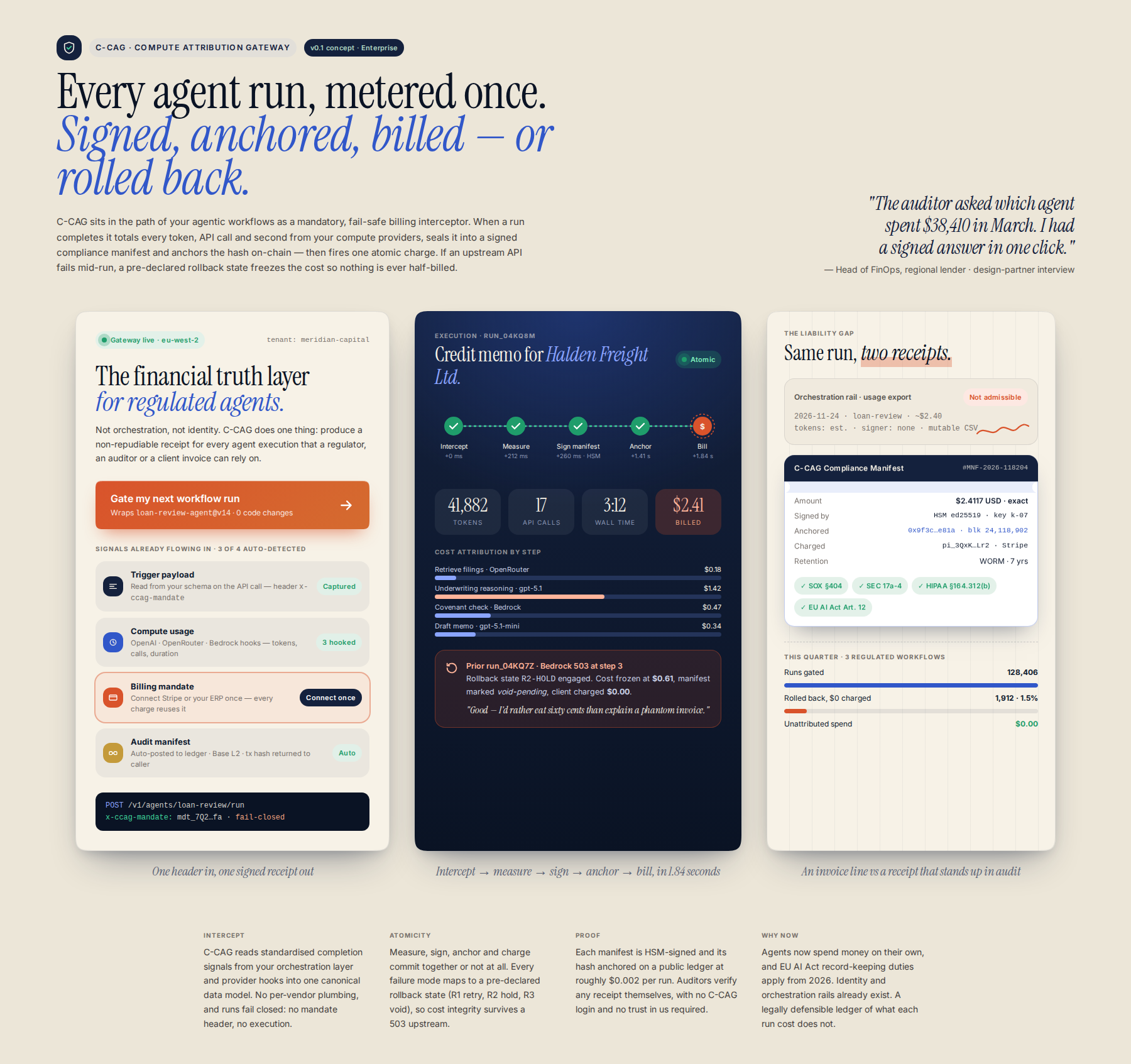
Process flow
Who it's for
Large commercial enterprises in regulated sectors (FinTech, HealthTech, LegalTech) that require irrefutable, non-repudiable proof of compute cost for compliance and billing.
Why they need it
As AI moves from experimental novelty to critical infrastructure, the current lack of a single source of truth for compute cost creates massive, unmanaged financial and legal liability. The bottleneck is not just measurement, but achieving compliance and atomicity—guaranteeing that the cost is accurately measured, attributed, and billeted immutably, even during operational failure. This is a legal requirement, not just a feature.
What it is
A specialized, pay-per-execution service layer focused solely on intercepting, measuring, and billing the compute output of complex agentic workflows. It acts as the mandatory financial compliance gatekeeper, generating an immutable, verifiable audit trail and financial receipt for every execution.
How it works
- The developer integrates the C-CAG as a mandatory, fail-safe billing interceptor.
- The agent workflow executes via external APIs (LLM/compute).
- C-CAG's primary role is the atomic transaction: intercepting the completion signal, calculating the total compute usage, and packaging this data into a signed, compliant manifest.
- This manifest is anchored to the blockchain and immediately triggers the final, atomic billing transaction to the user's linked wallet.
- Crucially, the system includes pre-defined, auditable rollback states for failed transactions, ensuring cost integrity regardless of external API failures.
Differentiation
We are not a general Orchestration Rail. Our differentiation is the Compliance-First Financial Truth Layer. While existing solutions (s1/s2/s3) handle Identity, Security, or general Orchestration, they fail to provide the legally mandated, auditable, and fault-tolerant financial transaction guarantee required by enterprise regulators. We combine real-time measurement with immutable proof and mandatory compliance checks, solving the 'legal liability gap' that no other tool addresses.
Implementation sketch
- Refine the core microservice wrapper to handle the manifest and initiate the billing cycle, prioritizing fault tolerance and state management (e.g., using a durable queue like Kafka).
- Develop a mock 'Legal Compliance Module' that simulates checking for required industry standards (e.g., HIPAA identifiers, GDPR deletion flags) before allowing the billing manifest to be signed, proving the compliance gate.
- Finalize the atomic payment logic: Write a prototype using a testnet environment (e.g., Base/Polygon) to execute the full sequence: Measure -> Sign -> Broadcast -> Confirm Payment, ensuring robust rollback logic is tested at every failure point.
First step: Model the state machine for a failed transaction (e.g., LLM fails after 80% compute). Define the exact compensating transaction required to correctly assign cost, status, and prevent financial ambiguity, and write the pseudocode for that rollback logic.
Remaining risks
- Regulatory Scope Creep and Jurisdictional Conflict: The legal landscape governing AI compute attribution (especially across different jurisdictions like GDPR, CCPA, HIPAA) is evolving faster than the product cycle. A single change in international law or industry compliance standard could invalidate the core 'Compliance-Grade' guarantee, requiring a multi-year overhaul of the billing logic. — Design the compliance module as a pluggable, external service layer (a 'Compliance Registry'). This allows the team to update and validate adherence to new regulations (e.g., a new EU data residency law) without touching the core atomic transaction logic or the billing rails.
- Vendor API Volatility and Compute Definition Drift: The core assumption is that external APIs (LLMs, data sources) provide stable, measurable compute units. If a major LLM provider changes its pricing model, API structure, or definition of a 'token' mid-cycle, the entire measurement layer breaks, leading to immediate billing disputes and failure of the 'Financial Truth Layer.' — Implement an aggressive abstraction layer (a 'Compute Unit Translator'). This layer must normalize all external compute metrics (tokens, GPU hours, API calls, data transfer) into a single, proprietary, and auditable internal 'Compute Unit' metric, insulating the billing logic from external provider changes.
- Integration Friction and Internal IT Bottleneck: While the value proposition is clear, the actual adoption requires deep integration into the client's existing, often archaic, enterprise IT infrastructure. The biggest risk is not the technology, but the client's internal resistance, complexity, or inability to grant the necessary access/permissions to make the C-CAG mandatory. — Focus the initial sales cycle on a 'Proof-of-Concept Wrapper' that requires minimal internal IT lift. Instead of demanding full system integration, offer a service that operates as a read-only, mandatory logging/reporting layer initially, building trust and demonstrating value before demanding write/billing access.
Watch for: A major enterprise client expresses interest in the 'Orchestration' or 'Identity' features (p1 or p2) before fully committing to the 'Compliance/Billing' use case. This indicates that the market views the product as a generalized middleware wrapper rather than a specialized, mandatory compliance tool, weakening the core defensibility. Kill criterion: A critical regulatory body issues a ruling or guidance that explicitly invalidates the concept of 'post-facto' compute attribution or mandates a level of real-time data control that requires the C-CAG to become a full, stateful data processing engine, thereby exponentially increasing the technical risk and regulatory burden beyond the scope of a billing gateway.
Sources the council used
Real-world evidence that grounded this idea — judge it for yourself.
- news.ycombinator.com
- agenticidentitybroker.dev
- news.ycombinator.com
- incode.com
- angularminds.com
- akamai.com
- ethereum.org