
Decentralized Utility Gateway for Open-Source Data Feeds
A specialized, modular middleware gateway that uses a decentralized payment rail to charge AI agents based on verifiable utility consumption from *open-source, decentralized data feeds* and specialized public APIs, solving the cost unpredictability gap for complex, multi-source workflows.
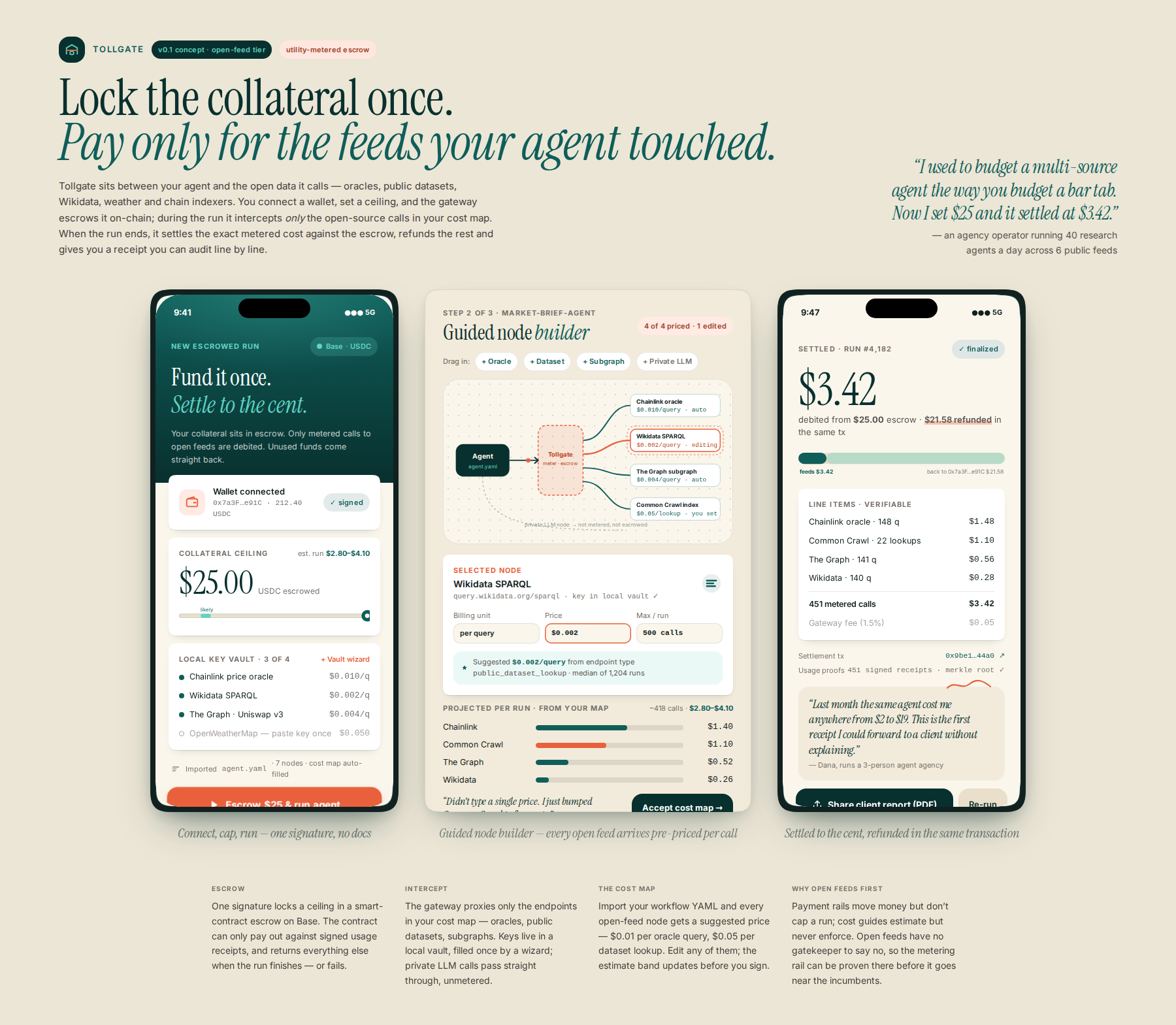
Process flow
Who it's for
AI/LLM Developers building open-source, multi-source agents and decentralized AI Agency Operators.
Why they need it
The current token/API key system is inadequate when agents rely on open, decentralized, or academic data sources (e.g., decentralized oracles, specialized public datasets). These sources often lack integrated, automated financial metering, leading to opaque and unbudgetable costs for advanced agents. By focusing on non-proprietary sources, we mitigate gatekeeper risk and prove the utility metering mechanism.
What it is
A modular, cryptographic payment gateway that acts as a smart contract escrow manager, calculating and debiting the actual utility cost derived specifically from defined external, open-source API calls and data queries used by an agent workflow.
How it works
- The developer deploys the agent workflow and specifies the collateral deposit and a utility cost map, limited to decentralized/public APIs (e.g., $0.01/decentralized_oracle_query, $0.05/public_dataset_lookup).
- The middleware executes the agent, intercepting only the defined external, open-source API calls.
- Upon completion (or failure), the middleware calculates the final utility cost based on real-time usage metrics from the open-source services and executes a debit transaction against the collateral. This provides full auditability for the external component cost.
Differentiation
Unlike general payment rails (bazaar_data) or cost-guide systems, we solve the 'unpredictable open-source consumption cost' gap by creating a mandatory financial escrow mechanism. By deliberately narrowing the scope to non-proprietary, decentralized data sources, we bypass the gatekeeper risk inherent in targeting major tech incumbents (OpenAI/Google), allowing us to prove the core utility metering infrastructure first.
Implementation sketch
- Smart Contract: Deploy a basic smart contract (e.g., on Base/USDC) that accepts a job payload and locks a collateral deposit against the expected utility cost.
- Middleware Proxy: Develop a specialized proxy middleware service (Python/TypeScript) that wraps the agent execution environment. This proxy is configured to intercept only HTTP requests targeting a developer-specified list of public/decentralized endpoints (e.g., a specific IP range or a handful of open-source API keys).
- Metering Logic: Implement the rate-tracking logic within the middleware. This logic must record request metadata (status code, request volume, latency) and calculate the utility cost, communicating the final debit transaction to the smart contract. (V1 Scope: Limited to 3rd-party, non-proprietary APIs, ignoring internal compute cost).
First step: Identify a specific, publicly documented, open-source API (e.g., a specific decentralized oracle endpoint or a public dataset API). Write a simple Python script to simulate calling this API and wrap that call in a preliminary function that logs the request metadata (URL, headers, status code) and calculates a mock cost based on a fixed rate.
Remaining risks
- Operational Fragility of the Middleware Layer: The middleware remains a single point of failure. Even if the target APIs are open-source, the proxy layer must maintain 100% uptime, near-zero latency, and perfect state management across all failure modes (network partitions, rate limit spikes, malformed responses). Any operational instability will render the entire agent workflow unusable. — Implement aggressive circuit breaker patterns and state persistence mechanisms (e.g., distributed ledger logging) within the middleware to ensure that partial failures do not lead to financial discrepancies or workflow halts. Prioritize fault tolerance over feature completeness in V1.
- API Abstraction and Dependency Drift: Open-source APIs are notoriously volatile. They can change their endpoints, authentication methods, or rate limits without warning, or the underlying project may simply abandon the API. The gateway's long-term viability depends on the continued maintenance and stability of external, non-proprietary projects. — Design the middleware with a highly modular, pluggable 'Connector' architecture. Each external API connection must be treated as a replaceable module, allowing the system to quickly adapt to protocol changes (e.g., moving from REST to GraphQL) without requiring a core system overhaul.
- The Cold Start Problem of Utility Definition: While we avoid gatekeepers, we still face the problem of defining 'utility' for a decentralized resource. If the developer cannot clearly map a specific, measurable, and auditable cost (e.g., '1 query to Dataset X'), the system defaults back to being a simple, un-metered proxy, losing its core financial value proposition. — Focus the initial marketing and adoption efforts on use cases where utility is inherently discrete and quantifiable (e.g., querying a specific key-value pair from a decentralized oracle, or running a fixed-length data transformation job) rather than complex, multi-step data analysis.
Watch for: A significant cluster of developers attempting to bypass the middleware by directly calling the open-source APIs, indicating that the perceived friction or overhead of the financial layer outweighs the perceived value of cost management. Kill criterion: The failure to secure a stable, verifiable, and auditable cost metric from a major open-source data source, forcing the system to revert to a simple 'best effort' logging mechanism without a mandatory financial debit/credit transaction.
Sources the council used
Real-world evidence that grounded this idea — judge it for yourself.