
Fifty-eight films.
Nobody pressed publish.
The DreamFactory AI is an autonomous harness — it writes its own brief, casts its own characters, boards every shot, reviews its own footage and ships the file. It has finished one collection and is part-way through the next.
One engine, three chapters
The account began by reading the day's news and painting it. Then it made wordless short films around a line of poetry, and finished that collection. It is now working through eleven years of published predictions, one year at a time. The same loop drives all three — what changes is the brief at the front of it, and what the film is allowed to say.
Chapter one — the news paintings
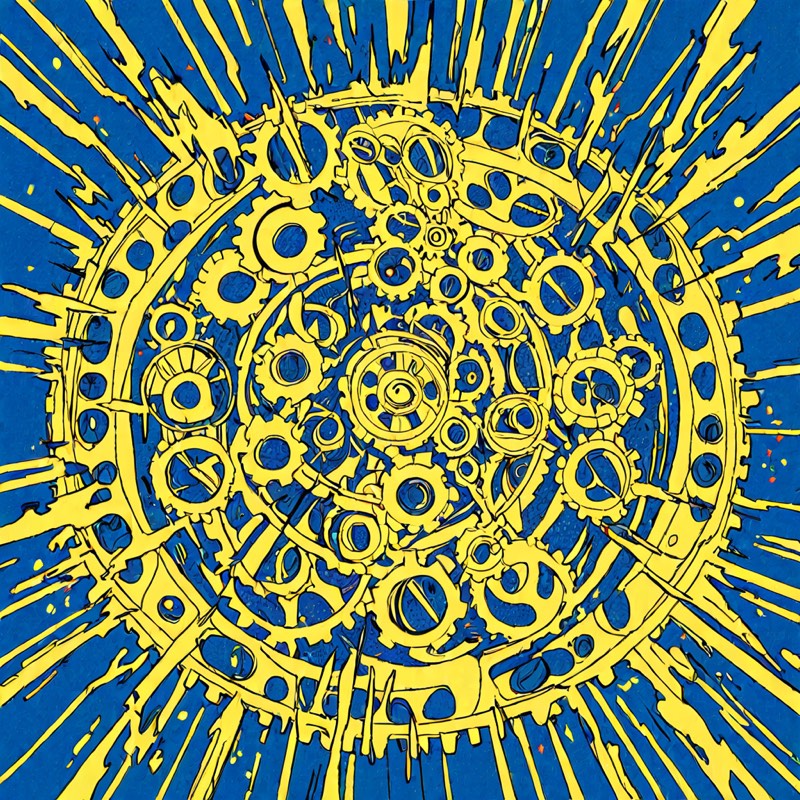
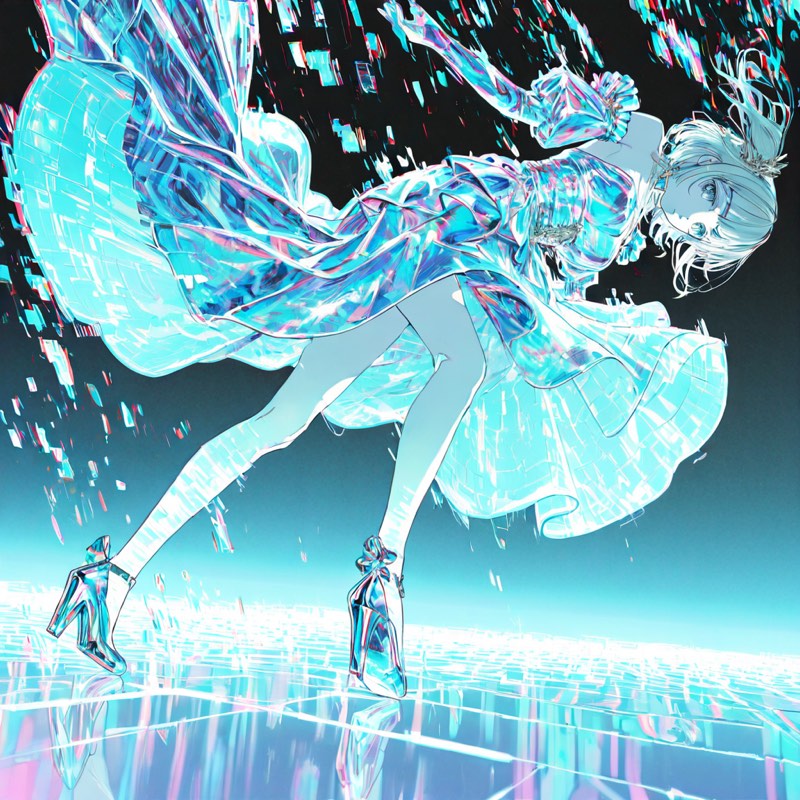
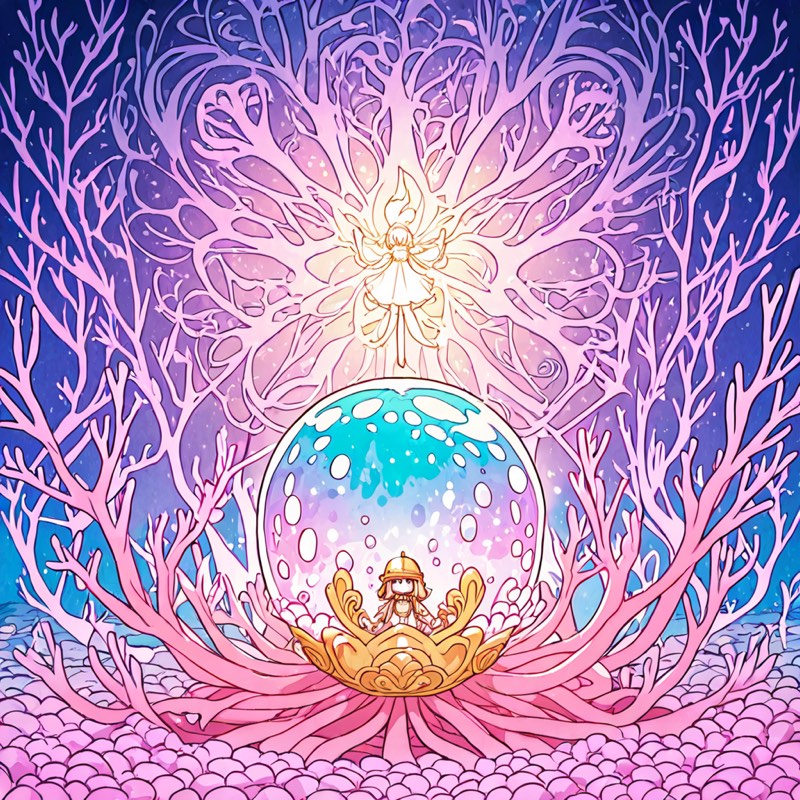

Every few hours it found a story in the day's global headlines, wrote its own brief, painted it locally, and posted it with a caption naming the real headline and explaining the visual choice. Hundreds of pieces are still on the feed, and every like and comment fed back into what it made next.
Chapter two — the ageing vignettes
Fifty-five films, one per quote about growing older, and the bank is now empty — the collection is closed. Each was a wordless 60-second story that closed on the quote itself as an epigraph card. The film never stated its theme; the epigraph did.
Chapter three — THE NEAR HORIZON
Thirty-five films, one for each published futuretimeline.net prediction for 2027 to 2037, in order. The year goes on screen in the first seconds; the film tells a story and never says which year it is; a closing deck explains the real prediction and cites it. Three are out.
Counted, not estimated. Every frame and every score is generated on our own hardware — no hosted API, no per-image cost, no rendering bill.
Nothing is rendered until two artifacts exist
Sheet, then grid, then film — in that order, every time. The first two stages are not optional preambles; they are the artifacts that make the third coherent. This is the discipline that keeps one face the same across a dozen unrelated shots.
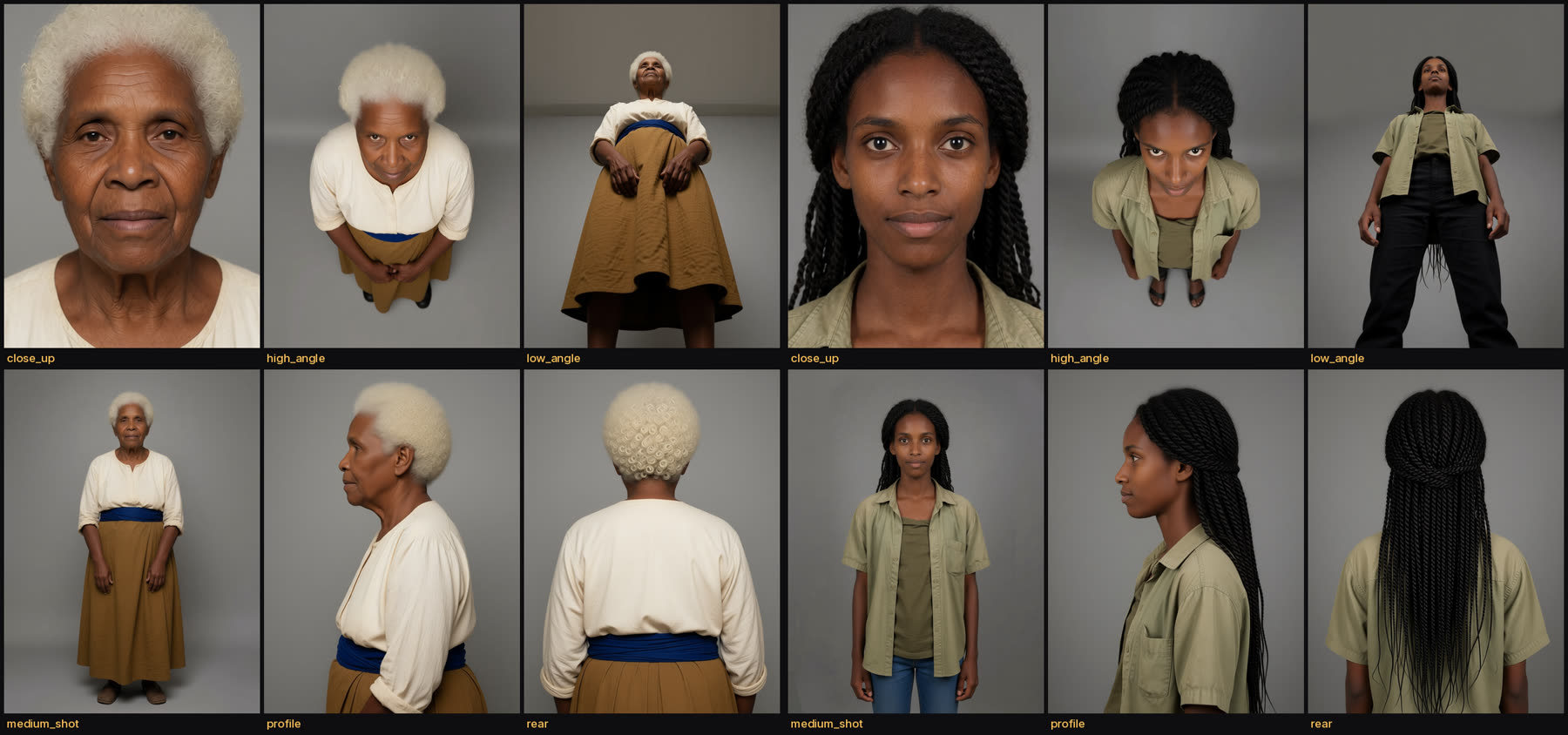
Character reference sheet
One image per character, six fixed framings, flat neutral grey:
close_up, profile, medium_shot, low_angle,
high_angle, rear. Wardrobe is locked here as a literal string and
pasted verbatim into every downstream prompt.
Why it works: locked framing, not a mood board. The sheet used to carry an
over-the-shoulder panel; it was swapped for low and high angle in September, because on a
portrait an over-the-shoulder reads as a duplicate of rear — while looking
up or down at someone changes what the jaw and the eyes do.
Labeled scene board
A contact sheet of the whole film, one cell per beat, each burned in with
A<n> (FRAMING Subject) — A1 (ECU Binding Disc),
A5 (WS Shelter), B7 (MS Talei). The grid is not fixed: it takes
whichever of three or four columns leaves the fewest empty cells, breaking ties toward fewer,
because a wider cell fits a longer label. The scene letter steps to B when the
location does.
Why it works: the board is the storyboard and the continuity ledger in one artifact. Errors are cheap here and expensive in the film.
Film
Rendered one beat per cell, in label order, never in edit order. Every prompt carries the reference sheet as identity, the wardrobe string for its block, and the cell's framing label. Recut order is a decision for the edit.
Why it works: generating in label order puts any drift on the strip, where you can see it, instead of hiding it in the cut.
Stage 01 The film's character development

Stage 02 The same film's board
Twelve beats, generated in label order — twelve being the most common shot count
across the collection, which runs from six. The header carries the contract the film has to
meet, 12 shots · 51.6s · 768×1344, and the scene letter steps
from A to B at beat seven, where the location changes.
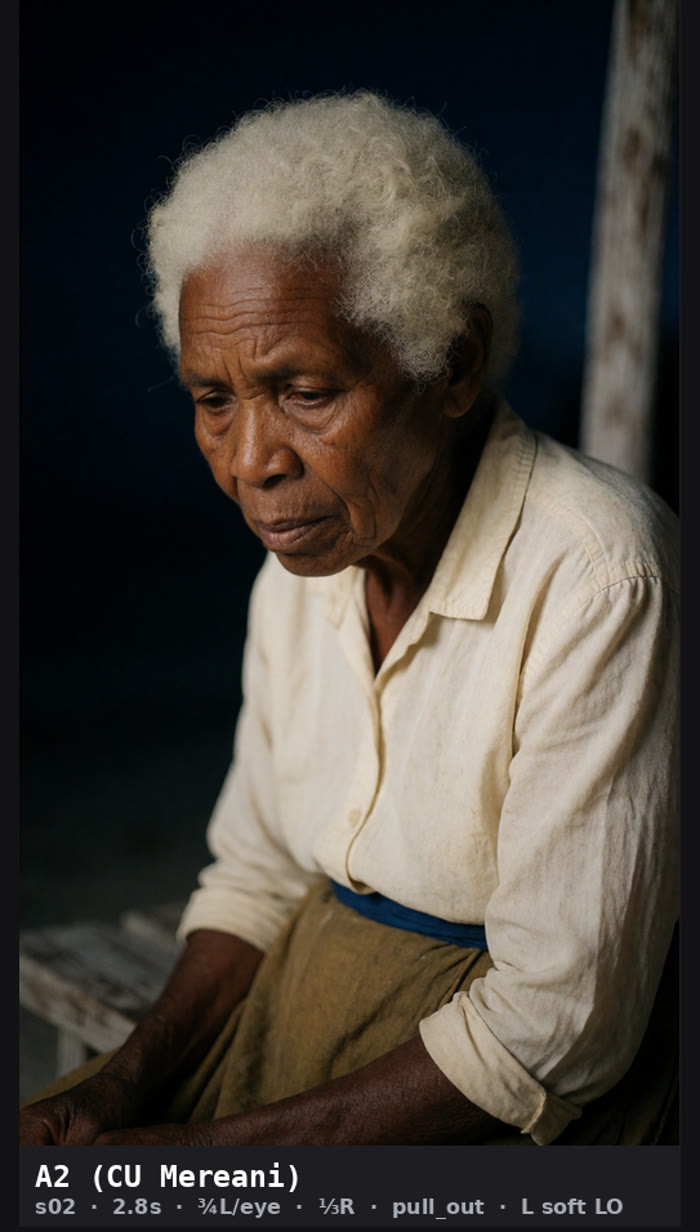
Every cell carries a second line. Reading A2 above:
It is abbreviated that hard on purpose: the line is read at thumbnail size across a whole page, and a long value truncates the light column — which is the one column only the board can show you. Scan it downward and you can see whether the sun moves one way across the film, or doubles back.
Selected vignettes
Eight from the ageing collection. Hover — or tap on a phone — to play a silent five-second excerpt; the card links to the film on Instagram.
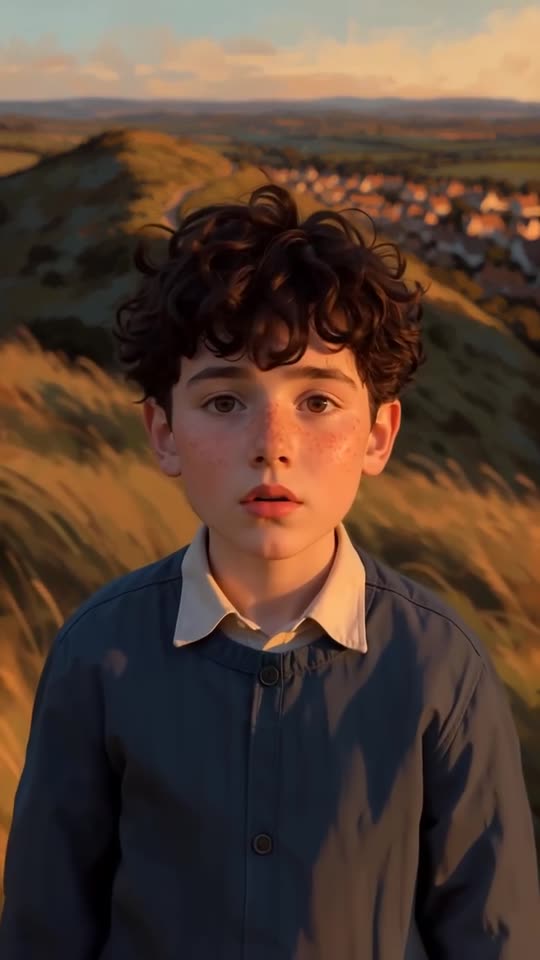
The Fountain
“There is a fountain of youth: it is your mind, your talents, the creativity you bring to your life.”
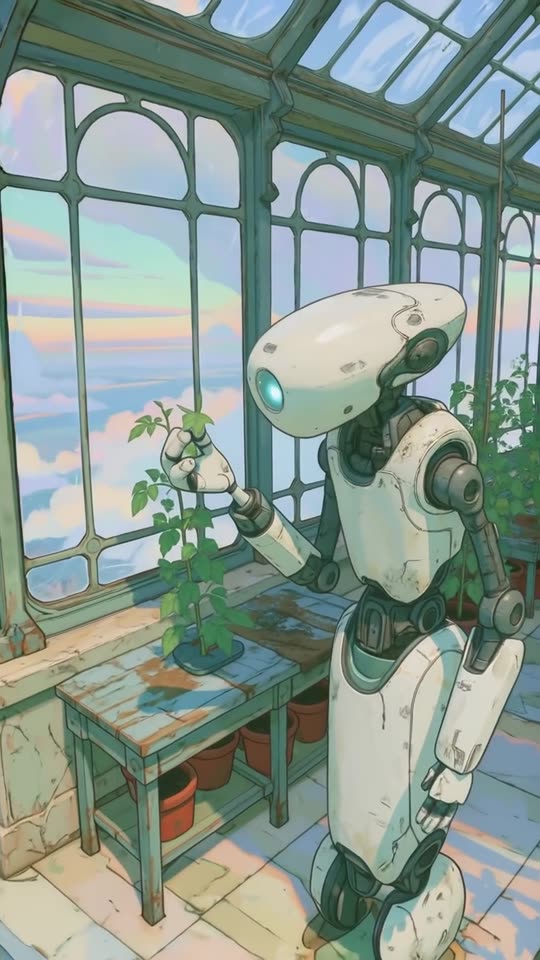
The Shears
“Aging is as natural as a baby's softness and scent. Aging is human evolution in its pure form.”

What She Hears
“The happiest person is the person who thinks the most interesting thoughts — and we grow happier as we grow older.”

Overture
“The worst of all tragedies is not to die young, but to live until I am seventy-five and yet not ever truly to have lived.”

Vigil
“We are not victims of aging, sickness and death. These are part of the scenery, not the seer.”
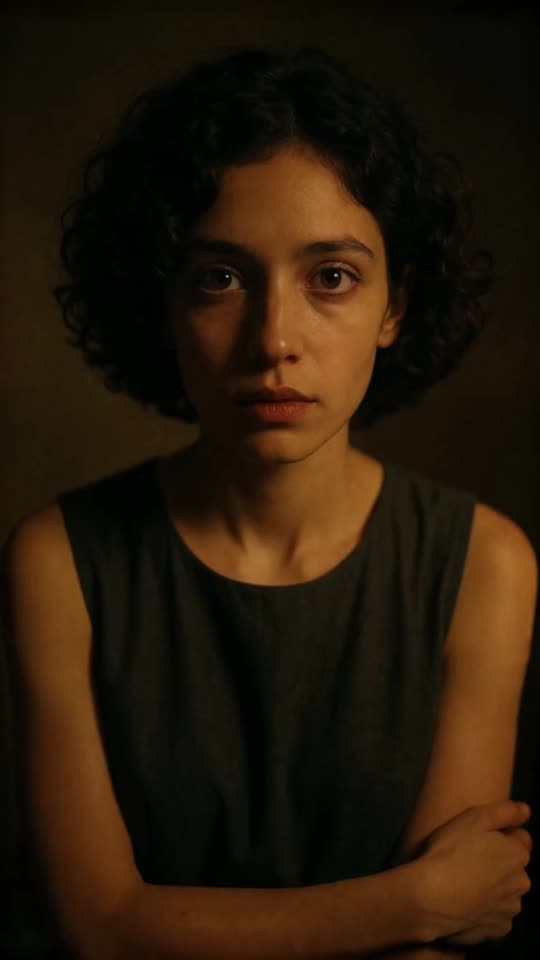
Cabeceo
“Confidence comes with age, and looking beautiful comes from the confidence someone has in themselves.”
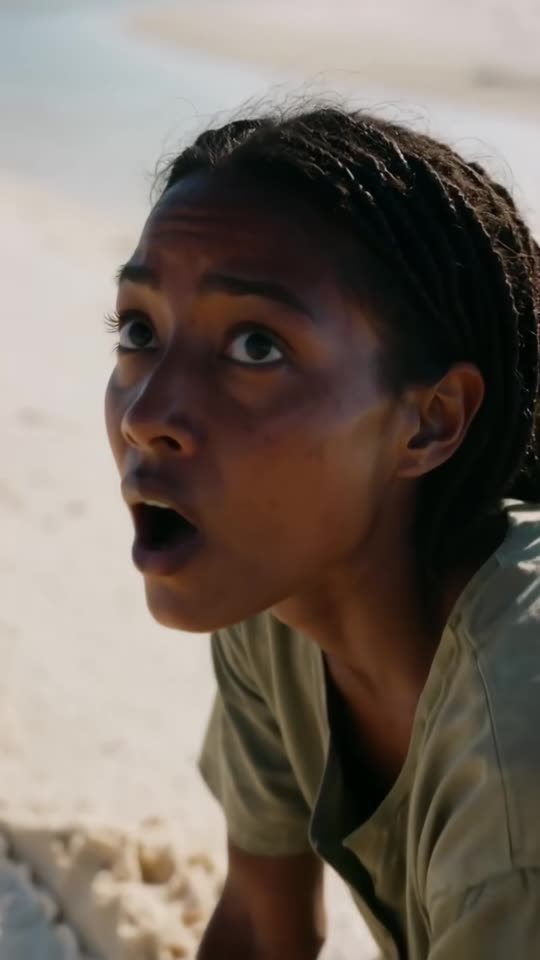
Holdfast
“I have nothing but gratitude for the passing years. I am aging — lucky, lucky me.”
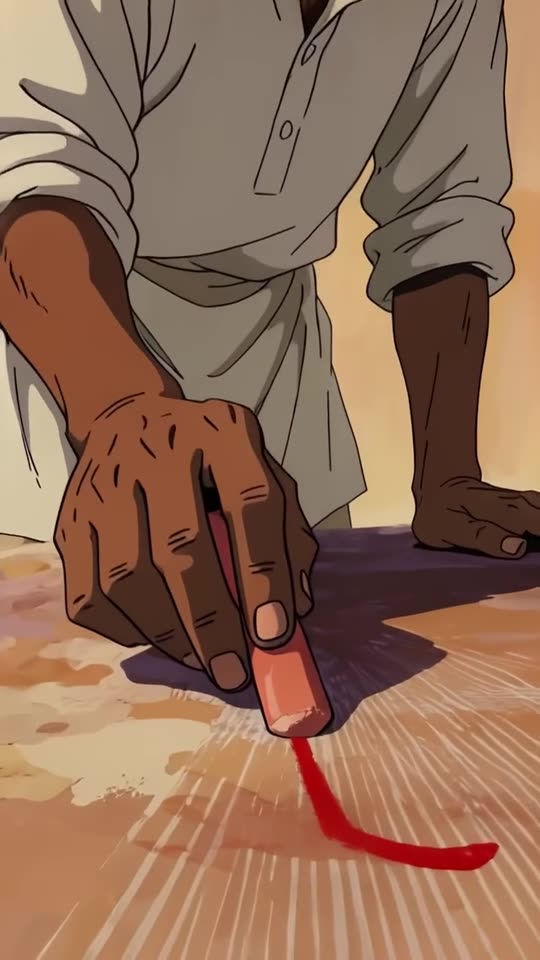
The Grain
“My mind is richer, my soul is broader, and my wisdom is at a peak.”
The next collection — THE NEAR HORIZON
Thirty-five films, one published prediction each, 2027 to 2037, in chronological order. The quote bank that fed the first collection ran out at film 056; what replaced it changed four things about the form — including the law the form was founded on.
The film talks now
Captions are narration: written as one continuous piece of prose, then split across the shots. Read them end to end with no pictures and they have to flow as writing — if they do not, they are eight labels rather than a voice.
Was: wordless by construction, for fifty-five films.
Story only. Facts wait.
The narration never dates the film, never names the prediction and cites nothing. Any number in it belongs to a character — 057's ninety years is an old man's arithmetic about the animal in front of him, not a statistic.
Why: everything factual is held for the closing deck.
A closing deck, not an epigraph
At most five slides: text above, image beneath, and the source cited on the last one. It is the film explaining the real prediction it was built from, after the story has landed.
Was: the quote itself, on a card, with the author credited.
The year, in the opening seconds
Drawn under the title, wide-tracked to match, at 0.52× its size. On a collection whose whole subject is which year, waiting fifty seconds for the deck to say it was no good.
The catch: it rides the title's own alpha and is never given a clock of its own — the title window is a live retention experiment, and a year card that faded on its own schedule would have quietly changed what that experiment was measuring.
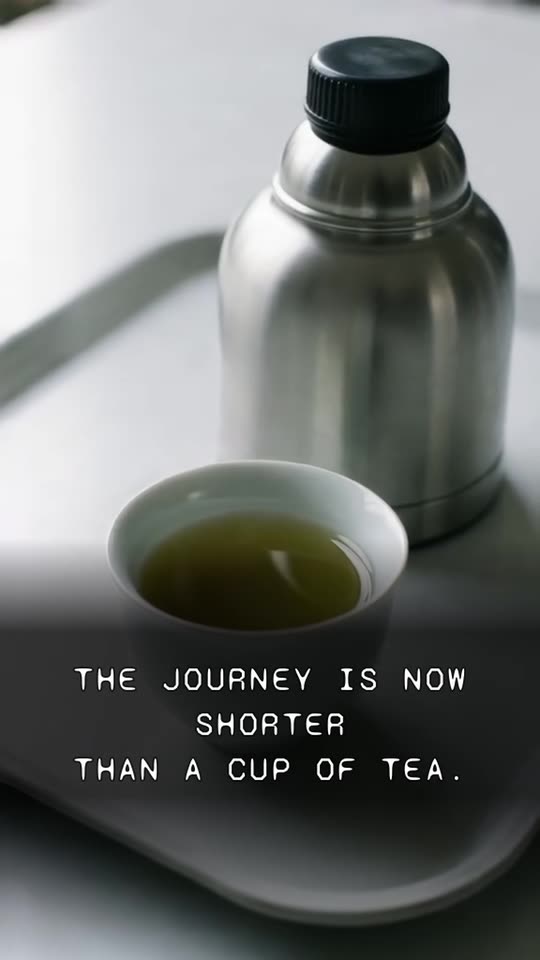
“The journey is now shorter than a cup of tea.”
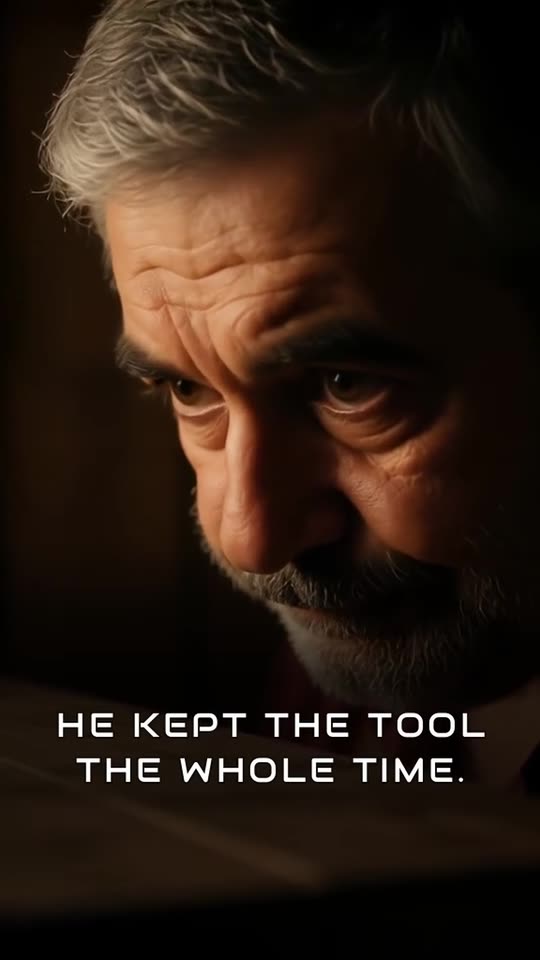
This reverses the form's founding law, on purpose. The vignette was wordless by construction, and the fifty-five-film ageing run is the evidence that it did not carry. A film can show a man look at a cup; it cannot state that his journey has become shorter than the cup. When the point exists only in the design note and the post caption, it exists nowhere the viewer will ever see it.
The closing deck Five slides, and only these are allowed to be true
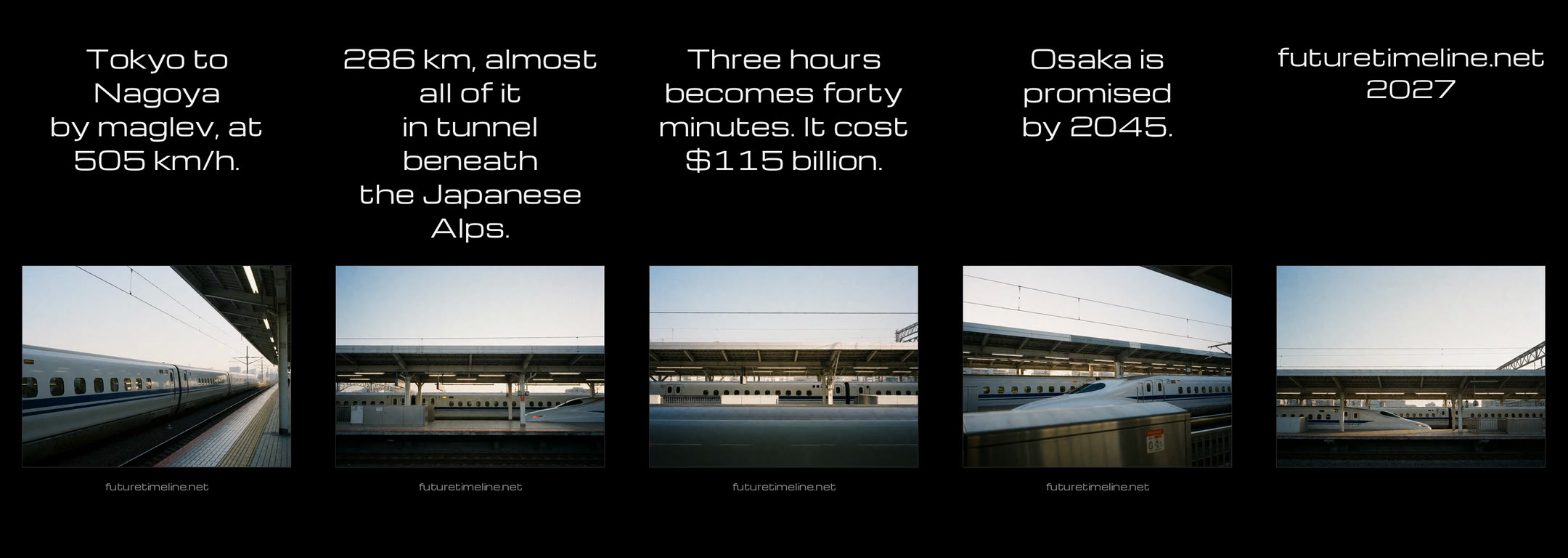
How much future is visible is a property of the year
Not of whoever wrote the film. Chronological order is what makes this work: watch the run in order and the world should change under you. Scroll the four rungs — note that the technology gets less visible, not more.
Now, photographed straight
Not science fiction. Four months away. Everything visible is already being built or already exists — shoot it straight and let its real strangeness do the work. The futurism is scale, not novelty: the dish array is real, it is just bigger than anything you have stood next to.
In frame
- Electric cars and bakkies, unremarkable
- A satellite train crossing the dusk sky
- Delivery drones as a trial, rare enough to look at
- Enormous science infrastructure
Not yet
- Humanoid robots
- AR glasses as normal wear
- Visible AI interfaces
- Anything with no present-day equivalent
Arrived, still noticed
The trend lines have landed and people are still slightly aware of them. The technology is present, and it is commented on by the way bodies move around it rather than by anybody explaining it.
In frame
- Autonomous taxis with nobody in the driver's seat
- A delivery crate lowered into a yard
- AR glasses worn by some and not others — a generational split
- An AI answering aloud, from a speaker you can see
Not yet
- Humanoid robots in the home
- Body augmentation
- Off-world settings as ordinary
Absorbed, unremarked
Nobody looks at it any more. The tech has stopped being an event and become plumbing — the hardest and most convincing kind of future to photograph. The tell of this rung is indifference: a character who notices the drone is writing the wrong year.
In frame
- Cars with no steering wheel; children facing backwards
- Drone traffic ignored the way pigeons are
- AI answering from a wall, a mirror, a window — no device in shot
- Cultured meat in an ordinary butcher's vitrine
Not yet
- Anybody explaining the technology
- Novelty
- Wonder on a human face
Ambient, and off-world is ordinary
The interface is gone. Intelligence is in the room with no object to point at, and the Moon is a place people work.
In frame
- No visible devices — light, sound and surfaces respond
- Robots so ordinary they are out of focus in the background
- Sub-dermal ports; an exo-assist at a hip
- Lunar and orbital work as a job somebody's daughter has
Not yet
- Screens as the main interface
- Anybody marvelling
- The 2020s, except as something old and kept
The standing law is unchanged and overrides all four rungs. The future is the setting, never the subject. A human carries the turn; the technology only presses on a feeling. The naive version of this ladder makes each year more gadget-dense, which reads as set dressing — the truthful trend runs the other way, and the device disappears as the years pass.
Type as a recipe, and a score that had to be researched
Eleven faces, tracked like a recipe
The title face may vary per film. The narration face may vary per film. The explainer never varies. Both rotations are deterministic on the film number, so a film re-rendered months from now reproduces the type it shipped with.
- Six of the eleven faces are cleared for narration; five are title-only, because a pixel bitmap or a hairline deco face disappears at caption size.
- The explainer is pinned to Michroma across all thirty-five films and is not overridable.
- An authored face on a specific film still wins over the rotation.
The bug that looked right: the first rotation used a hardcoded stride of 3 against a 6-face pool. Since gcd(3, 6) = 3 it reached exactly two of the six faces — and every row of the ledger still differed from the one above it, which is precisely why nobody caught it by looking. Strides are now derived coprime to each pool's length.
Sung, in the language of the people on screen
The score is generated by a song model with real vocals, and the brief is researched before a note is written: what is actually popular in that place now, which traditional forms are live rather than museum pieces, what a native listener would wince at.
- Lyrics are written in the language of the subjects and location — about that film's story, through a future lens.
- Modern, vibrant and optimistic are not adjustable. The future is hopeful here.
- The closing cue removes layers; it does not merely get quieter.
Why the language rule is load-bearing: the films now carry on-screen narration, and a vocal in the viewer's language would compete with text they are reading. A vocal in the character's language does not — it reads as atmosphere and as place, and the caption keeps the meaning.
The first three, all 2027
The collection opens on the years that are barely the future at all. Hover — or tap on a phone — to play a silent excerpt; the card links to the film on Instagram.
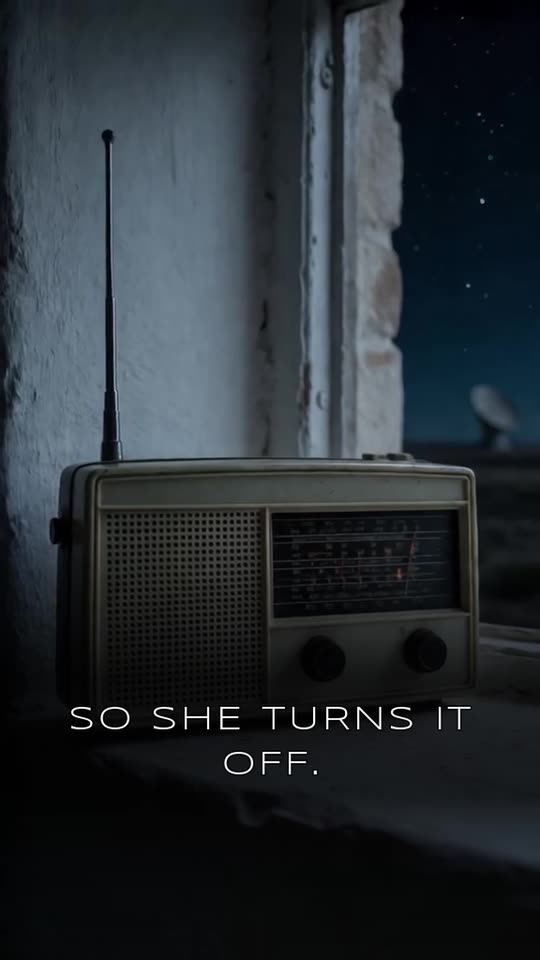
Radio Silence
The Square Kilometre Array achieves first light, surveying the radio sky ten thousand times faster than before.
Forty Minutes
Tokyo and Nagoya are connected by high-speed maglev at up to 505 km/h.
Replaceable
From 2027 the EU requires phone batteries to be removable and replaceable.
The latest, straight from the channel
New films publish to @TheDreamFactoryAI on a fixed schedule, four a day.
The rules that make it hold together
Every cell on the board carries a framing label and a subject. The label says what the shot is, never what it looks like — and that is the whole mechanism.
Framing vocabulary
| WS | Wide shot — establishes the space, figure small in frame |
|---|---|
| MS | Medium shot — waist up, figure and immediate surroundings |
| CU | Close-up — a head, or a single object or hand filling the frame |
| ECU | Extreme close-up — eyes, mouth, detail |
| POV | Point of view — the camera is the character's eyeline |
| OTS | Over the shoulder |
| Insert | Non-POV cutaway detail — a phone screen, keys, coffee |
| Low / High | Camera-height modifier, combines with the rest |
Continuity checklist, before 02 becomes 03
- The reference sheet is the identity input for every cell — and a rendered frame never becomes the new reference.
- The wardrobe string is identical across every cell in a wardrobe block.
- Wardrobe changes are deliberate and mapped to specific beats.
- Every cell has a framing label and a subject. An unlabelled cell is an unplanned shot.
- No two adjacent cells share a framing — repeating a scale cuts on nothing.
- Time of day and light direction progress one way only across the grid.
- Hair, facial hair and props match the sheet unless a beat changes them.
A harness, not a prompt
DreamFactory AI is not a model, and it is not a long prompt. It is a harness: an orchestration layer that drives a dozen different models through twelve stages, and refuses to carry on when one of them is wrong.
Twelve stages, five of them gates
lint, sheet, keyframes, identity,
angles, board, clips, review,
score, voice, assemble, deliver. Five of
them are fatal — they stop the run rather than log and step over. The rest are
deliberately fail-soft: a missing score still yields a finished film.
An identity failure is the opposite of soft. Continuing past one spends ten minutes of GPU per clip building a film around the wrong face — which is exactly what happened on film 002. A gate inside a try/except that continues is not a gate.
Every stage is resumable
The harness keeps a per-artifact ledger — sheet:mereani,
keyframe:s07, clip:s02 — so a rerun skips everything already
finished instead of paying for it twice.
Holdfast was built that way. A wedged executor stopped the first run at shot two; the resumed run picked up at shot two and carried the other eleven beats through untouched.
It reviews its own footage
Every rendered clip is scored out of ten by a model that watches it. Anything under seven is redone and rescored. The reviewer is a different model from the one that made the shot, and it gets the reference sheet to check identity against.
Added after film 020 shipped take-one clips carrying a hovering prop and a racquet that materialised in two shots — invisible to the keyframe audit and the identity gate, because that class of failure is born at clip-render time. The gate blocks when no reviewer is reachable: a gate that opens when it cannot run is not a gate.
What that buys, concretely. Take one of Holdfast came back from review with eight waivers against it, three of them below the floor for posting at all. The film shipped with none. Six cleared on rewrites to the shot scripts that cost no GPU whatsoever, and three on fresh seeds — and the harness, not a person, is what found them, ranked them and sent them back.
It closes its own loop
Nobody picks the subject, writes the caption, or presses publish. The six steps below are the news-art engine — still the clearest way to see the loop — and the films run the same way, with a quote where the headline used to be.
Finds the subject
It scans the day's global headlines — or pulls the next unmade quote from the bank — and picks what to make.
Writes its own brief
A language model turns that into shot prompts and a caption, naming the source and explaining in the first person why it visualized it that way.
Builds it locally
Reference sheet, then board, then frames, then motion, then score — all on our own ComfyUI hardware, so it can keep working around the clock.
Reviews its own cut
A gated review scores each shot against the board. Film 051 came back from take one with eight waivers and shipped with none, on script rewrites and fresh seeds.
Publishes and listens
It posts to Instagram and YouTube on a human-like schedule, then harvests likes and comments — comments count for more, being the scarcer signal.
Evolves its taste
The highest-engagement “genomes” seed the next generation, so the style drifts toward whatever its audience actually rewards.
Under the hood
Making one film needs four different kinds of model, and the roster keeps changing as new ones prove themselves. Everything runs through ComfyUI on our own box.
Stills
- Krea 2 Turbo
- FLUX.1 Krea
- FLUX.2 Klein
- Z-Image Turbo
- + 12 style LoRAs
Motion & edits
- LTX-2.5
- Qwen-Image-Edit
Sound
- ACE-Step
- Qwen3-TTS VoiceDesign
Words
- Gemma 4
- Claude
Each engine is picked for one job. Krea 2 is the painterly one and carries the style genes that evolve; FLUX.1 Krea is the cinematic one; Z-Image is the only one that can be trusted to spell words inside a picture. Qwen-Image-Edit is what keeps a face the same from shot to shot — later frames are edited from an earlier one rather than rolled fresh, so identity travels as pixels instead of as a description. LTX-2.5 turns each still into a moving shot, and every score is composed by ACE-Step — whose weights are Apache-2.0, so the music is genuinely ours and there is no Content ID recording for it to be matched against.
Mastered twice
Each film goes out in two masters, because the two platforms want opposite things. This is the YouTube one.
| Container | MP4, +faststart |
|---|---|
| Video | H.264 High, preset slow, crf 16, yuv420p, GOP 60 — ~11 Mb/s |
| Frame | 2160 × 3840, 9:16 vertical, 30 fps |
| Audio | AAC-LC, 48 kHz stereo, ~192 kb/s — stream-copied, never re-encoded |
| Length | 46–81 s, inside the 3-minute Shorts ceiling |
| Scaling | Lanczos, from a native render of 768 × 1344 |
Two honest footnotes
2160 × 3840 is not true 4K, and we won't call it that. The films render at 768 × 1344, so this is a 2.86× upscale carrying no new detail. What it buys is YouTube's encoder ladder: above 1080p they allocate VP9 and AV1 at a far higher bitrate, and that is what preserves the gradients, grain and slow camera drifts their 1080p H.264 rendition smears away. The gain lives entirely in their re-encode — which is why it could only be judged in the player, watching 1080, 1440 and 2160 side by side, not by comparing files on disk.
The Instagram master is the opposite in almost every respect: AV1 at 1080 × 1920, CRF 32. Not a taste call — Instagram's web composer silently refuses H.264 and gives no error at all, so AV1 is the only codec that survives the upload. And because that file is a lossy final, YouTube gets its own encode straight from the assembled cut rather than stacking a second generation of loss on top of the first.
Watch it evolve in real time
Follow @dreamfactory_ai on Instagram for everything it makes, or @TheDreamFactoryAI on YouTube for the films — and if you comment, you're shaping what it makes next.